Disclosure: Operating App publishes this page, and is on the list. Every product claim was checked against the vendor's pricing page, docs or help center (listed in the sources at the end), and each section says where Kantata is still the stronger choice.
Last updated September 25, 2026.
TL;DR
The best Kantata alternatives in 2026 are Operating, Parallax, Productive, Scoro, BigTime, Certinia and Rocketlane. No single tool is best for every firm. The right Kantata alternative depends on why a firm is leaving Kantata.
Operating fits consulting firms that want to keep their CRM and task tool and fix staffing, time, margin and invoicing, with pricing from $13 per person per month billed annually. Parallax fits firms that only need resource forecasting on top of their CRM and time tracker, and its pricing is quote only.
Productive fits agencies that want projects, time and billing in one tool, with pricing from $10 per user per month billed annually. Scoro fits agencies and consultancies that want CRM, quoting and invoicing in one suite, with pricing from $17 per user per month billed annually. BigTime fits US firms where time, billing and payments matter most, with pricing from $20 per user per month.
Certinia fits large firms that run sales and finance on Salesforce, and its pricing is quote only. Rocketlane fits teams that run customer onboarding and implementation projects, with pricing from $49 per user per month billed annually.
Kantata is still a strong fit for large firms that want one platform for tasks, resourcing and deep project accounting. Kantata does not publish prices.
Comparing only two tools? Read Operating vs Kantata or our guide to the best PSA software for consulting firms.
At a glance
Operating publishes the price of every standard plan; Productive, Scoro, BigTime and Rocketlane publish entry prices; Kantata, Certinia and Parallax are quote only. The two tables show where each tool is deep and what you give up compared with Kantata.
Kantata alternatives at a glance: fit and price (September 2026)
| Product | Best for | Public pricing | Main trade-off vs Kantata | Key integration advantage |
|---|---|---|---|---|
| Operating | Consulting and technical services firms of 30 to 500 people. | $13 to $21 per person per month billed annually. | No task-level project management and less flexible reporting. | Native HubSpot, Salesforce and Pipedrive, plus an MCP server, on every plan. |
| Productive | Agencies and smaller consultancies that want one tool. | $10 or $25 per user per month billed annually; Ultimate on request. | Fewer enterprise controls below the Ultimate plan. | Broad agency stack, but HubSpot and Salesforce need the unpriced Ultimate plan. |
| Scoro | Agencies and consultancies that want quote-to-cash in one suite. | From $17 per user per month billed annually for two apps. | Modular pricing adds up; SSO needs the Enterprise platform. | CRM, quoting and invoicing in one product, plus MCP on all packages. |
| BigTime | US accounting, engineering and consulting firms. | Essentials from $20 per user per month; other tiers on request. | Resource management and multi-entity sit in extra products. | Payments and QuickBooks built in from the entry plan. |
| Certinia | Large services firms run on Salesforce. | Quote only. | Requires Salesforce licenses and a partner-led rollout. | Native to Salesforce, with the same data model as sales. |
| Rocketlane | Customer onboarding and implementation teams. | $49 or $69 per user per month billed annually; Enterprise custom. | Thinner finance back office and a five-seat minimum. | Customer portal and HubSpot on every plan. |
| Parallax | Agencies and consultancies that want forecasting on top of their stack. | Quote only, priced by resources managed. | Covers only the planning part of Kantata. | Reads HubSpot, Salesforce, Pipedrive and many time trackers. |
At a glance: core PSA features (September 2026)
| Product | Resource planning depth | Project financials | Time tracking | Billing / invoicing | Project management approach |
|---|---|---|---|---|---|
| Operating | Deep: skills matching, open roles, bench and pipeline-weighted capacity. | Budgets, rate cards, cost rates, margin forecasts and revenue recognition. | Timesheets prefilled from the plan, with PM and manager approvals. | T&M, capped T&M, fixed price and retainer, synced to Xero or QuickBooks Online. | Gantt-style Timeline for projects and phases; tickets stay in your task tool. |
| Productive | Solid scheduling; skill matching needs the top plan. | Budgets, profitability and revenue recognition; rate cards from Professional. | Timers and timesheets; approvals from Professional. | Fixed, T&M and retainers, with Xero and QuickBooks from Professional. | Full PM with Gantt, boards and docs. |
| Scoro | Bookings and role placeholders in the Resource app. | Quotes, budgets and margins; revenue recognition in an add-on. | Timer and timesheets in the Track app. | Milestone, prepayment and recurring invoices; retainers supported. | Full PM with Gantt, tasks and a built-in CRM. |
| BigTime | Basic allocation in Premier; full resource management is a paid add-on. | Budgets and cost rates in higher tiers; rev rec mainly in Enterprise PSA. | Strong time and expense capture on every plan. | T&M, fixed fee, milestone and retainers, plus card and ACH payments. | Portfolio and Gantt views focused on financials. |
| Certinia | Enterprise depth: supply and demand, skills, requests and utilization. | Deep services financials and revenue recognition. | Timecards on Salesforce, from any device. | Billing events go to Certinia Accounting or your ERP for invoicing. | Projects created from Salesforce opportunities. |
| Rocketlane | From Premium: capacity, utilization and auto-allocation; skills in Enterprise. | From Premium: budgets, rate cards, margins and revenue recognition. | Timesheets with approvals and calendar sync on all plans. | T&M, fixed fee and subscription billing; accounting sync method not documented. | Client-facing projects with a branded customer portal. |
| Parallax | Deep forecasting: utilization, hiring and open roles. | Project P&L, margin and revenue forecasts; no formal rev rec found. | Built-in timesheets or Harvest and similar tools. | No invoicing; billing stays in another system. | Not a PM tool; connects to Asana and Jira. |
Why teams leave Kantata
The most common reasons are quote-only pricing with plan limits, setup and admin work, and a product scope that does not match the firm's stack. Missing features are rarely the issue, because Kantata covers a lot.
- Quote-only pricing and minimums. Kantata publishes no prices; its pricing page is a form. One third-party estimate from spring 2025 reported a 50-seat minimum and $50 to $110 per user.
- Key features sit in higher plans. Kantata's HubSpot integration runs on its M-Bridge platform and needs the Enterprise plan. SAML single sign-on is for Enterprise plans that meet a minimum license count. Rate cards and Gantt baselines are Premier or Enterprise only.
- Complexity and admin load. On G2, the most tagged cons for Kantata are complex usability, the learning curve and a UI that is not intuitive. The HubSpot connector and Kantata AI are both switched on by Kantata's Customer Success team.
- Scope that does not match the stack. Some firms want to keep Jira, Linear or Asana for tickets and only need staffing, time and margin. Others run everything on Salesforce and want a PSA inside it.
- Data location. Kantata's security page lists AWS Oregon as its primary data center, with disaster recovery in Virginia, and does not mention EU hosting.
Kantata is still a strong product. It covers task-level project management, resourcing, project accounting and custom reporting in one platform, its MCP server offers 150+ tools, and Kantata says more than 1,500 organizations use it. If you want one centrally governed platform for all of that, Kantata may still be the right call.
How we picked
We picked tools that can replace Kantata for at least one real use case, then checked each one against its own live pricing page, docs and help center. We did not use other comparison sites as a source for prices or features.
- PSA relevance: the tool must cover staffing or project economics for services firms, not only tasks. That ruled out general work tools such as Wrike, monday.com and Asana.
- Resource planning: scheduling, skills, capacity and utilization forecasting.
- Financials: budgets, rates, margins, revenue recognition and invoicing.
- Integrations: CRM, accounting, HR, API and MCP.
- Pricing transparency: whether prices are public, and which plan unlocks the features a Kantata buyer needs.
- Target customer: who the vendor says the product is for.
- Evidence quality: vendor docs first, then G2 and Capterra reviews for recurring themes.
We also checked the current search results for "Kantata alternatives" and "Mavenlink alternatives" so the list reflects what buyers compare. Accelo and NetSuite SuiteProjects Pro were close calls; see our SuiteProjects Pro alternatives guide for the enterprise end of the market.
The 7 alternatives
Each tool below is described the same way: what it is, why it can replace Kantata, where Kantata is still stronger, pricing and best fit. Operating comes first because it fits most consulting firms of 30 to 500 people.
1. Operating
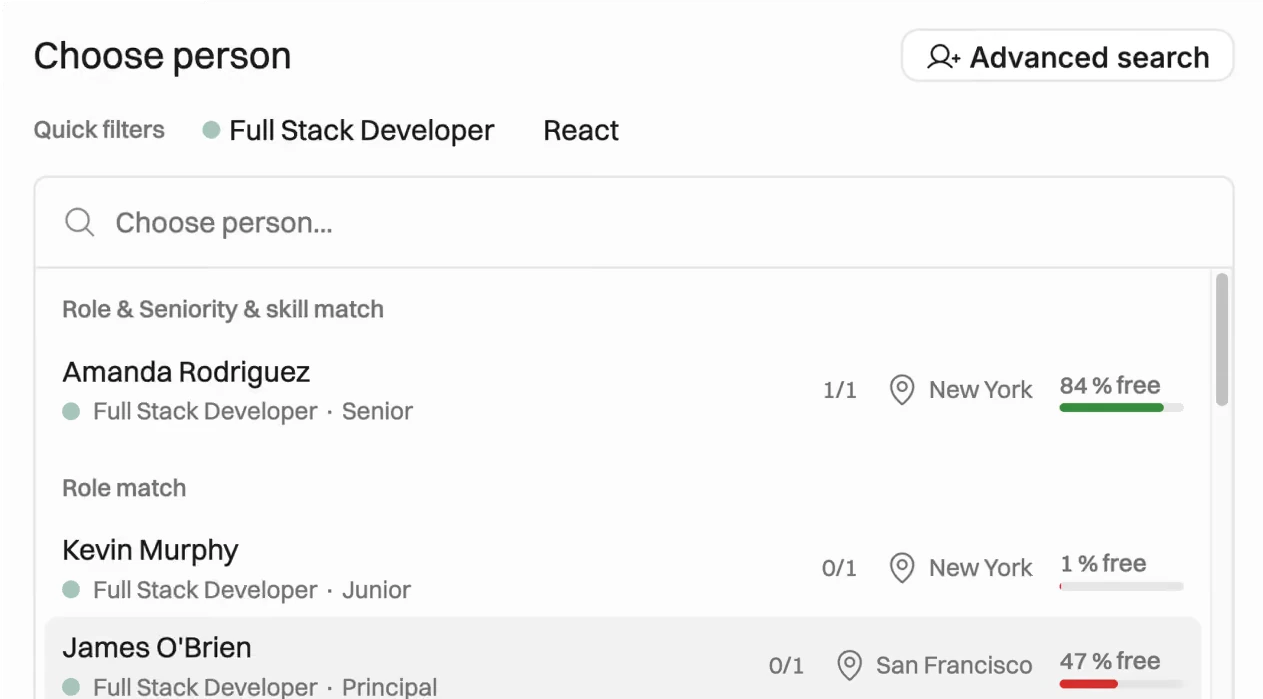
Operating is a PSA for consulting and technical services firms that runs staffing, capacity, a Gantt-style project Timeline, time tracking, project margins and invoicing in one system. It is the best fit for firms of 30 to 500 people that want to keep their CRM and task tool.
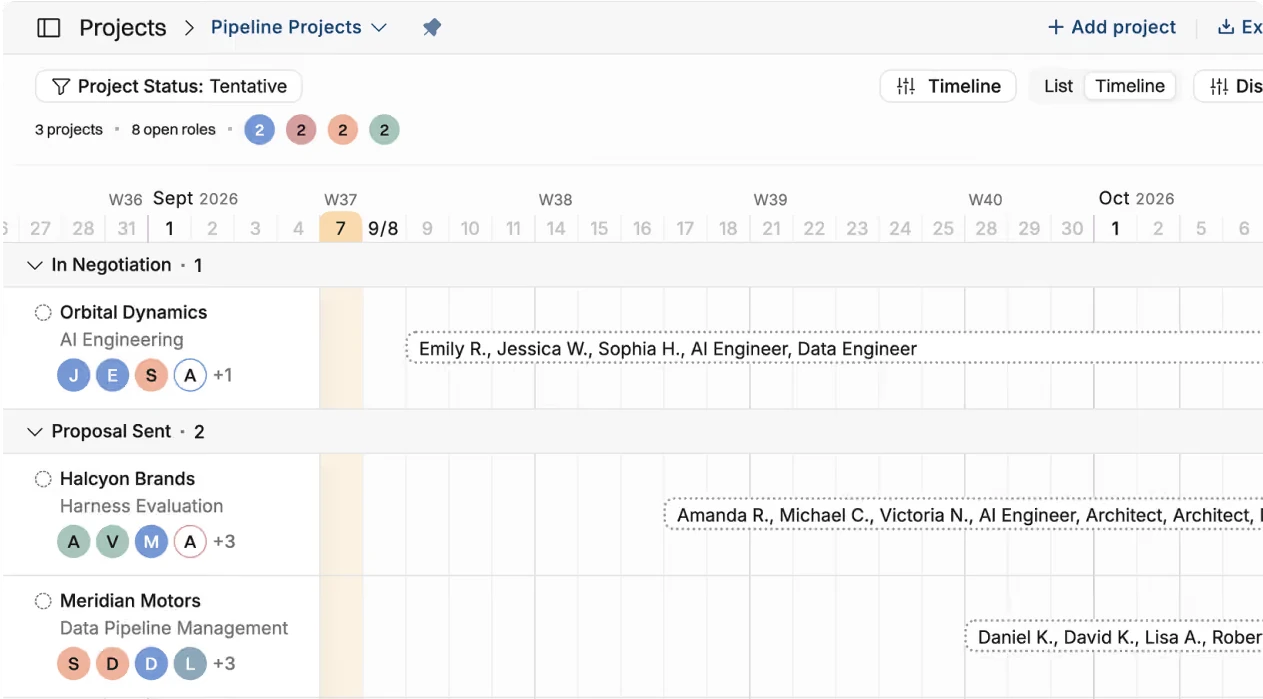
Why it is a credible Kantata alternative: it covers the same core chain as Kantata: pipeline, staffing, capacity, utilization, time, project financials, revenue recognition and invoicing. Deals from HubSpot, Salesforce or Pipedrive become tentative projects, and the capacity forecast weights them by deal probability.
Where it is stronger or different: prices are public, and every plan includes SSO, all integrations, the full REST API, data migration, training and support. Operating is SOC 2 Type II certified, GDPR compliant and hosted on AWS in Frankfurt, Germany. HubSpot, Salesforce and Pipedrive are native on every plan, while Kantata's HubSpot connector needs its Enterprise plan. The MCP server has 59 tools and works with Claude, ChatGPT and Gemini CLI. The Enterprise plan, from 100 people, adds volume discounts, a custom contract, an SLA and on-site onboarding.
Where Kantata may still be stronger: Kantata runs task-level project management, formal resource requests with approvals, deeper project accounting and custom BI dashboards. Its MCP server is larger (150+ tools). Operating does not support SCIM provisioning yet, and reviewers ask for more flexible reporting inside the app. Above 500 people, whether Operating fits depends on your governance and finance needs.
Core PSA capabilities: skills and availability matching for open positions, a bench view, a 1 to 6 month capacity forecast, budgets with rate cards and cost rates, margin forecasts, revenue recognition for ASC 606 and IFRS 15, timesheets with approvals, and invoices synced to Xero or QuickBooks Online. Harvest, HiBob and Flowcase connect natively; NetSuite is available through the API, with a native connector on the roadmap.
Pricing: Planning $15, Plan & Track $19 and Full Suite $23 per person per month billed monthly, or $13, $17 and $21 billed annually. People who are only scheduled cost $13 monthly or $11 annually. Enterprise pricing is custom. See pricing.
Best for: a consulting, IT services or engineering firm of 30 to 500 people that plans staffing from its CRM pipeline and keeps delivery in Jira, Linear or Asana.
Compare in detail: Operating vs Kantata: which PSA fits your firm?
See Operating on your own pipeline. Book a 30-minute walkthrough of staffing, capacity and margins with Lauri, our CEO. Book an intro
2. Productive
Productive is an all-in-one platform for agencies and consultancies that combines project management, resource planning, budgets and invoicing. It suits smaller teams that want one tool instead of several.
Why it is a credible Kantata alternative: like Kantata, it puts tasks, scheduling, time, budgets and billing in one product. Its planner supports tentative bookings and utilization planning on every plan.
Where it is stronger or different: entry prices are public and low, and reviewers often praise its ease of use. It is SOC 2 Type II compliant and hosted on AWS in the EU. It supports retainers (recurring budgets) from the Professional plan, and SSO is available on every plan.
Where Kantata may still be stronger: many features a Kantata buyer expects sit in Productive's Ultimate plan, which has no public price. That includes the HubSpot, Salesforce and NetSuite integrations, skill-based resource requests, financial forecasting, SCIM and the MCP server. The Salesforce sync is one-way and hourly, and milestone billing is a workaround rather than a billing type.
Core PSA capabilities: Gantt, board and list views (Gantt from Professional), resource planning with placeholders from Professional, budgets and profitability, basic revenue recognition, timesheets, expenses, and invoicing with Xero, QuickBooks, Exact and Sage from Professional.
Pricing: Essential $12 and Professional $29 per user per month billed monthly, or $10 and $25 billed annually. Ultimate is on request. The minimum is three seats.
Best for: a creative or digital agency, or a small consultancy, that wants projects, scheduling and budgets in one tool.
Compare in detail: Productive.io alternatives and what they cost
3. Scoro
Scoro is a modular PSA for consultancies, agencies, IT, architecture and engineering firms. You buy a platform and add apps for projects, resourcing, quoting, time and billing.
Why it is a credible Kantata alternative: it covers quote-to-cash in one product: CRM, quotes, budgets, projects, resource bookings, time, invoicing and costs. That makes it a real substitute for firms that use Kantata as their main operating system.
Where it is stronger or different: Scoro has its own CRM and quoting, which Kantata does not center on. It is ISO 27001 certified, and customers can choose where data is hosted (Canada, Germany, Sweden or Australia). Its MCP server comes with every package at no extra cost.
Where Kantata may still be stronger: Kantata has more formal resource governance, such as resource requests and weighted recommendations, and SX for Salesforce-native firms. Scoro's price grows with every app you add (with volume discounts from four apps), the Standard platform is capped at 10 roles, and SSO and SCIM need the Enterprise platform. Scoro does not publish a SOC 2 certification.
Core PSA capabilities: Gantt charts with dependencies, retainers, resource bookings with role placeholders, quotes and budgets, time tracking, milestone and recurring invoices, and Xero and QuickBooks integrations. Revenue recognition sits in an Advanced add-on.
Pricing: from $17 per user per month billed annually ($20 monthly) for the Standard platform with two apps, with a five-user minimum. Each extra app costs $6.50 billed annually, less with volume discounts from four apps, and the full end-to-end setup is $57 per user per month billed annually. The Enterprise platform starts at $27 billed annually.
Best for: an agency or consultancy that wants CRM, quoting, delivery and invoicing in one system and is ready to replace its CRM.
Compare in detail: What is the best alternative to Scoro?
4. BigTime
BigTime is a PSA built around time, billing and payments for professional services firms. It comes as BigTime PSA for growing single-entity firms and BigTime Enterprise PSA for multi-entity, multi-currency firms.
Why it is a credible Kantata alternative: every plan includes time tracking, invoicing, expense management and payments, and BigTime says more than 3,000 firms use it. For firms whose main Kantata use case is time and billing, it is a direct substitute.
Where it is stronger or different: billing is its strength: T&M, fixed fee, milestone and retainer billing, with card and ACH payments built in. QuickBooks starts on the entry plan, and BigTime's pricing page lists HubSpot there too (an older help article puts HubSpot in Advanced). BigTime holds SOC 1 Type 2 and SOC 2 Type 2 reports.
Where Kantata may still be stronger: full resource management (skills, scenario modeling, demand and capacity planning) is a separate paid add-on in BigTime, while Kantata includes resourcing in its core product. Multi-entity work, Xero and NetSuite sit in the separate Enterprise PSA product. BigTime hosts data only in the US and does not publish SCIM support.
Core PSA capabilities: time and expense tracking, approvals, invoicing and payments on every plan. Project budgeting, custom cost rates, multi-level approvals and the API start at Premier. BigTime also has an AI assistant and a beta MCP connection for time and expense data.
Pricing: Essentials starts at $20 per user per month. Advanced, Premier and Enterprise prices are on request, and add-ons such as Resource Management are billed separately.
Best for: a US accounting, engineering or consulting firm where time capture, billing and getting paid are the main problems.
Compare in detail: Operating vs BigTime
5. Certinia
Certinia, formerly FinancialForce, is a PSA and financial management suite built on Salesforce. It is the closest alternative to Kantata SX for large firms whose sales and finance already run on Salesforce.
Why it is a credible Kantata alternative: Certinia connects selling, staffing, delivery, billing and renewals on one Salesforce data model. Its resource management covers supply and demand, skills, utilization and capacity, and Certinia says more than 1,400 services and technology firms use it.
Where it is stronger or different: projects can be created straight from Salesforce opportunities. Certinia holds SOC 1 Type II, SOC 2 Type II and SOC 3 reports and runs on the Salesforce platform. Its Veda AI includes a Resourcing Agent, and in September 2026 Certinia announced that Veda actions can be called from tools such as Claude and Copilot through MCP.
Where Kantata may still be stronger: Kantata OX works without Salesforce, and Kantata can send invoices itself. In Certinia, PSA creates billing events that go to Certinia Accounting or your ERP for invoicing. Users who create projects from opportunities need full Salesforce licenses, and rollouts are usually partner-led.
Core PSA capabilities: resource requests by role, skills and rate, Work Planner, project management, timecards, T&M, fixed-fee, subscription and milestone billing, services financials and revenue recognition.
Pricing: quote only. Certinia sells subscription licenses and asks you to contact sales.
Best for: a larger services firm that has standardized on Salesforce for CRM and wants PSA on the same platform.
Compare in detail: Certinia vs Operating
6. Rocketlane
Rocketlane is a PSA for customer onboarding and implementation teams, with a branded customer portal at its core. It fits software companies and services teams that deliver projects together with their clients.
Why it is a credible Kantata alternative: its Premium plan adds resource planning, capacity, utilization, auto-allocation, budgets, rate cards, margins, revenue recognition and invoicing to its delivery tools. Rocketlane says it has migrated customers from tools including Mavenlink (Kantata), typically within 30 days (vendor claim).
Where it is stronger or different: the client experience is the focus: a branded portal, customer approvals and CSAT at milestones on every plan. HubSpot, the API and an MCP server with 24 tools are available from the entry plan. It is SOC 2 Type II certified and ISO 27001 compliant.
Where Kantata may still be stronger: Kantata documents named accounting connectors such as QuickBooks, Xero and NetSuite. Rocketlane's invoicing page says invoices sync with NetSuite, Sage or QuickBooks, but its help center points to Workato for the connection, so check how it works for your ledger. In Rocketlane, the skills matrix, soft allocations, multi-currency, billing schedules and SAML SSO need the custom-priced Enterprise plan. Implementation packages cost extra.
Core PSA capabilities: Gantt, list and board views, a customer portal, timesheets with approvals, resource management and financials from Premium, and T&M, fixed-fee and subscription billing.
Pricing: Standard $49 and Premium $69 per user per month billed annually, with a five-seat minimum. Enterprise is custom. A monthly billing option is not published.
Best for: a SaaS company's onboarding or professional services team that runs many client implementations at once.
7. Parallax
Parallax is a resourcing and forecasting layer for professional services firms. It reads the CRM and time tracking tools you already use, so it replaces only the planning part of Kantata.
Why it is a credible Kantata alternative: many firms use Kantata mainly for staffing and forecasting. Parallax covers that with utilization, hiring and revenue forecasts, open roles and project P&L, fed by your pipeline.
Where it is stronger or different: it connects to HubSpot, Salesforce, Pipedrive and other CRMs, and to time trackers such as Harvest, Toggl, Clockify and Tempo. Its ETC Agent reviews estimate-to-complete updates and shows the effect on utilization and margin. Parallax says firms are live in less than 30 days (vendor claim).
Where Kantata may still be stronger: Parallax has no invoicing, no formal revenue recognition and no project management, so it cannot replace Kantata on its own. We found no SAML SSO, SCIM, accounting integration or MCP server in its docs, and it does not publish a hosting region.
Core PSA capabilities: the Shaper for planning a project's staffing, rate cards and cost rates in multiple currencies, T&M, fixed bid and retainer financial models, margin forecasts, and built-in timesheets with approvals as an option.
Pricing: quote only. Pricing scales by the number of resources managed, from 15 to 1,500 or more.
Best for: an agency or consultancy that is happy with its CRM, time tracker and accounting tool and only wants better forecasting.
Compare in detail: Operating vs Parallax
Full comparison
The biggest differences between these tools are in plan gating, integrations, security and how they are rolled out. These two tables add those details, with Kantata as the benchmark.
Price and integrations compared (September 2026)
| Product | What your price includes | CRM integrations | Accounting integrations | API and MCP |
|---|---|---|---|---|
| Kantata (benchmark) | Quote only; features vary by plan (Teams, Professional, Premier, Enterprise). | Salesforce; HubSpot through M-Bridge on the Enterprise plan. | QuickBooks, Xero, NetSuite and Sage Intacct. | APIs and an MCP server with 150+ tools once Kantata AI is on. |
| Operating | Every plan includes SSO, all integrations, the API, migration and training. | Native HubSpot, Salesforce and Pipedrive on every plan. | Xero and QuickBooks Online; NetSuite through the API. | Full REST API and a 59-tool MCP server on every plan. |
| Productive | Key integrations and enterprise controls sit in the unpriced Ultimate plan. | HubSpot and one-way Salesforce on Ultimate only. | Xero, QuickBooks, Exact and Sage from Professional; NetSuite on Ultimate. | Open API on all plans; MCP on Ultimate. |
| Scoro | Two apps included; every extra app and add-on is priced separately. | Built-in CRM; HubSpot and Salesforce in the Sell or Estimate app. | Xero and QuickBooks in the Invoice or Spend app. | API on both platforms (key issued on request); MCP on all packages. |
| BigTime | Time, invoicing, expenses and payments in all plans; resource management extra. | HubSpot and Salesforce; BigTime's own pages disagree on which tier. | QuickBooks from Essentials; Xero and NetSuite with Enterprise PSA. | REST API from Premier; MCP in beta. |
| Certinia | Quote only, plus the Salesforce licenses your users need. | Native to Salesforce; no HubSpot or Pipedrive connector published. | Certinia Accounting or any ERP through middleware. | REST and SOAP APIs; Veda AI actions through MCP. |
| Rocketlane | Resource management and financials need Premium or Enterprise. | HubSpot on all plans; Salesforce from Premium. | Invoice sync with NetSuite, Sage or QuickBooks per its site; setup via Workato. | API on all plans; 24-tool MCP server. |
| Parallax | Quote based on resources managed; write API depends on tier. | HubSpot, Salesforce, Pipedrive, Copper and Zoho. | None found; invoicing stays elsewhere. | Free read-only reporting API; no MCP found. |
Security and rollout compared (September 2026)
| Product | SSO and SCIM | Security and hosting | Implementation |
|---|---|---|---|
| Kantata (benchmark) | SAML SSO on Enterprise with a license minimum; SCIM via Okta outside standard SSO. | SOC 1 and SOC 2 Type II; primary hosting in AWS Oregon. | Kantata services team or certified partners. |
| Operating | SSO with Okta, Google, Entra ID or SAML on every plan; no SCIM yet. | SOC 2 Type II and GDPR; hosted on AWS in Frankfurt. | Migration, training and process consulting included; go-live time not published. |
| Productive | SSO on all plans; enforced SSO and SCIM on Ultimate. | SOC 2 Type II; hosted on AWS in the EU. | Self-serve with a free trial; paid onboarding not published. |
| Scoro | SSO and SCIM on the Enterprise platform only. | ISO 27001 and GDPR; you choose one of four hosting regions. | Free self-onboarding up to 15 people; assisted tiers above, fees not published. |
| BigTime | SSO for all customers; SCIM not published. | SOC 1 and SOC 2 Type 2; US-only hosting. | Dedicated consultant; Enterprise PSA go-live in 4 to 6 months, per BigTime. |
| Certinia | Handled by the Salesforce platform. | SOC 1, SOC 2 Type II and SOC 3; data on Salesforce. | Mostly certified partners such as PwC. |
| Rocketlane | SAML SSO on Enterprise; SCIM documented for Okta and Azure. | SOC 2 Type II certified, ISO 27001 compliant; AWS region not published. | Implementation packages charged extra. |
| Parallax | Google or Microsoft login; SAML and SCIM not found. | SOC 2 Type 2; hosting region not published. | Hands-on setup by the Parallax team. |
Best by use case
Start from the problem you want to fix, not from a feature count. The table maps common Kantata use cases to a short list worth a demo.
Best Kantata alternative by use case
| Use case | Shortlist | Why |
|---|---|---|
| Existing CRM + PM stack | Operating, Parallax | Both read your CRM and leave tickets in your task tool; Operating also handles time, margin and invoicing. |
| Resource planning first | Operating, Parallax, Kantata OX as the benchmark | All three put staffing, capacity and pipeline-weighted demand at the center. |
| Salesforce-centric enterprise | Certinia, Kantata SX, Operating for firms that only need a connector | Certinia and SX run inside Salesforce; Operating syncs opportunities through a managed package. |
| Agencies | Productive, Scoro, Operating | Productive and Scoro include full PM; Operating fits agencies that keep their own PM tool. |
| IT / consulting services | Operating, BigTime, Certinia for larger Salesforce firms | These focus on rates, margin, utilization and billing rather than creative workflow. |
| Project delivery + onboarding | Rocketlane | Its customer portal and delivery tools are built for client implementations. |
| Smaller PS firms | Operating, Productive, BigTime | All three publish prices, and most of their Capterra reviewers are small businesses. |
| Complex enterprise PSA | Kantata SX, Certinia, BigTime Enterprise PSA | Multi-entity finance, governance and deep configuration matter more than entry price here. |
For firms of 30 to 500 people, Operating is on most of these shortlists because it covers staffing, time, margin and invoicing without replacing the tools a team already likes. Above 500 people, run a proper test with your own data before you decide.
Migrating from Kantata
Plan a Kantata migration as a short project with a test phase, not a one-day export. Decide what data must move, test it with one team, check the numbers match, then switch.
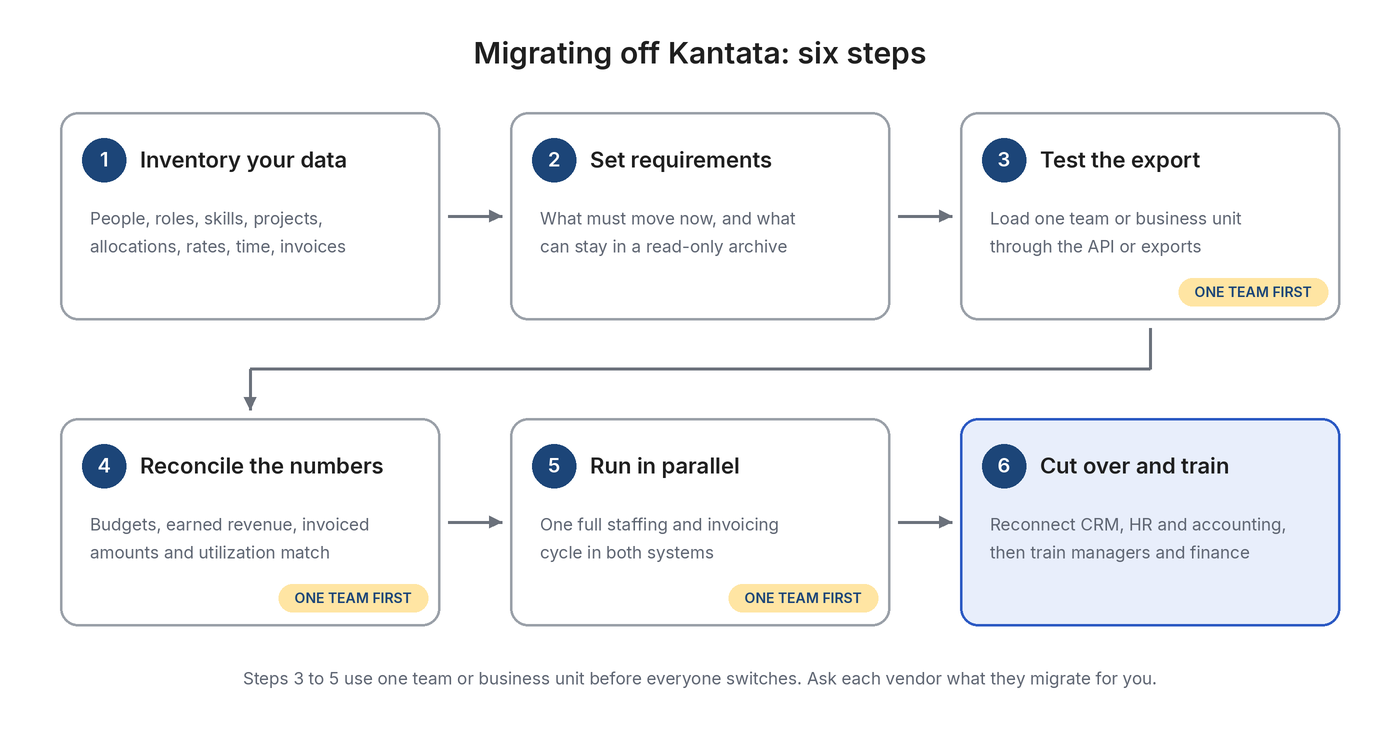
- Inventory your data. List people, roles, skills, clients, projects, future allocations, rate cards, cost rates, timesheets, invoices and custom fields in Kantata.
- Set requirements. Decide what must move (open projects, future allocations, rates) and what can stay in an archive (old tasks, closed projects).
- Test the export. Pull data through Kantata's API or exports and load one team or business unit into the new tool.
- Reconcile the numbers. Check budgets, earned revenue, invoiced amounts and utilization against Kantata for the test group.
- Run in parallel. Keep both systems for one staffing and invoicing cycle, and fix gaps before you switch everyone.
- Cut over and train. Reconnect CRM, HR and accounting integrations, switch off Kantata sync, and train resource managers, project managers and finance.
Before you sign, ask each vendor to confirm in writing:
- which data they migrate for you and which you move yourself;
- how historical time, invoices and revenue recognition are handled;
- how multi-currency, multi-company and custom fields map;
- which plan includes the integrations and SSO you need;
- how long a test migration of one team takes.
Operating includes data migration, training and process consulting in every plan. See our 7-step PSA rollout plan for the steps after migration.
Moving off Kantata? We will map your Kantata setup to Operating and run a test with one of your teams. Book a time with Lauri
FAQ
These are the questions buyers ask most when they compare Kantata alternatives. Each answer is short; the sections above have the detail.
What are the best Kantata alternatives in 2026?
Operating, Productive, Scoro, BigTime, Certinia, Rocketlane and Parallax. Operating is our top pick for consulting firms of 30 to 500 people; Certinia suits Salesforce-first enterprises and Rocketlane suits onboarding teams.
Is Kantata the same as Mavenlink?
Yes, in part. Mavenlink and Kimble merged in December 2021 and launched the Kantata name in May 2022. Mavenlink is now Kantata OX, and Kimble is now Kantata SX.
What is the difference between Kantata OX and Kantata SX?
Kantata OX is Kantata's own open, API-first PSA for high-growth services firms. Kantata SX is built natively on Salesforce for large, multi-entity organizations.
How much does Kantata cost?
Kantata does not publish prices. A third-party review from spring 2025 reported a 50-seat minimum and $50 to $110 per user, and put the annual minimum at about $35,000 to $66,000. Treat that as an estimate and ask Kantata for a quote.
Which Kantata alternatives have public pricing?
Operating ($13 to $21 per person per month billed annually, or $15 to $23 monthly), Productive ($10 or $25 billed annually below its Ultimate plan), Scoro (from $17 billed annually) and BigTime (Essentials from $20). Rocketlane publishes two of its three plans. Certinia and Parallax are quote only.
What is the best Kantata alternative for Salesforce users?
Certinia if you want the PSA to run inside Salesforce. Operating if you want Salesforce opportunities to become tentative projects in a separate PSA with public pricing.
What is the best Kantata alternative for HubSpot users?
Operating. HubSpot deals become tentative projects on every plan, and the capacity forecast weights them by deal probability. Kantata's HubSpot connector needs its Enterprise plan.
Which Kantata alternative is best for agencies?
Productive and Scoro if you want project management in the same tool. Operating if your agency keeps its own PM tool and wants staffing, time, margin and invoicing.
Can I replace Kantata without replacing my project management tool?
Yes. Operating and Parallax are built to sit next to Jira, Linear or Asana. Operating adds a Gantt-style Timeline for projects and phases, while tickets and backlogs stay in your task tool.
Which Kantata alternatives are SOC 2 certified and host data in the EU?
Operating (SOC 2 Type II, AWS Frankfurt) and Productive (SOC 2 Type II, AWS EU). Scoro is ISO 27001 certified and lets you pick an EU hosting region.
How long does a migration from Kantata take?
It depends on your data and integrations. Rocketlane says its migrations typically finish within 30 days and Parallax says firms are live in under 30 days (vendor claims); Operating does not publish a timeline. Ask every vendor for a test migration of one team first.
What are Operating's limits compared with Kantata?
Operating has no task-level project management, no SCIM provisioning yet and less flexible in-app reporting. It fits best from 30 to 500 people; above 500, it depends on your requirements.
Methodology and sources
We checked every product against its own live pricing page, docs and help center on September 25, 2026. Review scores come from G2 and Capterra on the same day.
- Pricing: taken from each vendor's pricing page. Where prices load with JavaScript (Operating, Productive, Scoro, Rocketlane), we read them from the page code and state whether they are billed monthly or annually.
- Features: checked against vendor docs and help centers. Where a vendor's own pages disagree, we used the more cautious reading.
- Reviews: used to find recurring themes, not to prove features. Operating and Parallax have far fewer reviews than the others.
- Vendor claims: go-live times, customer counts and case-study numbers are labeled as vendor claims.
- Third-party estimates: the Kantata price estimate comes from Springman Consulting and is labeled as an estimate.
- Screenshots: only Operating's own product images. We did not reproduce other vendors' interfaces.
- Not published: Kantata, Certinia and Parallax prices, Productive Ultimate and BigTime upper-tier prices, Rocketlane monthly prices, Kantata AI pricing and Operating's typical go-live time.
- Disclosure: Operating publishes this page.
Review scores (September 25, 2026)
| Product | G2 rating | G2 reviews | Capterra rating | Capterra reviews |
|---|---|---|---|---|
| Operating | 4.7 | 20 | 4.8 | 19 |
| Kantata | 4.2 | 1,572 | 4.2 | 629 |
| Productive | 4.6 | 77 | 4.6 | 109 |
| Scoro | 4.5 | 503 | 4.5 | 263 |
| BigTime | 4.4 | 1,798 | 4.6 | 662 |
| Certinia (PS Cloud) | 4.3 | 674 | 4.0 | 55 |
| Rocketlane | 4.7 | 871 | 4.7 | 128 |
| Parallax | 4.7 | 26 | 4.4 | 53 |
Kantata review themes: reviewers praise having project management, resourcing and finance in one place. The most tagged cons on G2 are complex usability, the learning curve and a UI that is not intuitive. Operating review themes: reviewers praise hands-on support, a simple interface, skill matching and the HubSpot, Harvest and MCP connections; the most repeated request is more flexible reporting.
Vendor-reported results: Kantata cites a 10% increase in resource utilization at Accedo, 36% less cost leakage at Finastra and a 20% improvement in services revenue forecasting at Cornerstone. Operating customer James Shaw, COO of Inventive.io, says "Operating is the glue between Harvest time tracking, HubSpot, and our reporting."
Sources: Operating
- Pricing
- Integrations
- Security
- Pipedrive integration
- MCP server
- Project phases in the Timeline
- Help: Security and privacy FAQ
- Help: SSO and SCIM
- Help: Billing types and known limitations
- Help: AI chat via MCP (59 tools)
- Help: Salesforce CRM
Sources: Kantata
- Pricing
- Mavenlink is now Kantata OX
- Kantata OX and SX
- Kantata name launch (May 2022)
- Integrations
- Security and compliance
- KB: HubSpot plan requirement
- KB: SAML SSO requirements
- KB: Rate cards
- KB: MCP server overview
Sources: other vendors
- Productive: pricing
- Productive: HubSpot integration
- Productive: security
- Scoro: pricing
- Scoro: security
- BigTime: pricing
- BigTime: pricing packages and add-ons
- Certinia: Professional Services Cloud
- Certinia: billing in PSA
- Rocketlane: pricing
- Parallax: pricing
- Parallax: why Parallax
Sources: third party
- G2: Kantata reviews
- G2: Operating reviews
- Capterra: Kantata
- Capterra: Operating
- Springman Consulting: Kantata OX review and price estimate
Written by Lauri Eurén, CEO of Operating. Last updated September 25, 2026.