Disclosure: Operating (operating.app) publishes this page and is one of the eight tools. We checked every product against its own pricing page, docs or help center, and each section says where Scoro or another tool is the better choice. Last updated October 2, 2026.
Short answer: The best Scoro alternatives in 2026 are Operating, Productive, Kantata, Teamwork.com, Accelo, BigTime, Projectworks and monday.com. There is no single winner. The right choice depends on one decision: do you want another suite that replaces Scoro's CRM, projects and billing in one product, or a specialist PSA that connects to the CRM, accounting and task tools you already use?
TL;DR: which Scoro alternative fits
| If you want to | Shortlist | Why |
|---|---|---|
| Keep your CRM and task tool | Operating | Staffing, time, margins and invoicing next to HubSpot, Salesforce or Pipedrive |
| Replace Scoro with another suite | Productive or Accelo | Pipeline, projects and billing stay in one product |
| Delivery PM first | Teamwork.com | Strongest task management; PSA depth on Optimize |
| Large, complex firm | Kantata | Deep governance and project accounting; quote only |
| Finance and billing first | BigTime or Projectworks | Payments and QuickBooks (BigTime), forecast margin and WIP (Projectworks) |
| Work management only | monday.com | Not a PSA; billing and margins need other tools |
| Scoro already works | Stay | Switching cost can exceed the gain |
What Scoro does today
Before you compare alternatives, be clear about what you would replace. Scoro is a professional services automation (PSA) platform for consultancies, agencies, IT, architecture and engineering firms. It is now sold as eight apps that share one data model (Scoro pricing).
Scoro's eight apps (October 2026)
| App group | Apps | What they cover |
|---|---|---|
| Work | Do, Deliver, Track, Resource | Tasks, projects, time and labor cost, bookings, planner, time off, utilization and team performance reports |
| Sales and finance | Sell, Estimate, Spend, Invoice | CRM and pipeline, quotes and budgets with cost and margin planning, bills and expenses, client invoicing |
| Add-ons | Advanced Work, Advanced Financials | Revenue forecasting, revenue recognition, WIP reports, quoted vs actuals, budget health (included in End-to-end) |
A few points matter for the comparison below:
- Resource planning: the Resource app has bookings and soft (tentative) bookings, skills and roles, heatmaps and utilization by person and role (Scoro resource planning).
- Billing: fixed fee with partial invoicing, time and materials, scheduled recurring invoices and a billing forecast, with Xero, QuickBooks and Sage Intacct connections (Scoro invoicing).
- AI and MCP: Scoro has an AI assistant called ELI and an MCP server on all packages. The MCP server can read and write projects, tasks, time entries and contacts, and read invoices and quotes (Scoro AI, Scoro MCP).
- Security: Scoro is ISO 27001 certified and lets you choose AWS hosting in Canada, Germany, Sweden or Australia. We did not find a SOC 2 report on its security page. SSO and user provisioning need the Enterprise platform (Scoro security, pricing).
- Pricing: as of October 2026, combinations start at $17 per user per month (Time-billing) and go up to $57 (End-to-end), with a five-user minimum. The page says annual billing saves 13 to 17% but does not say which billing period the listed prices use.
So Scoro is not a weak product. Users rate it 4.5 out of 5 on both G2 (503 reviews) and Capterra (263 reviews) (G2, Capterra). Any alternative has to beat it on a specific job, not on a feature count.
Why firms look for Scoro alternatives
These are the reasons we see in vendor documentation, pricing structure and review themes. They are situations to check, not universal problems.
- The CRM question. Scoro's Sell app is a CRM. Firms that already run sales in HubSpot or Salesforce must decide which system owns the pipeline. Scoro does connect to HubSpot and Salesforce (Scoro integrations), but you still pay for and maintain two places where deals can live.
- Price grows with apps. Scoro prices per user by app combination. If a 60-person firm puts everyone on End-to-end, it pays for CRM, quoting, PM, resourcing and finance for people who mostly log time and check their schedule (illustrative; ask Scoro how it prices different user types).
- Staffing is the real problem. Some firms mainly need forward capacity: who is free in six weeks, what the pipeline needs, which roles to hire. They may want a deeper staffing tool and fewer modules.
- Adoption and setup. On G2 and Capterra, the recurring Scoro complaints are the learning curve, navigation, limited invoice template customization and lag with large data sets (user-review evidence).
- Security or contract needs. Some buyers require SOC 2, SSO on every plan or a specific hosting setup. Scoro offers ISO 27001 and SSO on its Enterprise platform.
If none of these apply, you may not need to switch. We cover that in "When you should stay with Scoro" below.
Suite or specialist PSA: the first decision
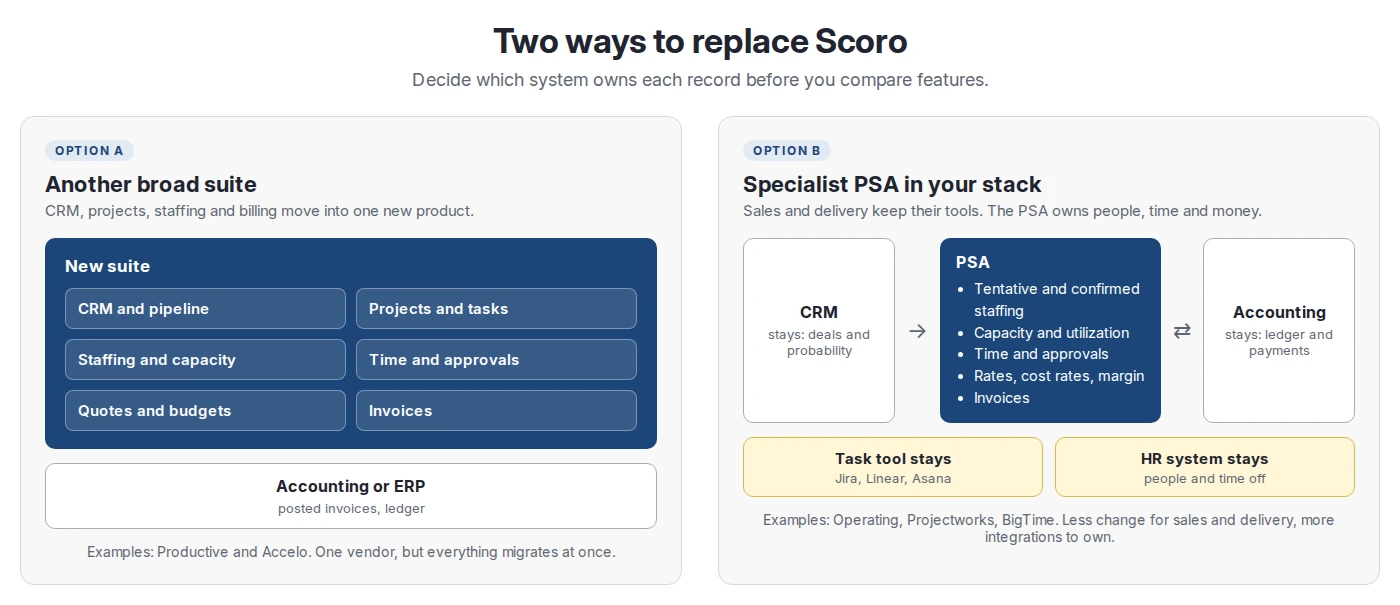
Replacing Scoro is not a one-for-one software swap. Scoro covers CRM, project management, PSA functions (staffing, time, project financials, billing) and reporting. When you leave it, you choose one of two architectures.
Option A: another broad suite
You move CRM, projects, resourcing and billing into one new product. Productive and Accelo are closest, because both include their own CRM. Teamwork.com and Kantata cover projects through billing but rely on an outside CRM. The benefit is one vendor and one data model. The cost is that you migrate everything at once, including your pipeline and task history.
Option B: a specialist PSA connected to your stack
You keep the CRM (HubSpot, Salesforce, Pipedrive), keep the task tool (Jira, Linear, Asana) and keep accounting (Xero, QuickBooks, NetSuite). The PSA owns staffing, time, rates, project margins and invoices. Operating, BigTime and Projectworks fit this model, with different strengths.
A simple test: list the record each system must own. If you want deals, tasks and invoices in one product, choose a suite. If sales already lives in a CRM your team likes, a specialist PSA usually means less change for sales and delivery teams. That is our inference from how the products are built, not a measured result.
Scoro alternatives compared
The table below is for building a shortlist. Pricing is as of October 2026 and in USD unless stated. "Quote" means the vendor publishes no price.
Scoro alternatives at a glance (October 2026)
| Tool | Best fit | Resource planning | Financials | PM | CRM | Key differentiator | Pricing |
|---|---|---|---|---|---|---|---|
| Scoro (baseline) | Agencies and consultancies that want quote-to-cash in one suite | Bookings, soft bookings, skills, utilization | Quotes, budgets, invoicing; rev rec and WIP in Advanced Financials | Full | Native | Eight modular apps on one data model | $17 to $57 per user, 5-user minimum |
| Operating | Consulting and IT services firms that keep their CRM and task tool | Skills matching, tentative projects from CRM, probability-weighted forecast | Budgets, rate cards, cost rates, margin forecast, invoicing on Full Suite | Timeline for projects and phases; no task management | Connects to HubSpot, Salesforce, Pipedrive | SSO, all integrations, API and MCP on every plan | $13 to $21 annual, $15 to $23 monthly |
| Productive | Agencies that want projects, time and billing in one tool | Scheduling and planning; skills from Professional | Budgets, profitability; rate cards from Professional | Full | Native sales pipeline | Low public entry price | $10 or $25 billed yearly; Ultimate quote |
| Kantata | Large, complex services firms | Deep resource management | Deep project accounting | Full | Integrates; Salesforce-native SX edition | Scale and governance; 150+ tool MCP server | Quote |
| Teamwork.com | Agencies that want strong delivery PM plus PSA | Scheduler with placeholders; role and skill planning on Optimize | Budgets, retainers, profitability; invoices exported to accounting | Full, strongest here | Integrates (HubSpot, Salesforce) | PM depth and free client users | $9.99 or $24.99 billed yearly; Optimize quote |
| Accelo | Firms that want CRM, projects, retainers and tickets together | Soft and hard bookings, placeholders (vendor claim) | Quotes, retainers, rate cards, invoicing | Full | Native | Client work and service desk in one system | Quote |
| BigTime | US firms where time, billing and payments matter most | Resource Management is a paid add-on | Strong billing and payments; QuickBooks | Light | Integrates (HubSpot, Salesforce) | Finance-first PSA with payments | Essentials from $20; others quote |
| Projectworks | Consulting, engineering and IT services firms on Xero or QuickBooks | Penciled bookings, placeholders, skills | Effective-dated cost rates, WIP, rev rec on Unleash | Light | Integrates; own CRM in beta | Consulting-grade financial forecasting | $17, $24, $41; 10-user minimum |
| monday.com | Teams that want flexible work management first | Resource planner on Enterprise only | No native budgets, rates or invoicing | Full | Separate monday CRM product | Flexibility and ecosystem | $9 to $19 billed annually; Enterprise quote |
Integrations, AI access and security (October 2026)
| Tool | CRM connections | Accounting | API and MCP | Security and hosting |
|---|---|---|---|---|
| Scoro | Native CRM; HubSpot and Salesforce | Xero, QuickBooks, Sage Intacct | REST API; read/write MCP on all packages | ISO 27001; choose CA, DE, SE or AU hosting; SSO on Enterprise platform |
| Operating | HubSpot, Salesforce, Pipedrive (deals become tentative projects) | Xero, QuickBooks Online; NetSuite through the API | Full REST API; read/write MCP on every plan | SOC 2 Type 2, GDPR, AWS in Europe; SSO on every plan |
| Productive | Native pipeline; HubSpot on Ultimate | Invoicing integrations from Professional | Open API; agents and connectors on Ultimate | SOC 2 Type II, GDPR |
| Kantata | HubSpot on Enterprise via M-Bridge; Salesforce | QuickBooks, Xero, NetSuite, Sage Intacct | APIs; 150+ tool MCP once Kantata AI is on | SOC 1 and SOC 2 Type II; AWS Oregon primary, Virginia for recovery |
| Teamwork.com | HubSpot; Salesforce on Optimize | QuickBooks, Xero; NetSuite on Optimize | API; read/write MCP on paid plans | ISO 27001, SOC 2 Type 2; US or EU hosting |
| Accelo | Native CRM; HubSpot, Salesforce, Pipedrive | QuickBooks, Xero, Sage Intacct; no NetSuite listed | REST API; MCP for Forecast PSA | SOC 2 Type 2; EU, US or AU hosting |
| BigTime | HubSpot, Salesforce | QuickBooks; Xero and NetSuite Enterprise only | API from Premier; MCP not documented | SOC 1 and SOC 2 Type 2; AWS |
| Projectworks | HubSpot (Scale), Salesforce (Unleash) | Xero, QuickBooks Online, Sage Intacct; no NetSuite | API on Unleash; MCP in private beta | SOC 2 Type 2; Azure; SSO from Scale |
| monday.com | Separate CRM; HubSpot (Standard+), Salesforce (Enterprise) | Third-party apps only | GraphQL API; MCP on all plans | SOC 2 Type II, ISO 27001; US, EU or AU |
The 8 best Scoro alternatives in 2026
Each tool uses the same structure: what it is, why you would consider it instead of Scoro, key strengths, trade-offs, best fit and pricing.
1. Operating
What it is: Operating (operating.app) is a PSA for consulting and technical services firms. It covers resource planning, capacity forecasting, timesheets, project budgets and margins, and invoicing. It is not a CRM and not a task manager (Operating info page).
Why consider it instead of Scoro: you keep your CRM. Deals from HubSpot, Salesforce or Pipedrive arrive as tentative projects, so you can staff a deal before it closes. The HubSpot import maps amount, owner, probability and close date, and writes nothing back to HubSpot (HubSpot integration).
Key strengths:
- Staffing in a Gantt-style Timeline, with project and people views up to three years ahead (Timeline docs).
- Skills, roles and seniority matching for open positions, a bench view and a capacity forecast that weights tentative work by CRM deal probability (pricing page).
- Rate cards, cost rates, planned vs actual utilization and delivery margin forecasts. Billing types include T&M, fixed price, capped, retainer, milestone and recurring.
- SSO, all integrations, the full REST API, data migration and training on every plan. SOC 2 Type 2, GDPR and AWS hosting in Europe (security).
- An MCP server where an AI assistant can read and change people, projects, allocations, time and budgets, and read invoices and reports, as the signed-in user (MCP server).
Trade-offs: no task-level project management, so tickets stay in Jira, Linear or Asana. No native CRM or quoting. NetSuite works through the API for now, and Jira and Slack are not on the integration list (integrations). Operating's own Kantata comparison says it has no SCIM provisioning yet and that reviewers ask for more flexible in-app reporting (Operating). It also has far fewer public reviews than Scoro.
Best fit: a consulting, IT services or engineering firm that plans staffing from its CRM pipeline and keeps delivery in its own task tool. Operating states its best fit as 30 to 500 people; above that, it depends on governance and finance needs (vendor claim).
Pricing: as of October 2026, Planning $15, Plan & Track $19 and Full Suite $23 per person per month billed monthly, or $13, $17 and $21 billed annually. Timesheets start on Plan & Track and invoicing on Full Suite. Enterprise starts at 100 people with a custom contract, SLA and on-site onboarding (Operating pricing).
2. Productive
What it is: an agency and consultancy platform that combines a sales pipeline, projects and tasks, resource planning, budgets, time tracking and invoicing.
Why consider it instead of Scoro: it is the closest suite-to-suite swap for agencies. Like Scoro, it has its own pipeline where won deals become projects (Productive), plus full task management.
Key strengths: budgeting, resource planning, time tracking, expenses and reporting on the entry plan. Professional adds recurring budgets (retainers), rate cards, skills and billable time approvals. Productive lists SOC 2 Type II and GDPR on every plan (Productive pricing). Reviewers often praise ease of use (user-review evidence).
Trade-offs: several things a 100-person firm compares with Scoro sit in the Ultimate plan, which has no public price: revenue forecasting, the Scenario Builder, multiple subsidiaries, the HubSpot integration and enforced SSO. Check this early if you sell through HubSpot.
Best fit: a creative or digital agency, or a smaller consultancy, that wants to move sales, delivery and billing into one tool.
Pricing: as of October 2026, Essential $10 and Professional $25 per user per month billed yearly, Ultimate on request, minimum three seats. Volume discounts from 50 users.
3. Kantata
What it is: an enterprise PSA, formed from Mavenlink and Kimble. Kantata OX is its standalone platform and Kantata SX runs on Salesforce (Kantata OX).
Why consider it instead of Scoro: firms move to Kantata when resource governance and project accounting outgrow a mid-market suite, for example many business units, formal resource requests and complex revenue rules.
Key strengths: deep resource management, project financials and reporting. Its MCP server offers 150+ read and write tools once Kantata AI is active (Kantata MCP). In June 2026 Kantata launched its Expertise Agent and says more than 1,500 organizations use it (vendor claim, press release).
Trade-offs: no public prices (Kantata pricing). The HubSpot integration needs the Enterprise subscription and runs on Kantata's M-Bridge platform (Kantata HubSpot docs). On G2 (4.2 from 1,572 reviews) the common complaints are complex usability and the learning curve (user-review evidence).
Best fit: a larger, multi-team services firm that needs central governance of resources and project finances. Salesforce-first firms should look at SX.
Pricing: quote only. For a deeper comparison, see our Kantata alternatives guide.
4. Teamwork.com
What it is: a project delivery platform for client work that now calls itself a PSA. It combines full project management with scheduling, budgets, time and profitability.
Why consider it instead of Scoro: your delivery teams live in tasks every day, and you want a stronger PM experience than Scoro's Do and Deliver apps, with free client users (vendor claim).
Key strengths: Gantt, board, list and table views; a resource scheduler with placeholders; and tentative projects that HubSpot deal stages can create (tentative projects). Budgets support hours, fee, fixed fee and retainers. Teamwork holds ISO 27001 and SOC 2 Type 2 and offers EU hosting (security). Its MCP server can read and write on all paid plans (Teamwork MCP).
Trade-offs: the PSA features most Scoro buyers want sit in Optimize, which is quote only: quotes, scheduling by role or skill, tentative work from the CRM pipeline, multi-currency budgets, profitability insights, Salesforce and NetSuite (Teamwork pricing). Cost rates are site-wide per user and cannot be overridden per project (profitability docs). Invoices are built from time and exported to accounting tools rather than managed as a full billing ledger (invoice docs).
Best fit: an agency or client-services team where task delivery and client collaboration matter more than finance depth.
Pricing: as of October 2026, Basics $9.99 and Accelerate $24.99 per user per month billed yearly; Optimize and Enterprise on quote. Paid onboarding packages run from $2,500 to $7,500 (Teamwork onboarding).
5. Accelo
What it is: a PSA with a native CRM, quotes, projects, retainers, tickets, time and invoicing. Accelo bought Forecast in July 2025 and merged the brands in May 2026 (acquisition, brand merge).
Why consider it instead of Scoro: it is the closest functional match to Scoro, and it adds a service desk and a client portal. Firms that mix project work, retainers and support tickets get them in one system.
Key strengths: native pipeline and versioned quotes (client management); HubSpot, Salesforce and Pipedrive connections; QuickBooks, Xero and Sage Intacct (integrations). Accelo describes soft and hard bookings, placeholders and pipeline-weighted capacity forecasts (vendor claim, resourcing). SOC 2 Type 2, with EU hosting by default for Forecast PSA (security).
Trade-offs: pricing is quote only. Classic Accelo and "Accelo Forecast PSA" still have separate logins and help centers, so ask which product you are buying. No NetSuite connector is listed. Reviewers mention a steep learning curve and a dated UI (G2 4.3 from 685 reviews, user-review evidence). Accelo's own comparison admits Scoro is strong on financial dashboards and revenue forecasting (Accelo vs Scoro).
Best fit: an agency or IT services firm that runs retainers and support next to projects and wants CRM inside the PSA.
Pricing: quote only; implementation guidance is included (Accelo pricing).
6. BigTime
What it is: a finance-first PSA for time, expenses, billing and payments. BigTime PSA serves single-entity firms; BigTime Enterprise PSA (the renamed Projector) adds multi-entity, multi-currency and revenue recognition (Enterprise PSA).
Why consider it instead of Scoro: your main pain is getting accurate time into invoices and getting paid, and you run QuickBooks.
Key strengths: every plan includes time tracking, invoicing, expenses and payments (BigTime pricing). T&M, retainer and fixed-fee invoicing posts to QuickBooks (invoicing docs). SOC 1 and SOC 2 Type 2 reports (trust center). BigTime says it averages 47 days from contract to go-live (vendor claim, BigTime).
Trade-offs: no native CRM. Full resource management (skills, soft bookings, role demand) is a separate add-on or part of Enterprise (resource management). Xero and NetSuite are Enterprise only (integrations). Project budgeting and custom cost rates start at Premier. Project management is light.
Best fit: a US accounting, engineering or consulting firm on QuickBooks where billing accuracy is the first problem to fix.
Pricing: Essentials starts at $20 per user per month; Advanced, Premier, Enterprise and add-ons are quote only. The page does not state the billing period or minimum seats.
7. Projectworks
What it is: a PSA for consulting, engineering and software services firms, built around resourcing, timesheets, invoicing and financial forecasting.
Why consider it instead of Scoro: finance wants forecast margin and WIP from the resource plan, and the firm already runs Xero or QuickBooks.
Key strengths: allocations in hours or percent of capacity, penciled (tentative) bookings, placeholders and skills (resourcing). Effective-dated cost rates per person, and forecast margin that includes future resourced cost (margin docs). T&M, fixed fee, retainer and percentage billing, plus WIP reports (invoicing). SOC 2 Type 2 (SOC 2).
Trade-offs: a 10-user minimum. HubSpot needs Scale; Salesforce, revenue recognition, the API and Sage Intacct need Unleash. Its own CRM and proposals are in beta, and the MCP server was in private beta in July 2026 (product update). No NetSuite connector is listed. G2 reviewers say custom reports need SQL (user-review evidence).
Best fit: a consulting or IT services firm on Xero, QuickBooks or Sage Intacct that keeps tasks in Jira, Azure DevOps or monday.com.
Pricing: as of October 2026, Build $17, Scale $24 and Unleash $41 per user per month as listed, and the page says annual billing saves 10%; Enterprise on quote (Projectworks pricing).
8. monday.com
What it is: a flexible work management platform. It is not a PSA, and we include it because many firms ask whether it can replace Scoro.
Why consider it instead of Scoro: your main need is flexible project tracking, and billing already lives in accounting or an ERP.
Key strengths: boards, timelines, automations and a large app ecosystem. A hosted MCP server on all plans (monday MCP). SOC 2 Type II and ISO 27001, with US, EU or Australian hosting (trust center).
Trade-offs: no native invoicing, rate cards, cost rates or project margins. The time tracking column (Pro and up) has a timer and manual entries, but its docs describe no billable flag or approvals (time tracking docs). The resource directory, planner and capacity manager are Enterprise only (resource management docs). Matching Scoro means building boards and adding marketplace apps.
Best fit: teams that want a work OS first, or that pair monday with a PSA for finance. Projectworks, for example, added a monday.com sync in July 2026.
Pricing: as of October 2026, Basic $9, Standard $12 and Pro $19 per seat per month billed annually; Enterprise on quote (monday pricing).
Also considered
Certinia fits large firms that run sales and finance on Salesforce; pricing is quote only (Certinia). Rocketlane fits onboarding and implementation teams, from $49 per user per month billed annually (Rocketlane pricing). Parallax is a forecasting layer, not a full PSA (Parallax); see Operating vs Parallax. NetSuite SuiteProjects Pro, formerly OpenAir, suits NetSuite shops (NetSuite).
How to choose the right Scoro alternative
Start from the job you want to improve. Then demo two or three tools with the same scenario.
Best Scoro alternative by use case
| Use case | Shortlist | Why |
|---|---|---|
| Keep the existing CRM and PM stack | Operating, Projectworks, BigTime | They read the CRM and leave tasks in your tool; Operating turns deals into tentative projects on every plan |
| Resource planning and capacity first | Operating, Kantata, Accelo | Tentative demand, skills and probability-weighted forecasts are central, not add-ons |
| Agencies | Productive, Teamwork.com, Accelo | Full PM plus budgets and retainers in the same tool |
| Consulting and IT services | Operating, Projectworks, Kantata | Roles, rates, cost rates, utilization and margin come first |
| Project profitability and WIP | Projectworks, BigTime, Kantata | Margin forecasts, WIP or revenue recognition are documented, some on upper plans or editions |
| Complex or large organizations | Kantata, Certinia, BigTime Enterprise PSA | Multi-entity finance and governance matter more than entry price |
| Lighter project management | monday.com, Teamwork.com | Strong task tools; plan where invoicing and margins will live |
| Price-sensitive buyers | Compare like for like | Price the plan that includes the features you need, not the entry plan |
Then run one representative scenario in each demo. For example (illustrative): "A HubSpot deal for a 12-week project at 60% probability needs two senior developers and one designer. Show us who is free, what it does to utilization next quarter, the forecast margin at our cost rates, and the first invoice."
For a full price view across 20 platforms, see our PSA pricing comparison.
What to consider before migrating from Scoro
Plan the move as a short project with a test phase. Scoro lets you export list views and reports as CSV or XLS, limited by the exporting user's permissions. We found no documented full-account export, so check this with Scoro before you give notice (Scoro export docs).
What to migrate and what to archive
| Data | Usually migrate | Usually archive or keep elsewhere |
|---|---|---|
| Clients and contacts | Active clients, billing contacts | Old leads and inactive contacts |
| CRM pipeline | Open deals, if the new tool owns the CRM | Closed deals, if the CRM stays in HubSpot or Salesforce |
| Projects | Open projects, phases, budgets | Closed projects and old tasks |
| People | Users, roles, skills, working hours | Leavers |
| Allocations | Future bookings from today forward | Past bookings (actuals cover history) |
| Time entries | Current period, and unbilled time | Older time, kept in an export for reporting |
| Rate cards and cost rates | Current rates with effective dates | Expired rates, kept for audit |
| Invoices | Open invoices | Paid invoices stay in accounting |
| Reports | Definitions of the KPIs you use | Old dashboards, rebuilt only if used |
| Integrations | CRM, accounting, HR, SSO | Zapier flows nobody owns |
- Inventory every Scoro app you use and the integrations attached to it.
- Decide which history matters for operations and what can stay in an archive.
- Test the export, then load one team into the new tool.
- Reconcile hours, budgets, invoiced amounts and utilization with finance.
- Run one staffing and one invoicing cycle in parallel.
- Cut over, reconnect integrations and train by role.
Ask each vendor in writing which data they migrate for you. Operating includes data migration and training in every plan. Our 7-step PSA rollout plan covers the steps after migration.
When you should stay with Scoro
Switching is not always the right call. Staying with Scoro is rational when:
- You use its CRM well. If sales, quoting and delivery already run in Scoro, a specialist PSA would add a CRM to buy and connect.
- Your setup works. If utilization, margins and invoices are reported on time, the gain from switching may be small.
- Switching costs more than the problem. Count migration, retraining, parallel running and lost reporting history.
- You would need several tools to replace it. Replacing CRM, PM, PSA and billing with three products adds integrations to own.
- The problem is configuration. Messy roles, missing cost rates or unused soft bookings are often fixed with a Scoro partner, not a new platform.
FAQ
What is the best alternative to Scoro?
It depends on your stack. Operating fits firms that keep their CRM and task tool. Productive fits agencies that want another suite. Kantata fits large, complex firms. Accelo is the closest functional match.
Who are Scoro's main competitors?
Productive, Kantata, Teamwork.com, Accelo, BigTime, Projectworks, Operating, Rocketlane and Certinia. monday.com is often compared but is not a PSA.
Is Scoro a PSA?
Yes. Scoro calls itself a PSA platform and covers projects, resources, time, quoting, billing and financial reporting, plus its own CRM.
What software is similar to Scoro?
Accelo and Productive are the most similar, because both include a native CRM, projects and invoicing. Teamwork.com is similar for project delivery.
What is the best Scoro alternative for consulting firms?
Operating or Projectworks for most consulting and IT services firms; Kantata or Certinia for large firms with complex governance.
What is the best Scoro alternative for agencies?
Productive, Teamwork.com or Accelo, if you want project management in the same tool. Operating, if you keep your own PM tool.
What is the best Scoro alternative for resource planning and capacity planning?
Operating, Kantata and Accelo put tentative demand and forecasting at the center. Operating weights CRM deals by probability on every plan.
What is the best Scoro alternative for project profitability?
Projectworks, BigTime and Kantata document margin forecasts, WIP or revenue recognition, some on upper plans or separate editions. Operating covers margin forecasts with rate cards and cost rates.
Is Scoro better than Productive?
Neither is better for every firm. Scoro publishes the price of its full suite, including WIP and revenue recognition. Productive is cheaper to start and popular with agencies, but revenue forecasting, HubSpot and enforced SSO sit in its unpriced Ultimate plan.
How does Scoro compare with Kantata?
Scoro is modular, publishes prices and includes a CRM. Kantata is quote only and built for larger firms that need deeper resource governance and project accounting.
How does Scoro compare with Operating?
Scoro replaces your CRM, PM and billing. Operating connects to your CRM, works next to your task tool and focuses on staffing, time, margin and invoicing, with SSO on every plan.
Can Scoro be replaced by monday.com?
Only partly. monday.com has no native invoicing, rate cards or margins, and resource management needs Enterprise. Most firms would pair it with a PSA or accounting tool.
Is there a cheaper alternative to Scoro?
Entry prices are lower for Productive, Teamwork.com, Operating and monday.com, but compare the plan that includes the features you need.
What should I consider before migrating from Scoro?
What data you need, how you export it, which integrations must move, and a test with one team. Reconcile the numbers before you switch everyone.
Methodology
We checked the current search results for "Scoro alternatives" and related queries, then picked tools that replace at least one real Scoro use case for professional services firms of about 30 to 500 people.
- Sources: vendor pricing pages, docs and help centers, checked September 25 to October 2, 2026. We did not take prices or features from other comparison sites.
- Pricing: where prices load with JavaScript (Operating, Scoro, Productive, Teamwork.com), we read them in a browser and state the billing period when the page does.
- Reviews: G2 and Capterra, used for recurring themes, not to prove features.
- Labels: vendor claims (go-live times, customer counts) and user-review evidence are marked as such. Example scenarios are illustrative.
- Not tested hands-on: this is a documentation-based comparison. We did not run trials of competitor products.
- Disclosure: Operating publishes this page.
Review scores (checked September 25 to October 2, 2026)
| Product | G2 rating | G2 reviews |
|---|---|---|
| Scoro | 4.5 | 503 |
| Operating | 4.7 | 20 |
| Productive | 4.6 | 79 |
| Kantata | 4.2 | 1,572 |
| Teamwork.com | 4.4 | 1,214 |
| Accelo | 4.3 | 685 |
| BigTime | 4.4 | 1,798 |
| Projectworks | 4.4 | 249 |
| monday.com | 4.7 | 17,244 |
Want to test Operating with your own pipeline? Book a 30-minute walkthrough with Lauri, our CEO.
Sources
Scoro
- Scoro: Pricing
- Scoro: Resource planning
- Scoro: Invoicing
- Scoro: MCP server
- Scoro: Scoro AI
- Scoro: Security
- Scoro: Integrations
- Scoro: Help: Exporting data
- Scoro: G2 reviews
- Scoro: Capterra
Operating
- Operating: Pricing
- Operating: Security
- Operating: Integrations
- Operating: HubSpot integration
- Operating: MCP server
- Operating: Help: Timeline layout
- Operating: Official information page
- Operating: Kantata alternatives (limits and fit)
Productive
Kantata
- Kantata: Pricing
- Kantata: Kantata OX
- Kantata: KB: HubSpot integration
- Kantata: KB: MCP server
- Kantata: Expertise Agent announcement
- Kantata: Security and compliance
- Kantata: G2 reviews
Teamwork.com
- Teamwork.com: Pricing
- Teamwork.com: Help: Tentative projects
- Teamwork.com: Help: Project profitability
- Teamwork.com: Help: Invoices
- Teamwork.com: MCP server
- Teamwork.com: Security
- Teamwork.com: Implementation services
- Teamwork.com: G2 reviews
Accelo
- Accelo: Pricing
- Accelo: Forecast acquisition
- Accelo: Brand integration
- Accelo: Client management
- Accelo: Resourcing
- Accelo: Integrations
- Accelo: Security
- Accelo: AI
- Accelo: Accelo vs Scoro
- Accelo: G2 reviews
BigTime
- BigTime: Pricing
- BigTime: Integrations
- BigTime: Help: Resource management
- BigTime: Help: Invoicing
- BigTime: Enterprise PSA
- BigTime: Trust center
- BigTime: Homepage
- BigTime: G2 reviews
Projectworks
- Projectworks: Pricing
- Projectworks: Resourcing
- Projectworks: Help: Project margin
- Projectworks: Invoicing
- Projectworks: July 2026 product update
- Projectworks: SOC 2 Type 2
- Projectworks: G2 reviews
monday.com
- monday.com: Pricing
- monday.com: Help: Resource management for Enterprise
- monday.com: Help: Time tracking column
- monday.com: MCP server
- monday.com: Trust center
- monday.com: G2 reviews
Also considered
- Also considered: Certinia PSA
- Also considered: Rocketlane pricing
- Also considered: Parallax pricing
- Also considered: NetSuite SuiteProjects Pro
Written by Lauri Eurén, CEO of Operating. Last updated October 2, 2026.