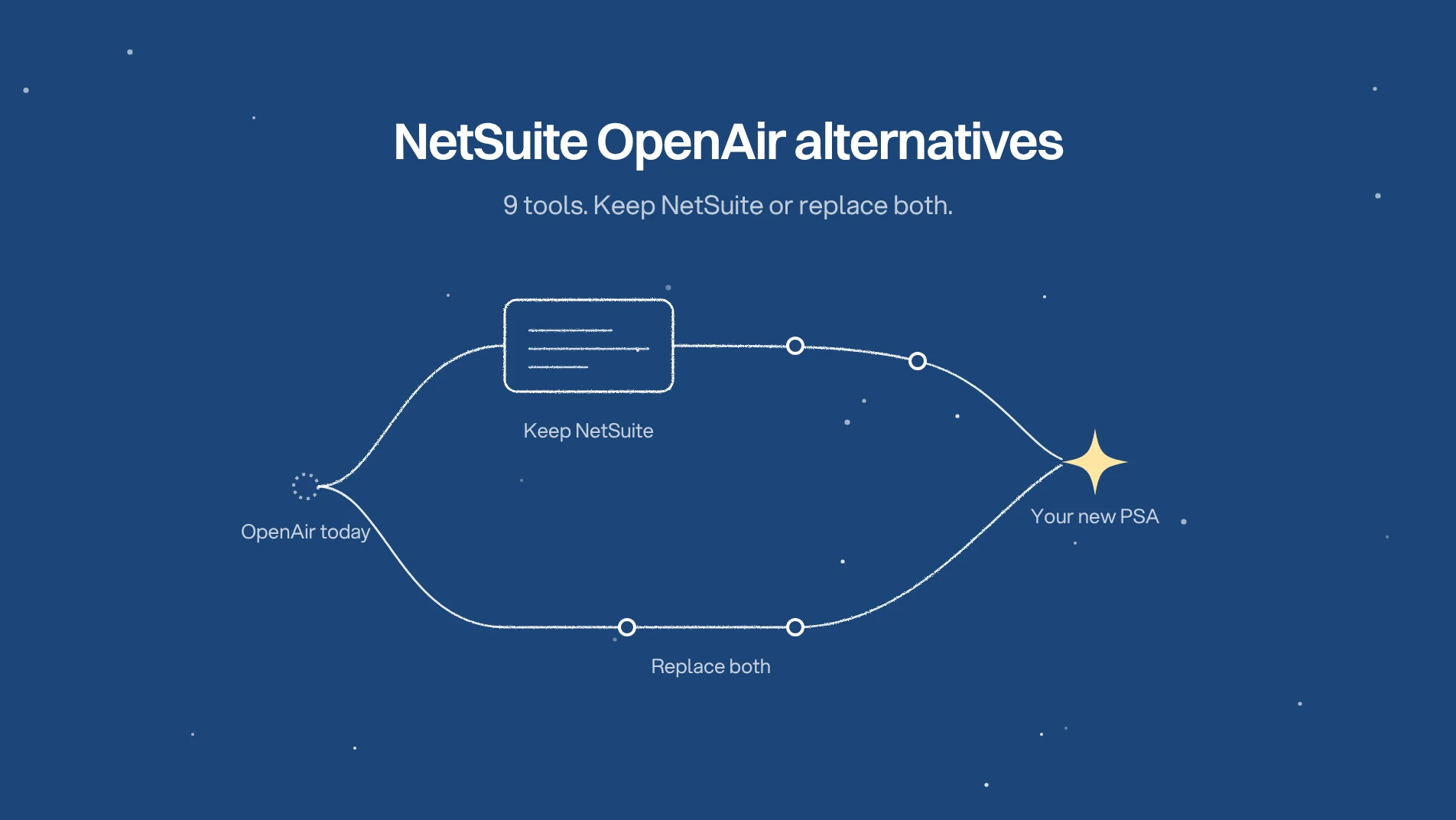
TL;DR: NetSuite OpenAir is now called NetSuite SuiteProjects Pro. If you keep NetSuite for your accounting, the best alternatives are Operating and Kantata. Pick Operating if you want a public price, from $13 per person a month, and you're fine linking it to NetSuite through its API. Pick Kantata if you need a ready-made two-way NetSuite connector and can pay enterprise prices. If you're replacing NetSuite too, look at Certinia if you sell in Salesforce, or at Operating, Projectworks or Ruddr with QuickBooks or Xero.
Short answer: Look for an OpenAir alternative when one of these is true:
- Your renewal is too expensive. Oracle publishes no price. Capterra lists a plan at $399 per user a month, and reviewers report big bills.
- Setup and changes take too much admin time. G2 users report about 4 months to set it up, and one change can affect a lot.
- You're tired of two systems and a sync. Even with Oracle's connector, OpenAir and NetSuite are two separate apps.
- You sell in Salesforce. Oracle has ended support for the 3-way Salesforce, OpenAir and NetSuite sync. New setups can't turn it on.
Stay if you have several hundred people, a NetSuite admin team and finance work built around real-time imports into NetSuite. We checked every price, plan and NetSuite connector below on the vendors' own sites on October 29, 2026.
Disclosure: we make Operating, and it has no ready-made NetSuite connector today. We say so in its row and its section. Every price and connector claim comes from the vendor's own pages, and outside numbers are marked.
NetSuite OpenAir alternatives compared
The biggest question is how each tool connects to NetSuite, so that's the second column. The third column shows where invoices go if you leave NetSuite.
| Tool and fit | How it connects to NetSuite | Other accounting | List price, yearly billing | G2 |
|---|---|---|---|---|
| SuiteProjects Pro (today) Baseline | NetSuite: Oracle's connector: bulk, scheduled and real-time sync | Other accounting: None (NetSuite is the ledger) | List price: Quote only. Capterra lists a Basic plan at $399 per user a month 50 people a year: Not published | G2: 3.7 |
| Operating Keep NetSuite or replace both | NetSuite: REST API today; connector on the roadmap | Other accounting: QuickBooks Online, Xero (both ways) | List price: $13, $17 or $21 per person a month 50 people a year: $10,200 (Plan & Track) or $12,600 (Full Suite) | G2: 4.7 |
| Kantata Keep NetSuite | NetSuite: Native, two-way, on Enterprise; needs NetSuite SuiteCloud Plus | Other accounting: QuickBooks, Sage Intacct; Xero on Enterprise | List price: Quote. VendorBenchmark estimates $60 to $90 per full user 50 people a year: About $36,000 to $54,000 if all 50 are full users (our math) | G2: 4.2 |
| BigTime Keep NetSuite | NetSuite: Native, on Enterprise PSA only | Other accounting: QuickBooks, Sage Intacct; Xero on Enterprise PSA | List price: Essentials from $20 per user (billing term not stated); Enterprise PSA quote 50 people a year: Ask vendor | G2: 4.4 |
| Productive Keep NetSuite | NetSuite: On Ultimate: invoices, credit notes and customers out (expenses too, per an April 2026 update), payments back | Other accounting: QuickBooks, Xero | List price: Ultimate quote; other plans $10 and $25 50 people a year: Ask vendor | G2: 4.6 |
| Certinia Replace both (Salesforce) | NetSuite: None; brings its own ERP | Other accounting: Its own Financial Management Cloud | List price: Quote. AppExchange: starting at $45 per user 50 people a year: About $72,000 to $120,000 at Vendr's full-PSA rates (our math), plus Salesforce seats | G2: 4.3 |
| Projectworks Replace both | NetSuite: None listed | Other accounting: Xero, QuickBooks, Sage Intacct | List price: About $17 to $41 per user; 10-user minimum 50 people a year: $10,260 (Build) | G2: 4.4 |
| Ruddr Replace both | NetSuite: None listed | Other accounting: QuickBooks, Xero, Sage Intacct | List price: Pro $24 per billable person 50 people a year: $11,520 (40 billable) | G2: 4.6 |
| Dynamics 365 Project Operations Replace both (Microsoft) | NetSuite: No connector; open APIs for external ERPs; customer invoicing needs Dynamics 365 Finance | Other accounting: Dynamics 365 Finance | List price: $135 per user a month 50 people a year: Up to $81,000 if all 50 need full licences; Finance extra | G2: 4.0 |
| Workday PSA Replace both (Workday) | NetSuite: None; one system with Workday Financial Management | Other accounting: Workday Financial Management | List price: Quote 50 people a year: Ask vendor | G2: 4.1 |
Checked October 29, 2026 on each vendor's site. Prices are USD per person per month billed yearly. Totals for 50 people use each vendor's seat rules at list price; Ruddr assumes 40 billable people. Kantata's range is our math at VendorBenchmark's $60 to $90 full-user rate. VendorBenchmark prices people who only log time and expenses as light users at $25 to $45. The M-Bridge add-on that runs the NetSuite connector may add $8 to $15 per user a month. Certinia's range is our math at Vendr's $120 to $200 for full PSA licences. Third-party prices don't state a billing term. Dynamics assumes 50 full licences; people who only log time can use a cheaper Team Members licence.
Keeping NetSuite as your ledger? Operating plans, tracks and prices the work. Sievo links it to NetSuite through the REST API. See what the link covers.
Book an intro · Operating and NetSuite
What the OpenAir rename changed, and what it didn't
NetSuite bought OpenAir in 2008, and Oracle bought NetSuite in 2016. Oracle announced the SuiteProjects Pro name at SuiteWorld in September 2024. It changed the names in the app on January 25, 2025. Oracle's release notes say the rename changed names "in display names only", with "no functionality changes". On February 15, 2025, sign-in and account addresses moved from openair.com to netsuitesuiteprojectspro.com. The old openair.com addresses still work "until further notice" for API and BI Connector requests, WSDL, and the NetSuite integration's real-time import and single sign-on.
How it's built didn't change. SuiteProjects Pro is still its own app, joined to NetSuite by Oracle's connector and a set of integration bundles. NetSuite's built-in PSA is a different product called SuiteProjects, without "Pro". Oracle describes it as "natively built on NetSuite". You'll also see "SRP", short for Services Resource Planning. NetSuite first used it in 2008 for NetSuite plus OpenAir. Some review sites now use it for NetSuite's own services features, and it lives on in the name of Oracle's SuiteProjects Pro SRP Integration bundle. So "NetSuite PSA" can mean either product, and reviewers still write "OpenAir" or "OA".
Oracle is still building the product. Release 2025.2 added a Resource Center with a booking grid. Release 2026.1 added optional AI project summaries in U.S. English. Release 2026.2 came out on October 10, 2026. So OpenAir isn't going away. Firms leave for other reasons.
Why firms leave OpenAir
Every reason below comes up in OpenAir reviews on G2 and Capterra, or in Oracle's own documentation.
Cost and renewals. Oracle doesn't publish a price, and NetSuite sells SuiteProjects Pro as an add-on. Capterra's $399 per user a month is only a rough guide. G2 shows an average discount of 29%, which tells you the list price is a starting point. One Capterra reviewer wrote in 2020 that they paid "over $20K/year" for 15 to 20 users, then moved to BigTime instead of renewing. That's at least $83 to $111 per user a month.
Setup and admin work. G2 users report about 4 months to set it up. Hard setup and a steep learning curve are among the most common complaints. A VP of professional services at a 150+ person consulting firm called it very configurable in 2021. But they warned that "one change can have a significant impact".
Timesheets and the interface. Consultants feel this every week. One management consulting reviewer complained about "Having to add notes for each and every activity when tracking time." A 2018 review describes save and submit buttons that leave timesheets unsubmitted. G2 reviewers still list ease of use as a plus, so it depends on the setup.
Reports that end up in spreadsheets. The same reviewer said their team used separate Smartsheets to keep track of who works on what. Several Capterra reviewers call the reporting thin, though G2 lists reporting as a plus.
Two systems and a sync. Even with Oracle's connector, SuiteProjects Pro and NetSuite are two apps. A controller wrote that they "were plagued with sync issues" moving data to NetSuite.
Salesforce. Oracle has ended support for the 3-way Salesforce, SuiteProjects Pro and NetSuite integration. New setups can't turn it on, and Oracle says it will remove it at a date it hasn't announced yet. Oracle's current list of integrations has no separate Salesforce connector. Outside tools such as Celigo still sell an OpenAir to Salesforce template.
When staying makes sense
SuiteProjects Pro may still be the safest choice if your firm has several hundred people, a NetSuite admin team and finance work built around real-time imports into NetSuite. If price is the main problem, a priced alternative still helps when you negotiate your renewal. If the problem is having a second system, NetSuite's built-in SuiteProjects module runs inside NetSuite, so there's nothing to sync. You'd get a price from your NetSuite account rep.
Path 1: keep NetSuite, replace the PSA
Here finance keeps NetSuite for accounting, and planning, time and project tracking move to a new tool. Before you compare features, list which records must reach NetSuite and in which direction. Usually that's customers, projects, approved time and invoices. Then check whether each tool syncs them with a built-in connector, an API job or an export. Operating is listed first because it's our product. It has no NetSuite connector, but its REST API comes with every published plan, so you know the software price up front. Building the link is extra work on your side. Kantata, BigTime and Productive put their NetSuite connectors on plans with no public price. If a ready-made connector for projects, time and expenses matters more, Kantata is the one that has it.
1. Operating: best for a public price and a NetSuite link you control
Best for: consulting and IT services firms from about 50 to 2,000+ people that want planning, time and invoicing in one tool, with or without NetSuite.
Operating covers resource planning with open roles (placeholders) and skills. It also has timesheets with approvals, planned vs actual hours and project budgets. Invoicing syncs both ways with QuickBooks Online and Xero. HubSpot, Salesforce and Pipedrive deals come in as tentative projects on every plan. Firms that keep NetSuite link it through Operating's REST API. The API covers about 55 kinds of records, including projects, clients, time entries, invoices and expenses. You can also export lists and reports for a monthly close.
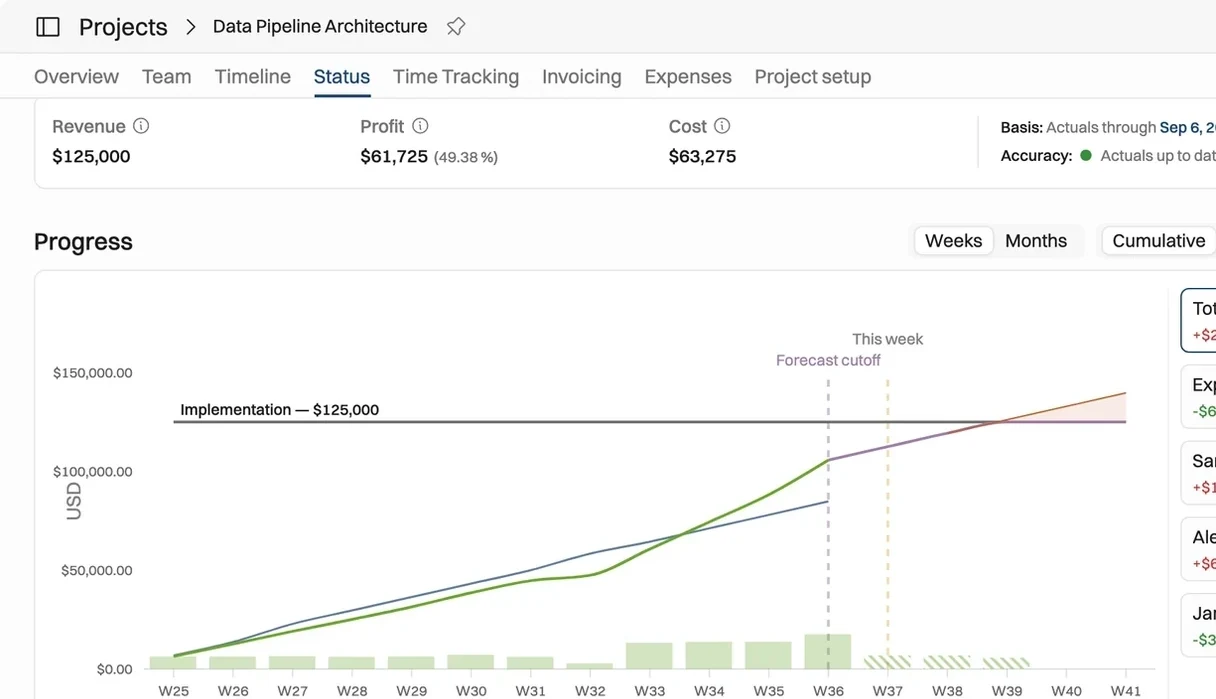
Perttu Paarma, VP of Professional Services at Sievo, describes the setup: "We connected Operating to NetSuite ERP via APIs".
NetSuite: no built-in connector today. Operating says one is on the roadmap.
Price: Planning costs $13, Plan & Track $17 and Full Suite $21 per person a month, paid yearly. Paid monthly, they cost $15, $19 and $23. Everyone who uses it counts, plus anyone scheduled who never logs in. Those scheduled-only seats cost less. There's no minimum number of seats, and pricing is custom from 100 people.
What it's missing: a ready-made NetSuite connector, and task lists, so delivery teams keep Jira or Asana for tasks.
G2: 4.7 stars.
2. Kantata: best for large firms that want a ready-made NetSuite connector
Best for: larger firms that keep NetSuite and want an enterprise PSA with a two-way connector built in.
Kantata, formerly Mavenlink, runs its NetSuite integration on its M-Bridge platform with 14 ready-made scenarios. Projects sync in either direction. Approved time goes to NetSuite as time bills. Expenses sync both ways. Invoices go to NetSuite, and paid amounts come back. Kantata also connects to QuickBooks, Xero and Sage Intacct, has a version that runs inside Salesforce, and offers MCP servers for ChatGPT, Claude and Copilot. For staffing, it has a skills list and "unnamed resources". Those are open roles that can only be booked as tentative.
NetSuite: built in and two-way, on the Enterprise plan. You also need NetSuite API access and a SuiteCloud Plus licence, which you buy from Oracle.
Price: you have to ask sales. VendorBenchmark estimates $60 to $90 per full user a month at list. It lists the M-Bridge integration add-on at $8 to $15 per user a month, so ask whether the connector costs extra. Vendr reports a median contract of about $40,600 a year.
What it's missing: a public price and a quick start. G2 users report about 4 months to set it up. See our Kantata alternatives if it's on your list.
G2: 4.2 stars.
3. BigTime: best for finance-first firms that can buy its Enterprise edition
Best for: firms that care most about time, billing and project accounting, and can buy BigTime's Enterprise PSA.
BigTime started as a time and billing tool. Essentials includes QuickBooks and HubSpot. Advanced adds Salesforce and Jira, and Premier adds Sage Intacct and the API. Its NetSuite connector is listed as "Available with BigTime Enterprise PSA". That's a separate edition with no public price, aimed at the CFO's team. Resource Management is an add-on with skills, what-if planning for tentative projects and an availability heat map.
NetSuite: built in, on Enterprise PSA only. BigTime doesn't say publicly what syncs or in which direction.
Price: Essentials starts at $20 per user a month. Advanced, Premier and Enterprise PSA have no public price.
What it's missing: a public price for the edition with NetSuite. Its pricing page doesn't mention open roles.
G2: 4.4 stars.
4. Productive: best for agencies that only send invoices to NetSuite
Best for: agencies and smaller consultancies that run delivery in one tool and only send invoices to NetSuite.
Productive's NetSuite integration copies invoices, credit notes and companies to NetSuite. Since an October 6, 2026 release, payments recorded in NetSuite sync back. Productive's April 2026 product update also mentions syncing expenses. Projects, time and budgets stay in Productive. HubSpot and Salesforce sync are also on Ultimate, while QuickBooks and Xero start on Professional.
NetSuite: on Ultimate only. Invoices, credit notes and customers go out, expenses too according to that update, and payments come back.
Price: Essential costs $10 and Professional $25 per user a month, paid yearly, with at least 3 seats. Ultimate has no public price. It was $33 per user a month paid yearly until July 2026, according to PricingSaaS.
What it's missing: NetSuite at a public price. Open roles stop at 5 on Professional and 10 on Ultimate. More in our Productive.io alternatives.
G2: 4.6 stars.
Path 2: replace NetSuite and the PSA together
Replacing both makes sense in three cases. NetSuite is there mainly to support the PSA. Your sales team runs on Salesforce and you'd rather run finance there too. Or QuickBooks or Xero is enough for a firm your size. None of the three main picks below has a NetSuite connector, so plan the move with your accountant.
5. Certinia: best for firms that sell in Salesforce
Best for: firms that run sales on Salesforce and want the PSA and accounting (ERP) on the same platform.
Certinia's Professional Services Cloud and Financial Management Cloud both run on Salesforce. So deals, projects, billing and the books share the same data. That does the job Oracle's retired Salesforce sync used to do. The downside is that everyone who uses it needs Salesforce access.
Price: you have to ask sales. Salesforce AppExchange shows "starting at $45" per user a month. Vendr reports $120 to $200 per user a month for full PSA licences at 50 to 100 users, with Salesforce seats on top.
What it's missing: a public price, and a low starting cost once you add Salesforce seats. Our Certinia vs Operating comparison covers the trade-offs.
G2: 4.3 stars.
6. Projectworks: best for finance-led firms moving to Xero or QuickBooks
Best for: firms where finance owns the plan and wants forecasting, invoicing and an accounting link on the cheapest plan.
Projectworks puts time and expenses, resourcing, invoicing and forecasting on its Build plan, with Xero and QuickBooks included. HubSpot needs Scale. Salesforce, Sage Intacct and the API need Unleash. Open roles hold demand on a project as pencil (unconfirmed) bookings.
Price: Build costs $19, Scale $27 and Unleash $45 per user a month, paid monthly. Paid yearly, they cost about $17, $24 and $41. You need at least 10 users, sold in groups of 5. Paying monthly still needs a one-year commitment, and setup help starts at $1,000.
What it's missing: a NetSuite connector, and the API on plans below Unleash.
G2: 4.4 stars.
7. Ruddr: best for firms where many people don't bill
Best for: firms moving to QuickBooks, Xero or Sage Intacct that have a lot of staff who don't bill clients.
Ruddr's Team plan covers time, invoicing and skills tracking. Pro adds people planning with open roles, HubSpot and Salesforce sync, and forecast reports. It connects to QuickBooks Online and Desktop, Xero and Sage Intacct. You only pay for people who bill, as long as at least half the team does.
Price: Pro costs $24 per billing person a month, paid yearly, or $30 paid monthly. There's no stated seat minimum.
What it's missing: a NetSuite connector. See Ruddr vs Operating for a closer look.
G2: 4.6 stars.
If you'd rather move everything onto one big suite
Workday PSA and Dynamics 365 Project Operations mostly make sense if your whole firm is moving onto that suite. Workday sells its PSA as "part of a single system with Workday Financial Management", on a quote. Dynamics 365 Project Operations costs $135 per user a month, paid yearly. Invoicing clients and revenue recognition need the version that runs with Dynamics 365 Finance. People who only log time can use a cheaper Team Members licence.
Also considered
Upland PSA, formerly Tenrox, is still sold on quotes. Its product page says it connects to NetSuite, but NetSuite isn't on its integrations page, so ask how that link works. BQE CORE was built first for architecture and engineering firms and lists no NetSuite link. Workamajig is for advertising and marketing agencies. It costs $49 per user a month for 10 or more users ($45 at 50 or more) and has its own accounting. Rocketlane started as a customer onboarding tool and now sells itself as a PSA, but its integrations page lists no NetSuite, QuickBooks or Xero connector.
OpenAir migration checklist
Most of the work goes into the NetSuite link and a month of running both systems. Start six months before renewal to leave time for both.
| Step | What to do | When |
|---|---|---|
| 1. Contract | Find your SuiteProjects Pro renewal date and notice period in the NetSuite contract. Ask Oracle for the renewal quote early. | 6 months before renewal |
| 2. NetSuite link | List the integration workflows you use today (customers, projects, time, expenses, invoices) and their direction. Decide what replaces each: a connector, an API job or a monthly export. | Month 1 |
| 3. Data export | Customers, projects and phases, rate cards, people and skills, open bookings, approved timesheets, expenses, unbilled time and open invoices. Keep 12 to 24 months of time history for reporting. | Months 1 to 2 |
| 4. Other integrations | CRM, HR system, single sign-on and BI. If you used the 3-way Salesforce sync, plan its replacement now. | Months 2 to 3 |
| 5. Setup and testing | Roles, rates, approval flows and invoice templates. Run last month's real close on test data. | Month 3 |
| 6. Parallel run | One month of timesheets and invoices in both systems. Reconcile totals with finance. | Months 3 to 4 |
| 7. Training and cutover | Train approvers and project managers first, then everyone who logs time. Cut over at the start of a month, after close. | Month 4 |
| 8. Notice | Give notice on SuiteProjects Pro per your contract, once the parallel run has passed. | Before the notice deadline |
A general plan. Your NetSuite partner and contract terms set the real dates.
Only comparing Operating and SuiteProjects Pro? Read our side-by-side: Operating vs NetSuite SuiteProjects Pro.
Other comparisons of ERP-adjacent PSA tools: Operating vs NetSuite SuiteProjects Pro, Deltek Vantagepoint and Ajera alternatives and Operating vs Polaris (Deltek). Every comparison we have written is on our comparison page.
Frequently asked questions
Is NetSuite OpenAir the same as SuiteProjects Pro?
Yes. Oracle renamed NetSuite OpenAir to NetSuite SuiteProjects Pro on January 25, 2025. It moved the web addresses to netsuitesuiteprojectspro.com on February 15, 2025. The features didn't change.
What's the difference between NetSuite SuiteProjects and SuiteProjects Pro?
SuiteProjects is NetSuite's PSA module, built inside NetSuite. SuiteProjects Pro is the former OpenAir. It's a separate app that syncs with NetSuite through Oracle's connector. NetSuite sells both as add-ons.
How much does NetSuite OpenAir cost?
Oracle doesn't publish OpenAir prices. Capterra and SelectHub list $399 per user a month without saying what's included, and G2 shows an average discount of 29%. One reviewer paid "over $20K/year" in 2020 for 15 to 20 users. That's at least $83 to $111 per user a month. Ask for a quote that splits out licences, setup and the NetSuite integration.
Does SuiteProjects Pro integrate with Salesforce?
Not through Oracle for new setups. Oracle has ended support for the 3-way Salesforce, SuiteProjects Pro and NetSuite integration. New setups can't turn it on, and Oracle will remove it at a date it hasn't announced. Existing users may keep using it. Outside tools such as Celigo still sell an OpenAir to Salesforce template.
Which OpenAir alternatives integrate with NetSuite?
Kantata has a two-way connector on its Enterprise plan, which also needs a NetSuite SuiteCloud Plus licence. BigTime lists NetSuite on its Enterprise PSA edition. Productive syncs invoices, credit notes, customers and payments on Ultimate, and expenses too according to a 2026 update. Operating connects through its REST API today, with a connector on the roadmap.
Can I keep NetSuite and replace OpenAir?
Yes. Many firms keep NetSuite for accounting and move planning, time and project tracking to a new PSA. Decide which records must reach NetSuite. Usually that's customers, projects, approved time and invoices. Then check whether the new tool syncs them with a built-in connector, an API job or an export.
How long does it take to move off OpenAir?
Most of the time goes into rebuilding the NetSuite link and running both systems for a month. Setup times vary. G2 users report about 4 months for Kantata, and Projectworks says most firms on its standard onboarding go live in four to six weeks. Start six months before renewal to leave room for that month.
Is OpenAir being discontinued?
No. Oracle still builds SuiteProjects Pro. Release 2026.2 came out on October 10, 2026, after AI project summaries arrived in 2026.1. What Oracle has retired is the old name and login addresses and the Exchange Integration Manager, whose support ended January 13, 2026. It has also retired the 3-way Salesforce sync for new setups.
What are the main NetSuite OpenAir competitors?
For consulting and professional services firms: Kantata, Certinia, BigTime, Operating, Ruddr, Projectworks and Productive. Workday PSA and Dynamics 365 Project Operations compete when a firm is moving onto those suites.
How we compared these tools
On October 29, 2026 we checked each vendor's pricing page, integrations page and help center, plus Oracle's SuiteProjects Pro documentation. Prices are US dollars per person per month, before discounts. G2 ratings are star ratings only. Review quotes come from Capterra, and the Sievo quote from Operating's integrations page. Outside prices from Capterra, SelectHub, VendorBenchmark, Vendr and PricingSaaS are marked where we use them.
Sources: Oracle: SuiteProjects Pro account URLs, Oracle: integration bundle release notes, Oracle: SuiteProjects Pro integrations, Oracle: 3-way Salesforce integration, Oracle: 3-way sync removal notice, Oracle: 2026.2 release notes, Oracle: Help Center updates, NetSuite: SuiteProjects Pro 2025.1, NetSuite: SuiteProjects Pro 2025.2, NetSuite PSA, NetSuite SuiteProjects datasheet, Oracle: NetSuite Integration guide, Diginomica on SuiteWorld 2024, Software Advice on NetSuite SRP, SuiteProjects Pro pros and cons on G2, Computerworld on the 2008 acquisition, Oracle completes NetSuite takeover, InfoWorld on NetSuite SRP, Oracle: Project Summary, Celigo OpenAir to Salesforce, SuiteProjects Pro on Capterra, SuiteProjects Pro reviews on Capterra, SelectHub on SuiteProjects Pro, SuiteProjects Pro on G2, SuiteProjects Pro pricing on G2, Operating pricing, Operating integrations, Operating and NetSuite, Kantata NetSuite integration, Kantata integrations, Kantata Xero integration, Kantata unnamed resources, Kantata pricing on G2, Kantata pricing, VendorBenchmark on Kantata, Vendr on Kantata, BigTime pricing, BigTime integrations, Productive NetSuite export, Productive product updates, Productive pricing, PricingSaaS on Productive, Productive placeholders, Productive Salesforce integration, Certinia PS Cloud, Certinia on AppExchange, Vendr on Certinia, Projectworks pricing, Projectworks placeholder resources, Ruddr placeholders, Ruddr pricing, Ruddr integrations, Workday PSA, Workday PSA datasheet, Dynamics 365 Project Operations, Dynamics 365 Project Operations pricing, Project Operations deployment types, Project Operations Team Members, Upland PSA, Upland PSA integrations, BQE CORE pricing, BQE CORE integrations, Workamajig pricing, Rocketlane, Rocketlane integrations, Operating resource planning help, Operating on G2, BigTime on G2, Certinia and Kantata on G2, Productive on G2, Projectworks on G2, Ruddr on G2, Workday PSA on G2, Project Operations on G2. All accessed October 29, 2026.
Ready to plan your move off OpenAir? See Operating on your own projects and pipeline, and how the NetSuite link would work for your firm.