
Model your consulting firm so your human and agent teams understand the context

Offices, teams, roles, seniority levels, currency exchange rates and more—each carrying its own dated history. Promote someone or move them to another office, and last year's numbers are intact.

A white connected dot line forming an abstract constellation with a yellow star on black background.

Support for a complex organization structure

Model a matrix organization, set up your sites correctly, make sure exchange rates stay up-to-date.

History that stays true

Many of the data like the person's site, role and seniority level are time-gated, so your historical data stays correct.

Simplified yellow illustration of a human brain viewed from above, showing the left and right hemispheres on a light blue background.

Context for AI agents

By modelling your firm in Operating, both your team agents have the context to work confidently, so your operations run on autopilot.

Everything your firm is made of

Sites, groups, roles, seniority, skills and tags are all yours to define, and sites and groups nest, so a matrix of offices and practices is real structure.

Sites and subsites, each with its own working hours and holiday calendar
Groups to model your team structure
Roles, marked billable or not, along with ranked seniority levels
Skills nest under your own categories, at levels you name, with how each person feels about using them
Client tags and project tags sit in categories you define, and both can nest
Multiple revenue recognition models for ASC 606-compliant accruals
Legal entities with their own TAX id & locale, task lists, vendors and permission sets

History that stays intact

Change a single field and every number that ever used it changes with it. In Operating these are dated series, so a calculation reads the value that applied on the day.

Site, role and seniority are dated series, not fields, so nothing is overwritten: if someone moves or gets promoted, data stays intact
Cost rates, cost cards and rate card assignments carry dates, so a raise never restates a closed month
Dated indiviual working hours, so going part-time one month leaves other months' capacity as it was
Multi-currency support and time-gated currency exchange rates
All reports and exports read the value that applied on the date

Context your agents can act on

An agent is only as reliable as the model underneath it, and this one is explicit, dated and open to query.

Read and write the whole model over MCP, from Claude, ChatGPT or an agent you build
The same structure over a full REST API, on every plan
Skills, levels, availability and time off are fields to filter on, not prose to interpret
Ask about last quarter and get last quarter's offices, roles and rates

One id, carried across every system

Your systems only agree with each other if they share a key.

A deal in the CRM, a project in Operating and a job in the ERP are one engagement under three names. Keep your data consistent with Operating in the middle.

So every record in Operating can carry an external id and the name of the system it came from. The field is yours. Operating stores it and never uses it for anything itself.

Put the statement of work id from your CRM onto the tentative project, then carry the same id into your ERP once the work is booked. One engagement keeps one key from pipeline to ledger.

Projects also carry their own number for the people who read reports, and the external ids come out in the CSV export beside it.
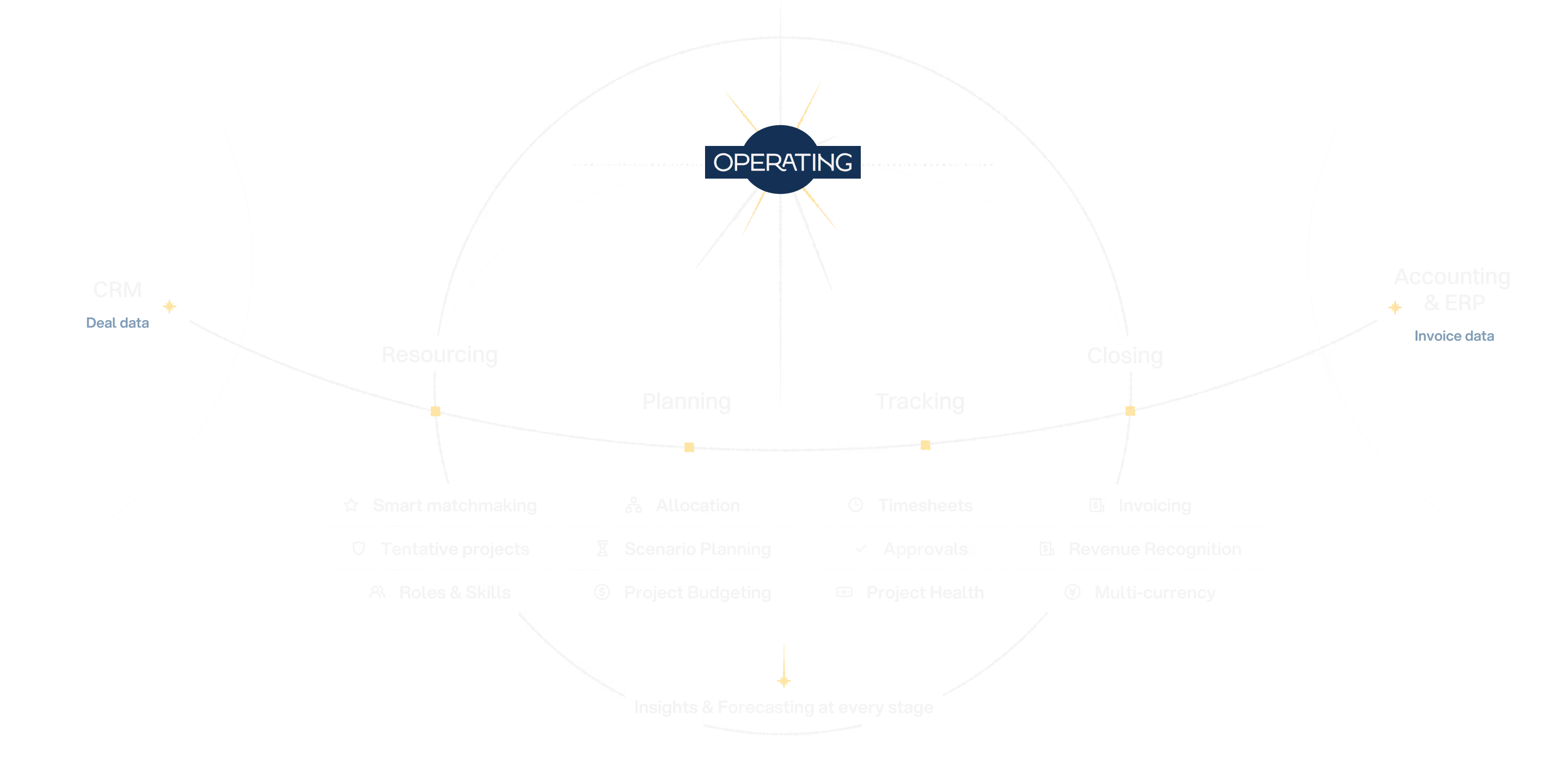
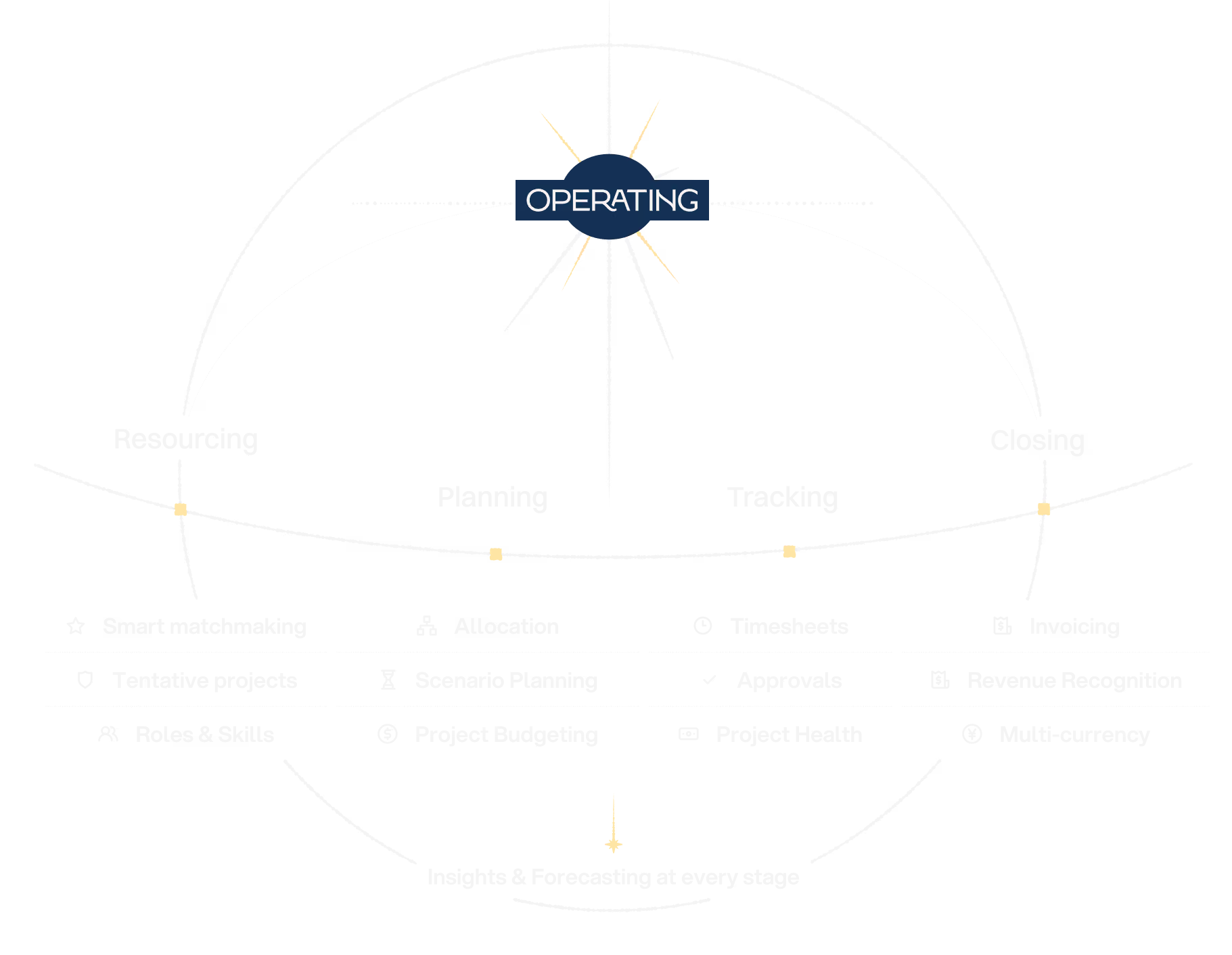
Diagram showing a circular flowchart labeled 'OPERATING' at the top center within a blue star. An arrow points downward from OPERATING to a horizontal line labeled 'Do Work,' followed by arrows pointing to boxes labeled 'Inputs' on the left and 'Outputs' on the right. Below 'Do Work,' there are four boxes labeled 'Perform,' 'Create,' 'Carry Out,' and 'Execute' in a row. Underneath these boxes, the text reads: 'Operations involve the actual tasks and processes to turn inputs into outputs according to a planned method with the required resources.'Diagram illustrating the operating figure of merit with a circle divided horizontally into four quadrants labeled Design, Handoff, Revenue, and Retention linked clockwise around the circle. The center shows the word OPERATING with arrows pointing outward. Inside the circle, a horizontal axis is labeled from -10% to +10%, indicating tolerance bounds on key metrics for successful operation.
White radial lines extending downward on a solid dark blue background.

Get started

Talk with Lauri,
our CEO