


Pricing verified against vendor sources on July 29, 2026.
TL;DR
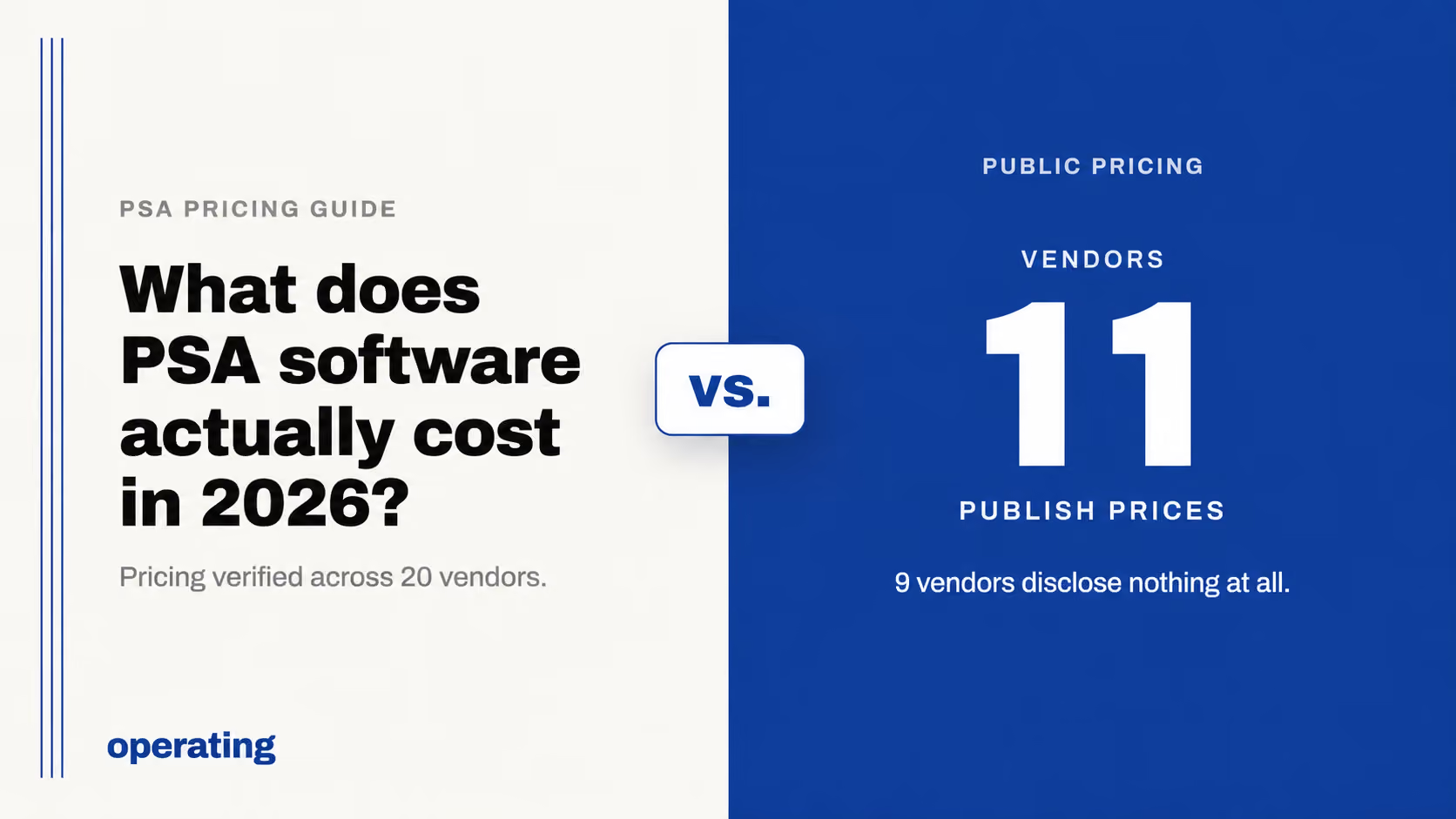
We checked the official pricing page of 20 PSA and resource-management platforms on July 29, 2026. Eleven publish a list price. Nine publish nothing at all.
The findings that matter if you’re building a budget:
- Published list prices for consulting-firm PSA run from $5 to $99 per person per month. The floor is scheduling-only tools (Resource Guru at $5 per person/month on annual billing, Float Starter at $7, Runn Lite at $7). Full-suite platforms that include time tracking, project financials, and invoicing sit between $12 and $69. Rocketlane Enterprise, at $99 per team member/month billed annually, is the highest published figure we found.
- Nine platforms publish no price whatsoever: Kantata, Certinia PS Cloud, Deltek Vantagepoint, Deltek Ajera, NetSuite SuiteProjects Pro, Dayshape, CMap, Parallax, and Precursive. Certinia has no pricing page at all. Parallax’s /pricing URL now redirects to its homepage. For these, budget planning starts with a sales call.
- “Per user” means five different things. Float and Harvest Forecast bill for anyone on the schedule whether or not they ever log in. Projectworks bills for “an active person… irrespective of whether that person logs in or not.” Resource Guru bills for people “whether they log in or not and regardless of their permissions,” plus non-human resources like vehicles. Dayshape bills per resource managed and explicitly excludes report-only users. Ruddr charges only for billable members but enforces a 50% floor. Same headline rate, materially different bill.
- The list price is often not the whole bill. Harvest’s Flex billing adds usage charges for active projects, clients, tasks, and invoicing, and Harvest’s own help centre gives the example of a bill going “from a seats-only $44 to $404 once usage is added.” Rocketlane meters automation runs. Projectworks puts API access in its top tier. Scoro makes multi-entity an add-on.
- Two price increases are documented first-party in the last 24 months. Resource Guru raised prices across every plan effective July 1, 2026. Harvest replaced its plan structure with Teams/Enterprise plus Flex or Unlimited billing.
- Implementation is the least transparent line item in the category. Only two vendors publish anything concrete: Projectworks states onboarding “begins at $1000,” and NetSuite states plainly that “there is also a one-time implementation fee for initial setup” without naming an amount. Every widely circulated implementation multiple we could trace — 1x to 3x first-year licence — comes from a vendor, an implementation partner, or a lead-generation publisher. No independent analyst firm publishes one.
- Practical takeaway. Before you compare rates, get each vendor’s written answer to one question: who exactly counts as a billable seat? Then ask what triggers a charge that isn’t a seat. Those two answers move total cost more than the per-seat number you’re negotiating.
Disclosure: Operating is one of the 20 platforms compared here. We publish our own pricing, we’ve named the firm profiles where other tools are the better choice, and every figure below is sourced to the vendor’s own page, including ours, so you can check our claims the same way you check theirs.
What Is PSA Software?
Professional services automation (PSA) software runs the business side of billable work. Where a project management tool tracks tasks, a PSA tracks the commercial reality underneath them: who is available, what they cost, what they’re billed at, how many hours went where, what that means for project margin, and what gets invoiced at the end of the month.
Who uses it. PSA platforms are bought by consulting firms, digital and creative agencies, IT and engineering services firms, architecture and engineering practices, and professional services teams inside software companies. Inside those firms, the day-to-day users split into four groups: resourcing and staffing managers assigning people to projects, consultants logging time, delivery leads and project managers watching budgets, and finance approving timesheets and generating invoices. Leadership uses the reporting layer — utilization, margin, forecast.
The problems it solves. Most firms arrive at PSA from the same place: a capacity spreadsheet only one person can edit, a separate time tracker, a CRM that nobody connects to delivery planning, and a month-end close held together by exports. That setup fails in predictable ways. Nobody knows who is genuinely free three weeks out. A project looks profitable until expenses land. Time gets logged on Friday from memory, so hours are approximately right and quietly written off at invoicing. Sales sells work the delivery team can’t staff.
Common features. A full PSA typically includes resource planning and capacity forecasting, project staffing with skills and availability matching, project budgets and rate cards, time and expense tracking, timesheet approval workflows, planned-versus-actual reporting, utilization dashboards, project financials and margin reporting, revenue recognition, and invoicing. Around that core sit integrations with CRM (to see pipeline work before it’s won), HRIS (to pull people and approved time off), and finance systems. Newer entrants add AI assistants and, increasingly, agent access to the underlying data.
Where the operational gain comes from. The efficiency case rests on removing the gaps between systems rather than on any single feature. When allocations, logged time, approvals, and invoices live in one place, the reconciliation that used to take a finance team days becomes a report. When a scheduler can see the sales pipeline, tentative projects get staffed before they’re won instead of scrambled after. When consultants see their own allocations on their timesheet, entry takes seconds and happens the same day — which matters because time logged on Friday is a reconstruction, not a record.
What to weigh when evaluating. Beyond feature checklists, four things separate a good fit from an expensive mistake:
- Which of the four modules you actually need. Resource planning, time tracking, financials, and invoicing are sold separately by many vendors. Buying all four when you only need planning is the most common way firms overspend.
- Whether it fits alongside your finance system or replaces it. Firms with statutory accounting requirements — government contracting, indirect rate structures, multi-entity consolidation — usually keep their ERP and need a PSA that integrates cleanly rather than competing.
- How the seat metric maps to your headcount. If you plan around contractors, a bench, or placeholder roles, the seat definition can change your bill by 30% or more at an identical rate.
- What implementation genuinely requires. Self-serve, vendor-led onboarding, and mandatory partner involvement are three very different budgets and timelines.
Research Methodology and Data Sources
Every price in this article was taken from the vendor’s own pricing page, help centre, or official documentation, accessed on July 29, 2026. We fetched each page directly rather than relying on software directories, and we recorded the price string as written, including its billing period and currency.
We treated a figure as published only when it appeared on an official vendor page. Where a vendor’s page showed a plan but no number, or routed to a form, we recorded it as not publicly disclosed rather than substituting an estimate. Several pricing pages calculate figures client-side from a seat-count or billing toggle; where we could recover only one toggle state, we say so in the entry.
Principal sources. Official pricing pages for Operating, Scoro, Productive, Projectworks, Runn, Float, Ruddr, Rocketlane, Resource Guru, Harvest, Harvest Forecast, and BigTime. Official product, licensing, services, and contact pages for Kantata, Certinia, Deltek Vantagepoint, Deltek Ajera, NetSuite SuiteProjects Pro, Dayshape, CMap, Parallax, and Precursive. Vendor help centres for billing mechanics — principally the Harvest Help Center article on pricing plans and the Resource Guru 2026 Pricing FAQ. Full list with URLs and access dates in the Sources section.
Limitations, stated plainly.
- Nine vendors publish no numbers, so their entries describe structure rather than cost. Nothing here should be read as an estimate of what they charge.
- We deliberately excluded the estimated price bands that circulate for gated enterprise platforms in aggregator articles and AI-generated comparisons. We could not trace them to a source, and publishing an unattributable number as a “third-party estimate” would give it a credibility it hasn’t earned.
- Where a pricing page was internally inconsistent — Productive’s rendered figures, Resource Guru’s stale comparison row — we report the inconsistency instead of picking the figure that suits the argument.
- Contract minimums, renewal escalators, and discount levels are commercial terms that mostly don’t appear in public. Treat every published rate as list price before negotiation.
- Two third-party cost claims are quoted in the analysis section with explicit caveats about their provenance. They are context, not evidence.
The information in this article comes from publicly available sources accessed on July 29, 2026. Pricing, features, packages, and commercial terms change, sometimes without notice, and public pages can be incomplete or out of date — we found two that were. Confirm current pricing, capabilities, contract terms, and implementation costs directly with each vendor before you make a decision.
In-Depth PSA Pricing Comparison
Operating publishes three priced tiers, per person per month: Planning at $13 (resourcing, capacity planning, utilization reporting, project budgeting, rate cards, skills, delivery margin forecasting), Plan & Track at $17 (adds timesheets, approval flows, planned versus actual, time balance), and Full Suite at $21 (adds invoice generation, flexible invoicing cycles, multi-company support, expenses). Enterprise, positioned at “100 people and up,” is quoted individually and adds volume discounts, custom contract, SLA, and on-site onboarding. Monthly and yearly billing are offered, with a stated saving of up to 17% on yearly. No minimum seat count is published. Notably, single sign-on, access to all integrations, and full API access are included on every tier rather than gated, and the page states that every plan includes data migration, training, and support — no onboarding fee is published, though custom ERP integration work and process-consulting pilots are quoted separately. Seat definition is disclosed: per-person pricing “counts all users plus anyone scheduled or allocated, even if they don’t sign in,” with scheduled-only seats billed at a lower published rate. A free trial is offered; its length is not stated on the pricing page. Target profile: consulting and professional services firms that want resourcing, delivery, and financial operations in one system, with AI and agent access to the data.
Scoro publishes four tiers in five currencies. In USD, per user per month: Core $19.90 annual / $23.90 monthly, Growth $32.90 / $38.90, Performance $49.90 / $59.90, and Enterprise custom. The minimum is five seats, confirmed in Scoro’s own FAQ. A 14-day free trial requires no credit card. The pricing-relevant detail for consulting buyers: the Planner, timesheet view, cost and profit forecasting, and revenue recognition all sit in Performance, the third tier — so a firm that needs resource planning is comparing against $49.90, not $19.90. Single sign-on, approval flows, time locking, and WIP reporting are Enterprise-only. Multiple entities is a paid add-on, as are the customer portal, Salesforce integration, and Sage Intacct connector. API access exists on all tiers but is rate-limited by tier. Four onboarding packages are named — Self-Onboarding (free, up to 15 people), Assisted, Professional (15–49 people), and Custom (50+) — but no onboarding prices are published, and the FAQ states the free self-onboarding package is “not suitable for teams of 15+ people.” Target profile: agencies and consultancies wanting quote-to-cash breadth in one tool.
Productive publishes Essential, Professional, and a custom Ultimate tier, in USD, with a 14-day free trial and no credit card required. Its pricing page computes figures from a user-count stepper, and at the time of access the page rendered inconsistent values: Essential appeared as both $10 and $12 per user/month depending on the block, with the feature-comparison header showing $9 billed yearly; Professional appeared as $25 and, in the comparison table, $24 billed yearly. We are not publishing a single authoritative Productive rate on that basis — the observed range was $9–$12 (Essential) and $24–$25 (Professional) per user per month, and you should confirm the current figure with the vendor. Structurally, Productive is one of the more generous entry tiers in this comparison: resource planning, time tracking, budgeting, reporting, and API access are all in Essential. Professional adds rate cards, HRIS and invoicing integrations, skills, and approvals. Ultimate adds revenue forecasting, scenario building, multiple subsidiaries, enforced SSO, webhooks, and SCIM provisioning. No minimum seat count and no onboarding fee are stated. No seat definition is published. Target profile: agencies and services firms wanting project profitability in one tool.
Projectworks publishes three tiers, per user per month on annual billing: Build $17, Scale $24, Unleash $41, each carrying a 10% annual saving badge. The minimum is 10 users, “billable in bands of 5.” A 21-day free trial requires no credit card. Projectworks is unusually direct about two things other vendors leave vague. First, the seat definition: “A user is defined as an active person in Projectworks (irrespective of whether that person logs in or not). There is only one type of user.” Second, implementation: “Our onboarding fee begins at $1000, depending on your requirements,” covering data migration and training, varying with organization size and data complexity — making it one of only two vendors in this comparison to publish an implementation number at all. Time tracking, expenses, resourcing, invoicing, forecasting, and margin reporting are in Build. SSO, multi-office, multi-currency, and the main integrations arrive in Scale. API access, direct data connection, multi-entity, purchase orders, and Premium Support are all reserved for Unleash at $41 — relevant if you intend to pipe PSA data into a warehouse or BI tool. Target profile: consultancies wanting time, resourcing, and invoicing without an enterprise implementation.
Runn prices per resource seat rather than per user, which it states explicitly: “Runn’s pricing is resource seat-based, not user-based. Each resource in your planner requires one seat.” Lite is $7 and Standard $11 per resource seat/month; Advanced is “Contact us for custom pricing.” The minimum is 20 resource seats, with volume discounts above 100. Runn distinguishes resources from users — “People and Resources are the same thing. They represent the employees, contractors, or materials you manage in your Planners. Users are the people who have login access” — and, unusually for this category, does not charge extra for placeholders: “All plans include unlimited placeholders.” A 30-day free trial is available on Standard, but trialling Lite or Advanced requires contacting the vendor. Timesheets and API access are not in Lite; they start at Standard. SAML SSO, resource requests, and custom dashboards are Advanced. Implementation and training are listed as “Eligible” rather than included, defined as “you may qualify for a feature or service based on your plan or setup, but it isn’t automatically included” — no fee is published. Target profile: firms that need planning and forecasting depth more than invoicing.
Float publishes Starter at $7 and Pro at $12 per scheduled person per month, with a custom Enterprise tier. There is no seat minimum, and a 30-day trial defaults to Pro with no credit card. The seat rule is the clearest in the category and cuts both ways: “You only pay for team members you add to the Schedule for resourcing,” and separately, “Anyone appearing on the Schedule… whether they need account access or not — is counted as a paid seat.” People who don’t need scheduling can be added as free guests with view access. Placeholders are included at 1x on Starter and 5x on Pro, custom on Enterprise. Project estimates, actuals tracking, estimates-versus-actuals reporting, rate cards, multi-currency, and SSO are all Pro-tier. Enterprise adds dedicated onboarding, rollout and training, priority support, SLAs and custom contracts — no fee published. Float does not include invoicing or revenue recognition, so it is a resource-planning layer rather than a full PSA. Target profile: firms whose problem is scheduling, not month-end close.
Ruddr publishes Team at $14 per user/month billed annually ($17 monthly) and Pro at $24 annually ($30 monthly), with volume pricing quoted on request for large annual Pro workspaces. There is no seat minimum, and a 30-day trial needs no credit card. Ruddr’s billing model is distinctive: “Only pay for billable team members. Non-billable personnel are free.” With one important qualifier — “as long as 50% or more of your total workspace members are billable. If fewer than 50%… Ruddr will charge for 50% of the total workspace members, regardless of their billability.” Time tracking, invoicing, API, and SSO are all in the base Team plan. Resource allocations, rate cards, multicurrency, revenue recognition, project health, CRM integrations, and the SLA are Pro. Two onboarding packages are described by duration — 1 to 3 weeks and 3 to 6 weeks — with no published fee. Ruddr publishes a rare renewal protection: pricing locked for the first 24 months, then no more than one increase per 24-month period capped at 10%. Target profile: services firms wanting straightforward per-billable-head pricing.
Rocketlane publishes four tiers, all billed annually, per team member per month: Essential $19, Standard $49, Premium $69, Enterprise $99. The first three carry a five-member minimum. No monthly rate is published anywhere on the page. A 14-day trial is available, business email required, and Premium and Enterprise route to sales. Implementation is explicitly excluded from the plans: “Implementation packages are not directly included in the plans and will be charged extra based on the scope and onboarding services required” — amount not disclosed. For a consulting-firm buyer the tier fences matter enormously: resource planning, capacity management, utilization tracking, project budgeting, rate cards, margins, revenue recognition, and invoicing all begin at Premium ($69). Automation is metered at 50, 200, and 500 runs per user per month before Enterprise’s unlimited. An AI Fills add-on is $29 per user/month. SAML and role-based access control are Enterprise. Target profile: firms whose delivery model centres on customer onboarding projects with a client portal.
Resource Guru raised prices across every plan effective July 1, 2026, documented in its own 2026 Pricing FAQ. Current annual rates per person/month: Grasshopper $5, Blackbelt $8, Master $12, with monthly rates of $6, $9.60, and $14.40. Non-human resources are billed separately at $2.50, $4, and $6 each on annual. Enterprise is quoted. There is no seat minimum and no setup fee — “no setup fees or cancellation charges.” The seat rule is explicit: “you will be charged for people whether they log in or not and regardless of their permissions,” and the help centre gives a worked example where 3 schedulers, 10 view-only users, and 5 vehicles means paying for 13 people and 5 other resources. Free placeholders are capped at 1, 5, and 10 by tier; extras bill at the per-person rate. Timesheets, budget tracking, and project rates start at Blackbelt; SSO, approval workflow, and phone support at Master; the Enterprise API at Enterprise. A trial exists but its length is not published. Data-quality note: Resource Guru’s pricing page still carried a stale $4.16 figure in its comparison header and meta description at the time of access, and the new monthly rates appear only in the help-centre FAQ. Target profile: teams that need scheduling and nothing heavier.
Harvest and Harvest Forecast are billed as two separate products. Harvest publishes Free ($0, one seat, two projects), Teams at $9 per seat/month billed annually ($11 monthly), Enterprise at $14 annually ($17.50 monthly), and a custom Enterprise Plus. Forecast is a single plan at $5 per person/month billed annually ($6.25 monthly). A 30-day trial needs no credit card; there is no seat minimum. Two mechanics deserve close reading. First, every paid Harvest tier is described as “starting from,” because Harvest now bills either Flex — “a per-seat rate plus usage-based charges calculated on your prior billing period’s activity: active projects, active clients, active tasks, and invoicing” — or Unlimited, a fixed usage fee. Harvest’s own help centre explains that usage charges “first appear at your renewal — not at sign-up. This is why a bill can jump (e.g. from a seats-only $44 to $404 once usage is added.)” Second, Forecast’s seat rule counts both schedulers and the scheduled: “This includes people who have not been invited to sign in to the account.” Harvest also notes its post-trial checkout “pre-selects Enterprise + Annual by default.” Target profile: teams wanting time tracking and light scheduling, with the Flex model understood before signature.
BigTime publishes one number: “BigTime Essentials starts at $20 per user/month.” Advanced, Premier, and Enterprise are not publicly disclosed, and every plan CTA is “Request Demo” or “Speak with an Expert.” No free trial is offered, so a demo is effectively required. No annual rate, no minimum seats, and no contract length are published. Structurally, Essentials covers time, expenses, invoicing, portfolio management, rate management, approvals, SSO, and QuickBooks and HubSpot integrations. Advanced adds multi-currency expenses, custom reports, Salesforce and Jira, and marks DCAA compliance as a paid extra. API integrations arrive at Premier, and resource management is a separate module rather than a tier feature — as are BigTime Quotes and Data Hub, none of them priced publicly. Target profile: firms wanting time-and-billing depth, including government-contracting compliance, and comfortable buying through sales.
Kantata publishes no list price. Its pricing page is a request form: “Every services business is unique, so your pricing should be too. We tailor plans based on your company size, goals, and the way your team works.” No free trial. Implementation is confirmed as a separately priced line item in Kantata’s own Professional Services Addendum, which defines professional services as “consulting, design, implementation, configuration, training and other services” priced per statement of work, with out-of-pocket expenses reimbursed on top. The addendum also confirms subscription fees are committed for a term set out in the order form. Minimum seats, contract length, and fee amounts: not publicly disclosed. Target profile: mid-market to enterprise services organizations buying through a sales process.
Certinia PS Cloud has no pricing page at all. The product page’s only call to action is “Request a Demo,” and the contact page says “Whether you’re curious about our products, pricing, or anything else, our team is eager to assist you.” Certinia’s user licensing page states that “Anyone accessing Certinia functionality or intellectual property (or Salesforce functionality or intellectual property through Certinia) — whether directly or indirectly — must have a paid user subscription.” Implementation is routed to third parties: “We work with a trusted network of Certinia certified partners.” Prices, minimums, and implementation fees: not publicly disclosed. Because the product is Salesforce-native, the platform dependency belongs in any budget model — confirm with Certinia and Salesforce which licences your user population requires, since Certinia’s public pages do not spell this out. Target profile: enterprise services organizations already committed to Salesforce.
Deltek Vantagepoint and Deltek Ajera publish no prices; there is no /pricing path on deltek.com. Both route to “Request a Demo.” Deltek’s professional services page names three implementation tiers — Quick Launch, Power Launch, and Tailored — with no amounts: “Whether you need speed, depth, or full customization, we offer implementation options built for your business.” Licensing metric, minimum seats, contract length, and fees: not publicly disclosed. One correction worth making, because it circulates: legacy pages suggesting a free Vantagepoint or Ajera trial redirect to current pages that offer none. Target profile: architecture, engineering, and consulting firms needing project accounting and, for Vantagepoint, government-contract compliance depth.
NetSuite SuiteProjects Pro is sold as an add-on module to the NetSuite platform, and NetSuite publishes the cost structure without any figures: “Users subscribe to NetSuite for an annual license fee. Your license is made up of three main components: core platform, optional modules and the number of users. There is also a one-time implementation fee for initial setup.” Module fees “also vary.” That makes NetSuite the only vendor in this comparison to state on its own site that a mandatory one-time implementation fee exists. Product tours and sales contact only, no self-serve trial. Amounts, minimums, and contract length: not publicly disclosed. Target profile: firms consolidating services delivery into a full ERP.
Dayshape publishes no price but is unusually specific about its metric: “Licenses are priced per resource managed in the platform, and there is a one-off fee for implementations. There is optional product functionality, bespoke infrastructure, and additional services add-ons available.” Its definition of a licensed resource is the most buyer-favourable we found: “any person with projects assigned to their Dayshape schedule during the license year, or any person specifically requested to be booked on projects… For example, Resource Managers that are involved in the scheduling of work but are not billable resources will not incur a fee, nor will other users, such as those who need access to see reports.” Licensing runs on an annual “license year” with mid-term add-ons co-terminating at the anniversary. Demo only. Amounts: not publicly disclosed. Target profile: large accounting and professional services firms with complex, AI-assisted scheduling needs.
CMap publishes four tiers per industry vertical — Starter, Growth, Pro, Enterprise — with a full feature matrix and no prices on any tier; every CTA is “Book a demo.” Optional add-ons are listed as MS Teams, MS Outlook, CMap Documents, CMap Portfolios, and SSO, with footnote markers reading “* = additional cost.” Onboarding comes in two published methodologies, Quick-start and Phased, with optional Hypercare Essential and Hypercare Enhanced add-ons, and the FAQ confirms scope is set by a consultant: “we’ll bring in one of our consultants to scope the onboarding plan.” No fee amounts. Target profile: architecture, engineering, consulting, life sciences, and accounting firms wanting a vertical-specific fit.
Parallax no longer has a pricing page — getparallax.com/pricing redirects to the homepage, although the navigation still shows a pricing link. Only calls to action are “Get a Demo.” Prices, metric, minimums, and implementation fees: not publicly disclosed. Target profile: digital services firms focused on forecasting and financial modelling alongside an existing stack.
Precursive publishes no prices but discloses more commercial terms than any other gated vendor. Three named plans (Project Management, Resource Management, Revenue Management) with feature lists only. From its pricing FAQ: billing is “billed annually, charged per user per month”; the minimum is 30 users (“Something to grow into if you don’t need that many straight away!”); a Salesforce licence is required — asked directly whether one is needed, the answer is “Yes. We are 100% native on Salesforce, we can assist in bringing you onto the platform”; and a trial is conditional, arranged by contacting support. NetSuite, Xero, and QuickBooks integrations require a third-party connector, Breadwinner. Two “* = additional cost” markers appear in the plan matrix. Target profile: Salesforce-first services organizations above 30 users.
Comparison Table 1
All figures as published on official vendor pages, accessed July 29, 2026. Currency as shown by the vendor; all figures below are USD.
| Platform | Starting Price | Pricing Model | Free Trial | Key Features at Entry Tier | Best For | Pricing Transparency |
|---|---|---|---|---|---|---|
| Operating | $13 per person/mo | Per person/month, 3 tiers + Enterprise | Yes, length not published | Resource planning, staffing, budgets, rate cards, utilization, SSO, all integrations, full API | Consulting firms wanting planning through invoicing in one system | Full list price published |
| Productive | $9–$12 per user/mo (page rendered inconsistently) | Per user/month, 3 tiers | Yes, 14 days | Resource planning, time tracking, budgeting, reporting, API | Agencies focused on project profitability | Published but page inconsistent |
| Projectworks | $17 per user/mo (annual) | Per user/month, min 10 users in bands of 5 | Yes, 21 days | Time, expenses, resourcing, invoicing, forecasting, margin reporting | Consultancies wanting full workflow without enterprise implementation | Full list price + onboarding floor published |
| Scoro | $19.90 per user/mo (annual) | Per user/month, min 5 seats, 4 tiers | Yes, 14 days | Quote-to-cash breadth; resource planner only from tier 3 | Agencies wanting one tool end to end | Full list price published; onboarding fees not |
| Ruddr | $14 per user/mo (annual) | Per billable member/month, 50% floor | Yes, 30 days | Time, invoicing, API, SSO | Firms wanting to pay only for billable heads | Full list price + renewal cap published |
| Rocketlane | $19 per team member/mo (annual) | Per team member/month, min 5, 4 tiers | Yes, 14 days | Projects, time tracking, timesheets, client portal; resourcing and financials from Premium | Firms delivering customer-onboarding projects | List price published, annual only |
| Runn | $7 per resource seat/mo | Per resource seat, min 20 seats | Yes, 30 days on Standard only | Planning and forecasting; timesheets from tier 2 | Planning-led firms not needing invoicing | Two of three tiers published |
| Float | $7 per scheduled person/mo | Per scheduled person, guests free | Yes, 30 days | Scheduling, capacity; actuals and rate cards from Pro | Firms whose problem is scheduling only | Two of three tiers published |
| Resource Guru | $5 per person/mo (annual) | Per person + per non-human resource | Yes, length not published | Scheduling; timesheets from tier 2 | Small teams needing scheduling only | Published; page partly stale |
| Harvest + Forecast | $9 + $5 per seat/mo (annual) | Per seat, plus usage-based Flex charges | Yes, 30 days | Time tracking, invoicing; scheduling via Forecast | Teams wanting time tracking, with Flex understood | Published, but usage charges variable |
| BigTime | From $20 per user/mo | Per user/month, 4 tiers | No | Time, expenses, invoicing, portfolio, SSO; resourcing is a separate module | Firms needing time-and-billing depth incl. DCAA | Entry tier only |
| Kantata | Not publicly disclosed | Tailored quote | No | Not applicable | Mid-market to enterprise services organizations | Gated |
| Certinia PS Cloud | Not publicly disclosed | Per user subscription, Salesforce-native | Demo only | Not applicable | Enterprise Salesforce-committed firms | Gated, no pricing page exists |
| Deltek Vantagepoint | Not publicly disclosed | Quote | Demo only | Not applicable | A&E and consulting firms needing project accounting | Gated |
| Deltek Ajera | Not publicly disclosed | Quote | Demo only | Not applicable | Smaller A&E practices | Gated |
| NetSuite SuiteProjects Pro | Not publicly disclosed | Platform + modules + users, annual | Product tour only | Not applicable | Firms consolidating into full ERP | Gated; cost structure published, no figures |
| Dayshape | Not publicly disclosed | Per resource managed | Demo only | Not applicable | Large accounting and PS firms | Gated; metric published |
| CMap | Not publicly disclosed | Quote by user count + add-ons | Demo only | Not applicable | Vertical-specific A&E, consulting, accounting | Gated; 4 tiers shown unpriced |
| Parallax | Not publicly disclosed | Quote | Demo only | Not applicable | Digital services forecasting | Gated; pricing page removed |
| Precursive | Not publicly disclosed | Per user/month, billed annually, min 30 users | Conditional | Not applicable | Salesforce-first firms above 30 users | Gated; terms published, no price |
Read the “Starting Price” column with care. It reflects each vendor’s cheapest published tier, and those tiers contain very different things. Float at $7 and Operating at $13 are not comparable products — Float’s entry tier does not track actuals or produce invoices. Scoro at $19.90 and Rocketlane at $19 look similar until you notice that neither entry tier includes the resource planning most consulting firms are shopping for; in Scoro that arrives at $49.90 and in Rocketlane at $69. The honest way to use this table is to identify the cheapest tier that contains the capability you actually need, then compare those numbers.
Comparison Table 1
All figures as published on official vendor pages, accessed July 29, 2026. Currency as shown by the vendor; all figures below are USD.
| Platform | Who counts as a billable seat (as published) | Minimum | Implementation fee (published) |
|---|---|---|---|
| Operating | “All users plus anyone scheduled or allocated, even if they don’t sign in — no one is counted twice.” Scheduled-only seats bill at a lower rate | None stated | None; data migration, training, and support stated as included |
| Projectworks | “An active person in Projectworks (irrespective of whether that person logs in or not). There is only one type of user.” | 10 users, bands of 5 | “Begins at $1000, depending on your requirements” |
| Float | “Anyone appearing on the Schedule… whether they need account access or not.” Unscheduled people are free guests | None stated | Not publicly disclosed |
| Harvest Forecast | “Both the people who schedule and the people who are being scheduled… includes people who have not been invited to sign in” | None stated | Not publicly disclosed |
| Resource Guru | “People whether they log in or not and regardless of their permissions,” plus all non-human resources; placeholders above the free allowance | None stated | None — “no setup fees or cancellation charges” |
| Runn | Per resource seat: employees, contractors, or materials in the planner. Login users are separate. Unlimited placeholders included | 20 resource seats | Not publicly disclosed; listed as “Eligible” |
| Dayshape | Per resource managed; report-only users and non-billable resource managers “will not incur a fee” | Not publicly disclosed | “A one-off fee for implementations,” amount not disclosed |
| Ruddr | Billable members only — but a 50% floor applies: below 50% billable, “Ruddr will charge for 50% of the total workspace members” | None stated | Not publicly disclosed; two packages by duration |
| Rocketlane | Per team member; customer members unlimited. Whether partners consume seats is not stated | 5 (first three tiers) | Charged extra, “based on the scope”; amount not disclosed |
| Scoro | Not publicly disclosed | 5 seats | Four packages named; amounts not disclosed |
| Productive | Not publicly disclosed | Not stated | None mentioned |
| Harvest | Not publicly disclosed | None | Not publicly disclosed |
| BigTime | Not publicly disclosed | Not stated | Not publicly disclosed |
| Precursive | Per user/month, billed annually | 30 users | Not publicly disclosed |
| Kantata / Certinia / Deltek (both) / NetSuite / CMap / Parallax | Not publicly disclosed | Not publicly disclosed | Kantata: per SOW. NetSuite: one-time fee confirmed. Deltek: three tiers named. CMap: two methodologies. All amounts undisclosed |
The vendors that publish a seat definition tend to publish an unfavourable one. That is a mark of candour rather than a reason to avoid them. Float, Projectworks, Resource Guru, and Harvest Forecast all state plainly that non-logging people cost money. Five vendors that publish list prices say nothing at all about it. If your firm plans around a bench, contractor pool, or placeholder roles, silence is the answer you need to chase in writing.
Analysis and Recommendations
Which platforms look most affordable. On published list price alone, the cheapest options are the scheduling-only tools: Resource Guru from $5, Float from $7, and Runn from $7. But affordability has to be measured against the job. None of those three produce invoices, and Runn and Resource Guru put timesheets on the second tier. For a firm that needs planning, time, financials, and invoicing in one place, the lowest published full-suite figures are Operating's Full Suite at $21 per person/month, Projectworks Scale at $24, and Ruddr Pro at $24 — with Harvest Teams plus Forecast at a combined $14 per person/month if you're willing to run two products and accept Flex usage billing.
Which offer the clearest pricing. Projectworks publishes the most complete commercial picture in the category: three prices, a stated minimum, a seat definition, and an implementation floor. Ruddr is close behind, and adds a contractual renewal cap — pricing locked 24 months, then no more than one 10% increase per 24-month period — which almost nobody else publishes. Operating, Scoro, Float, Runn, Resource Guru, and Harvest all publish list prices. At the other end, Certinia has no pricing page and Parallax has removed the one it had.
Where the strongest value tends to sit. Value depends on which tier contains what you need, and this is where headline rates mislead most. Three examples from the research. Scoro's entry tier is $19.90, but its resource planner and revenue recognition are in the $49.90 tier. Rocketlane's entry tier is $19, but resource planning and all project financials start at $69. Projectworks' entry tier includes resourcing and invoicing at $17, but API access and multi-entity are $41. Meanwhile Productive and Operating both put API access in the entry tier, and Ruddr includes API, SSO, time tracking, and invoicing in its $14 base plan. If integration or data extraction matters to you, that fencing is worth more than a few dollars of seat rate.
Small firms. Below roughly 20 people, the full-suite platforms are often more system than the problem requires — and one of the more useful things we found is that several vendors say so implicitly through their minimums. Runn starts at 20 resource seats, Precursive at 30 users, Projectworks at 10, Scoro and Rocketlane at 5. For a small team whose real pain is "who is free next month," Float, Resource Guru, or Runn Lite will answer it for under $10 per person. Adding invoicing and revenue recognition to that stack is a decision to make when month-end genuinely hurts, not before.
Midsize firms. Between roughly 30 and 200 people is where full-suite PSA earns its cost, because it's the size at which spreadsheet coordination stops scaling and the write-offs become visible. Operating, Projectworks, Ruddr, Scoro Performance, Productive Professional, and BigTime all target this band. The deciding factors are usually the seat metric, whether resource planning sits in a tier you can afford, and whether implementation is self-serve or scoped by a consultant.
Enterprise. Above roughly 300 people, or wherever statutory accounting, multi-entity consolidation, or government-contract compliance is in scope, the gated platforms exist for real reasons. Deltek Vantagepoint's project accounting and compliance depth, Certinia's Salesforce-native architecture, NetSuite's single-ERP consolidation, and Dayshape's scheduling engine for large accounting firms each solve problems that a mid-market PSA does not. If your requirements include DCAA compliance, indirect rate structures, or consolidating delivery into an existing ERP, a lighter platform is the wrong tool at any price — and no amount of published pricing transparency changes that.
What inflates total cost of ownership. Six drivers, all evidenced above rather than inferred:
- Seat definitions that count people who never log in. At a 50-person firm planning around 15 contractors, this is the difference between 50 and 65 paid seats at an identical rate.
- Capability sitting two tiers above the entry price. Resource planning at Scoro and Rocketlane, timesheets at Runn and Resource Guru, API access at Projectworks and BigTime.
- Usage-based charges layered on seats. Harvest Flex is the clearest documented case, and Harvest's own help centre supplies the illustration: a bill going from $44 to $404 once usage is counted, first appearing at renewal rather than sign-up.
- Metered automation. Rocketlane's 50 to 500 automation runs per user per month, before Enterprise.
- Add-ons for things you assumed were included. Multi-entity at Scoro. Teams, Outlook, documents, and SSO at CMap. Non-human resources and extra placeholders at Resource Guru.
- Implementation and partner scope. The line item nobody publishes.
On implementation multiples, a caution. You will see the claim that PSA and ERP implementation costs 1x to 3x the first-year licence fee. It is real as a published statement — ERP Research states that "implementation — consulting, data migration, and training — usually runs 1x to 3x the first-year software fee" — but it is presented as a rule of thumb with no dataset, and the same page elsewhere says the median is 1.5x to 2x. For NetSuite specifically, the 1x–2x figure that circulates traces to a single implementation partner, while three other named partners put it at 1.5x–3x. We found no independent analyst firm publishing an implementation-to-licence multiple at all. Use these as a reason to demand a written statement of work, not as a budget.
On enterprise deal benchmarks, a stronger caution. The most-cited public figure for Deltek Vantagepoint comes from VendorBenchmark, which reports 100–300 user quotes of $120,000–$240,000 annually negotiated to $90,000–$175,000, and Vision-to-Vantagepoint migrations landing 30–50% above prior spend. Before you plan against it: VendorBenchmark's own methodology page describes its output as "a calibrated market reference model… not an archive of other people's contracts," its customer-contributed pool is described as empty, the page contains two internal contradictions, and Vendr's separate estimate for a smaller user band implies 10–20% typical discounts rather than 22–28%. These are modelled estimates from commercially interested publishers. Quote them as such or not at all.
Why the cheapest option often isn't the cheapest. Three mechanisms, in order of how often they bite. First, the tier trap: a $19.90 seat becomes a $49.90 seat the moment you need the module you were shopping for, and you've now negotiated the wrong number. Second, the seat trap: two vendors at $12 can differ 30% on the invoice because one counts your bench and the other doesn't. Third, the integration trap: a cheap platform that fences API access forces either a tier upgrade or a manual export process whose cost lands on your ops team's calendar rather than your software budget. Run the arithmetic on the tier that contains what you need, at the seat count the vendor will actually bill, with data access included. That number is the comparison.
Compare This Against Your Own Numbers
If it's useful, take the two questions from this article into your next vendor call: who exactly counts as a billable seat, and what can generate a charge that isn't a seat. Get both in writing before you compare rates.
Operating's own pricing is on our pricing page — three tiers, published rates, with data migration, training, support, SSO, all integrations, and full API access included on every plan. You can start a free trial without talking to anyone, or book a call if you'd rather have someone walk your firm's numbers with you and tell you honestly whether we're the right fit.
If you're earlier in the process, our breakdown of the best PSA tools in 2026 covers capability fit rather than cost, and PSA vs ERP is worth ten minutes if you're weighing a module inside your finance system against a dedicated platform. If your shortlist runs toward the agency-management end of the category, we did the same pricing teardown on Productive.io and its alternatives, including which capabilities sit above the tier you'd be quoted.
Frequently Asked Questions
1. What is PSA software? Professional services automation software runs the commercial side of billable work: resource planning and capacity forecasting, project staffing, time and expense tracking, project budgets and rate cards, utilization and margin reporting, revenue recognition, and invoicing. It sits between the project management tools that track tasks and the finance system that keeps the books, and it exists because the connection between those two is where consulting firms lose money — hours logged late, projects that look profitable until expenses land, capacity nobody can see three weeks out.
2. How much does PSA software typically cost? Based on published list prices verified on July 29, 2026, the range for consulting-firm software in this category runs from $5 to $99 per person per month. Scheduling-only tools start at $5 to $7 (Resource Guru, Float, Runn). Full-suite platforms with time tracking, financials, and invoicing publish rates from $12 to $69, with most mid-market options landing between $17 and $49 for the tier that actually contains resource planning. Nine of the 20 platforms we checked publish no price at all, so for those, budget planning begins with a sales conversation.
3. What affects the price of a PSA platform? Four things, in roughly descending order of impact. The seat metric — whether you pay for people who never log in. The tier your required capability sits in, since resource planning, timesheets, and API access are frequently fenced above the entry price. Add-ons and usage charges, from multi-entity fees to metered automation runs to usage-based billing on active projects and clients. And implementation, which is the least transparent line item in the category and can exceed the first year's licence cost on enterprise platforms.
4. Is PSA software priced per user? Usually, but "user" is defined inconsistently, and this is the most expensive detail buyers overlook. Float and Harvest Forecast bill for anyone on the schedule, including people never invited to sign in. Projectworks bills for any active person "irrespective of whether that person logs in or not." Resource Guru bills for people regardless of permissions, plus non-human resources like vehicles. Runn bills per resource seat, which includes contractors and materials, but includes unlimited placeholders free. Dayshape bills per resource managed and excludes report-only users. Ruddr bills only for billable members, subject to a 50% floor. Operating counts all users plus anyone scheduled or allocated, with scheduled-only seats at a lower rate. Ask for the definition in writing.
5. Are implementation fees usually included? Rarely, and rarely disclosed. Of the 20 platforms we checked, only Projectworks publishes an amount — onboarding "begins at $1000" — and only NetSuite states outright that a mandatory one-time implementation fee exists without naming it. Resource Guru says there are no setup fees. Operating states that data migration, training, and support are included on every plan. Everyone else either doesn't mention implementation or names packages without prices: Scoro has four onboarding tiers, Ruddr two, CMap two methodologies plus Hypercare add-ons, Deltek three implementation tiers, and Kantata sells it as a separate statement of work. Assume it is extra until a contract says otherwise.
6. Do PSA providers offer free trials? The transparent-pricing group generally does: 30 days at Float, Runn (Standard plan only), Ruddr, Harvest, and Harvest Forecast; 21 days at Projectworks; 14 days at Scoro, Productive, and Rocketlane. Operating and Resource Guru offer trials without publishing a length. The gated group generally doesn't — Kantata, Certinia, both Deltek products, Dayshape, CMap, Parallax, and BigTime all route to a demo instead, and Precursive offers a trial only on request. If self-serve evaluation matters to your process, that split is itself a shortlist filter.
7. What is the difference between PSA and project management software? Project management software tracks work: tasks, dependencies, deadlines, collaboration. PSA tracks the economics of that work: who is available and at what cost, what the client is billed, how planned hours compare to actual ones, what the project margin is, and what gets invoiced. A firm can run projects in Asana or Jira and still have no idea whether last quarter was profitable. PSA answers the second question, which is why buyers usually arrive after outgrowing a project tool plus a time tracker plus a capacity spreadsheet.
8. Is PSA software suitable for small businesses? Sometimes, and the vendors' own minimums are a useful signal. Runn starts at 20 resource seats, Precursive at 30 users, Projectworks at 10, Scoro and Rocketlane at 5. Below roughly 20 people, a scheduling tool at $5 to $12 per person plus a time tracker usually answers the real problem, which is visibility into who is free. The case for a full PSA strengthens when month-end close consumes real finance time, when write-offs become material, or when nobody can produce a reliable forecast — not at a particular headcount.
9. How can companies compare total cost of ownership? Build the model on the tier that contains what you need, not the entry tier, and on the seat count the vendor will actually bill rather than your headcount. Then add the items that are separately priced: implementation, premium support, add-on modules, multi-entity, API or data-access upgrades, and any usage-based component. For enterprise platforms where nothing is published, treat implementation as a material multiple of first-year licence and demand a scoped statement of work before signing. As a worked illustration using published list prices only — 50 people, three years, no discounts, feature parity explicitly not assumed — Operating Full Suite is $36,000, Harvest Teams plus Forecast is $25,200 before Flex usage charges, Projectworks Scale is $44,200 including its $1,000 onboarding floor, Ruddr Pro is $43,200, Scoro Performance is $89,820, and Rocketlane Premium is $124,200. Those figures compare very different capability sets and exclude every undisclosed cost, which is exactly why the model matters more than the ranking.
10. What questions should buyers ask before signing a PSA contract? Ten, each pointed at a documented trap: Who counts as a billable seat — schedulers, scheduled people, contractors, placeholders, report-only users, non-human resources? If someone never logs in, do we pay for them? Are placeholders free, capped, or charged? Can we get prorated credits when seats are removed mid-term? Which integrations, API endpoints, and data-export rights are in our quoted tier? What happens when we hit an automation or usage limit — do we get charged or does it stop? What implementation work is mandatory versus optional, and can we see the statement of work? Can we self-implement, or is a partner effectively required? What support is standard, and what costs extra? And how does renewal pricing work — is there a cap on increases, and can the pricing model itself change?
Sources
All URLs accessed July 29, 2026.
Official vendor pricing pages
- “Pricing — Operating PSA for Consulting Firms,” Operating
- “Plans & Pricing | Scoro,” Scoro
- “Pricing & Plans — Productive,” Productive
- “Projectworks Pricing | Plans for Consulting Time Tracking, Resourcing & Invoicing,” Projectworks
- “Pricing for Better Resource Management | Runn,” Runn
- “Float Pricing | Float.com,” Float
- “Ruddr — Pricing,” Ruddr
- “Rocketlane Pricing Plans | The Best Enterprise PSA Platform,” Rocketlane
- “Resource Guru Pricing,” Resource Guru
- “Time Management & Invoicing at Cost Effective Pricing | Harvest,” Harvest
- “Time Planning Software Pricing — Harvest Forecast,” Harvest
- “Pricing — Professional Services Automation Software,” BigTime
- “Request Pricing | Kantata,” Kantata
- “Pricing,” Dayshape
- “CMap | Architects & Engineers Plans & Pricing,” CMap
- “PSA on Salesforce | Precursive,” Precursive
Official vendor help centres, documentation, and terms
- “Information About Pricing Plans,” Harvest Help Center — Source of the Flex billing description and the $44-to-$404 example.
- “2026 Pricing FAQ,” Resource Guru Help Center — Edited July 15, 2026; source of the July 1, 2026 price-change table.
- “How Much Does It Cost?,” Resource Guru Help Center — Edited July 1, 2026; source of the seat-counting example.
- “Pricing and Plans,” Float Support
- “Professional Services Addendum | Kantata,” Kantata
- “User Licensing | Certinia,” Certinia
- “Professional Services Automation,” NetSuite — Source of the licence-component and one-time implementation-fee statement.
- “NetSuite Modules,” NetSuite
- “Professional Services,” Deltek — Covers Quick Launch, Power Launch, and Tailored implementation tiers.
- “CMap | Onboarding,” CMap
Official vendor product pages
Used to confirm the absence of published pricing.
- “Professional Services Cloud for Salesforce | Certinia,” Certinia
- “Deltek Vantagepoint: ERP for A&E and Consulting Firms | Deltek,” Deltek
- “Ajera: Project Management & Accounting Software for A&E | Deltek,” Deltek
- “NetSuite SuiteProjects Pro | NetSuite,” NetSuite
- “Parallax | Resource Planning Software for Professional Services,” Parallax — The
/pricingpath redirects to this page.
Third-party sources
Used for context only and flagged as such in the analysis.
- “Deltek Pricing 2026: What Enterprises Actually Pay,” VendorBenchmark LLC — Updated April 2026. See also the VendorBenchmark methodology statement, which describes its output as “a calibrated market reference model … not an archive of other people’s contracts.”
- “Deltek Software Pricing & Plans 2026: See Your Cost,” Vendr
- “ERP Implementation Cost Breakdown 2026 | What You Will Really Pay,” ERP Research — Last reviewed July 24, 2026.
- “Deltek Vantagepoint Pricing,” TrustRadius — Confirms that no pricing plans are listed.


