.avif)
Quick summary: A project tracking tool for professional services compares budgeted, planned, and spent hours and dollars across a client portfolio, and in this context is usually called a professional services automation platform. It needs flexible billing types, several revenue recognition methods, and recurring or custom billing cycles, because consulting firms mix hourly and fixed-price work. Project managers, operations leaders, finance, and resource managers all use it; one team found $25,000 of mistakenly unbilled work in a single month across roughly 100 consultants.
Professional services firms depend on predictable delivery. Whether you run a consulting practice, an IT services team, or a digital agency, you need a clear view of how projects are progressing against the plan. A project tracking tool provides that visibility. It focuses on budgeted, planned, and spent hours (and dollars), how phases are progressing, and whether projects are staying within the expected time and cost boundaries.
Most firms already track this information somewhere, often in a mix of spreadsheets, timesheets, and disconnected tools. A project tracking platform brings it together so project managers and operations leaders can see the real picture without manual work. This helps the companies have better oversight on all of the projects, making decision making easier. A project tracking platform is something that's often called a professional services automation (PSA) platform in this context.
What Project Tracking Covers in Professional Services
Budgeted, Planned, and Spent Hours
Client projects in consulting are usually scoped around hours or it it's a fixed price project; a fixed chunk of money. A project tracking tool lets you compare the baseline budget to the delivery plan and to the hours actually spent. When these numbers drift, the tool highlights where and why.
Typical views include:
- Budgeted revenue vs. actualized revenue vs. invoiced revenue
- Budgeted hours versus planned hours
- Planned versus spent hours
- Remaining hours per phase, team member, or skill group
- Overruns or underutilization within the week or sprint
Consulting teams rely heavily on these views because even small variances can impact utilization, margins, and client expectations. This can get pretty tricky quite fast. Unfortunately, a professional services firm often has different types of billing models, e.g. per hour and fixed price and revenue is recognized differently over different projects. A good tool has flexible billing type options, support for revenue differnet recognition methods, and if the tool has invoicing, it should also acmmodate for recurring and custom billing cycles.
Burnup and Delivery Pace
Most professional services projects follow a predictable rhythm. A burnup chart shows whether the team is keeping pace with the original plan. This is particularly useful in consulting where project phases often stack tightly and delays in one phase create downstream pressure.
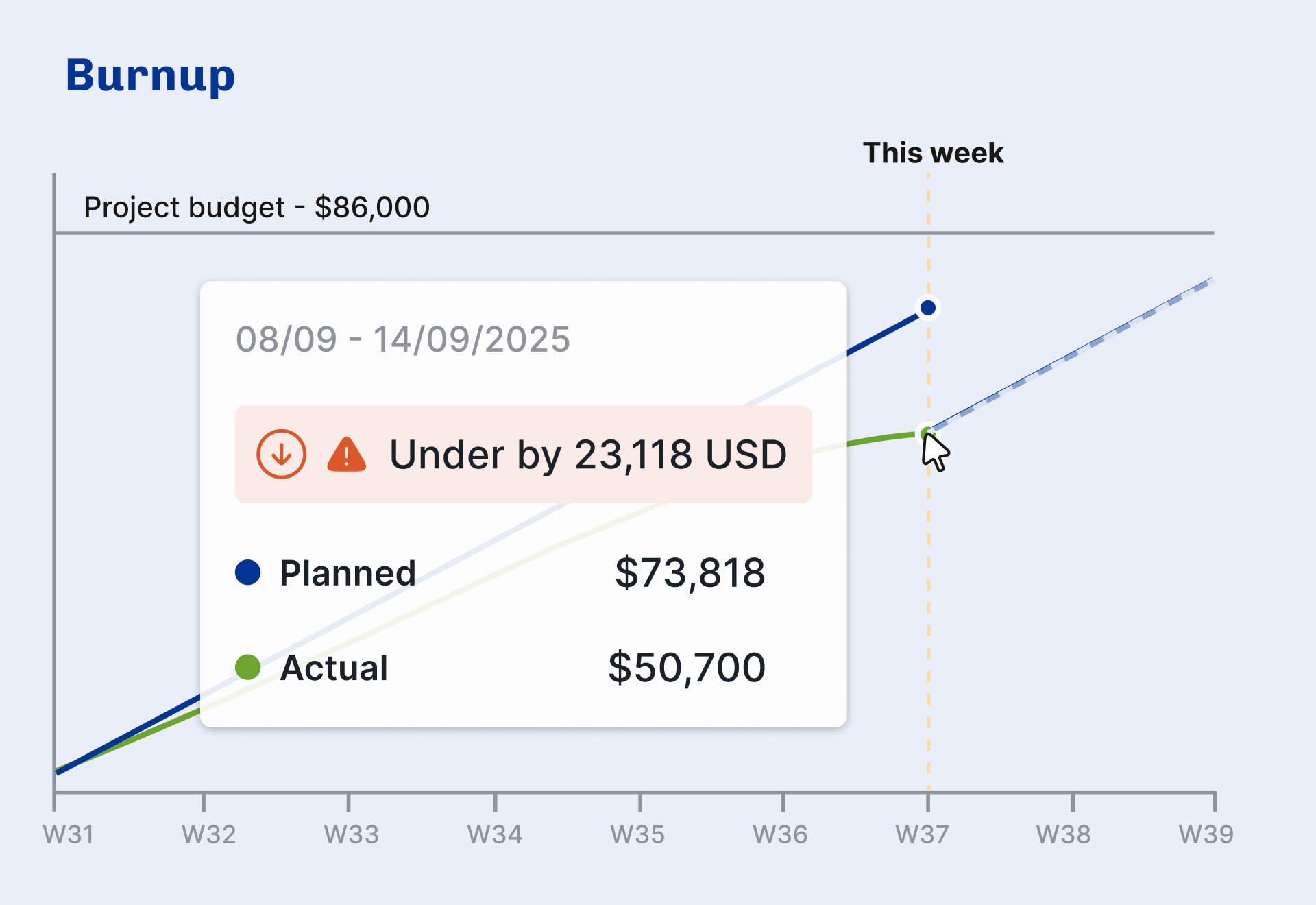
Burnups help you see:
- Whether teams are burning too quickly or too slowly
- If scope creep is forming
- Whether plans need to be reset with the client
- Early signals of margin risk
For multi-month programs, burnup visibility becomes the main tool for forecasting delivery outcomes.
Phase-Level Visibility
Consulting and agency projects rarely run at the task level inside a PSA or resource planning system. Instead, they revolve around phases like discovery, design, build, testing, rollout, or advisory cycles.
A project tracking tool lets you divide work in phases if needed, and visualize the projects in a GANTT chart-like manner.
Work Allocation and Staffing Adjustments
Because most consulting teams run multiple projects at the same time, work allocation is a central part of tracking. A project tracking tool highlights how people are allocated relative to the plan and whether the capacity for the week or month is appropriate.
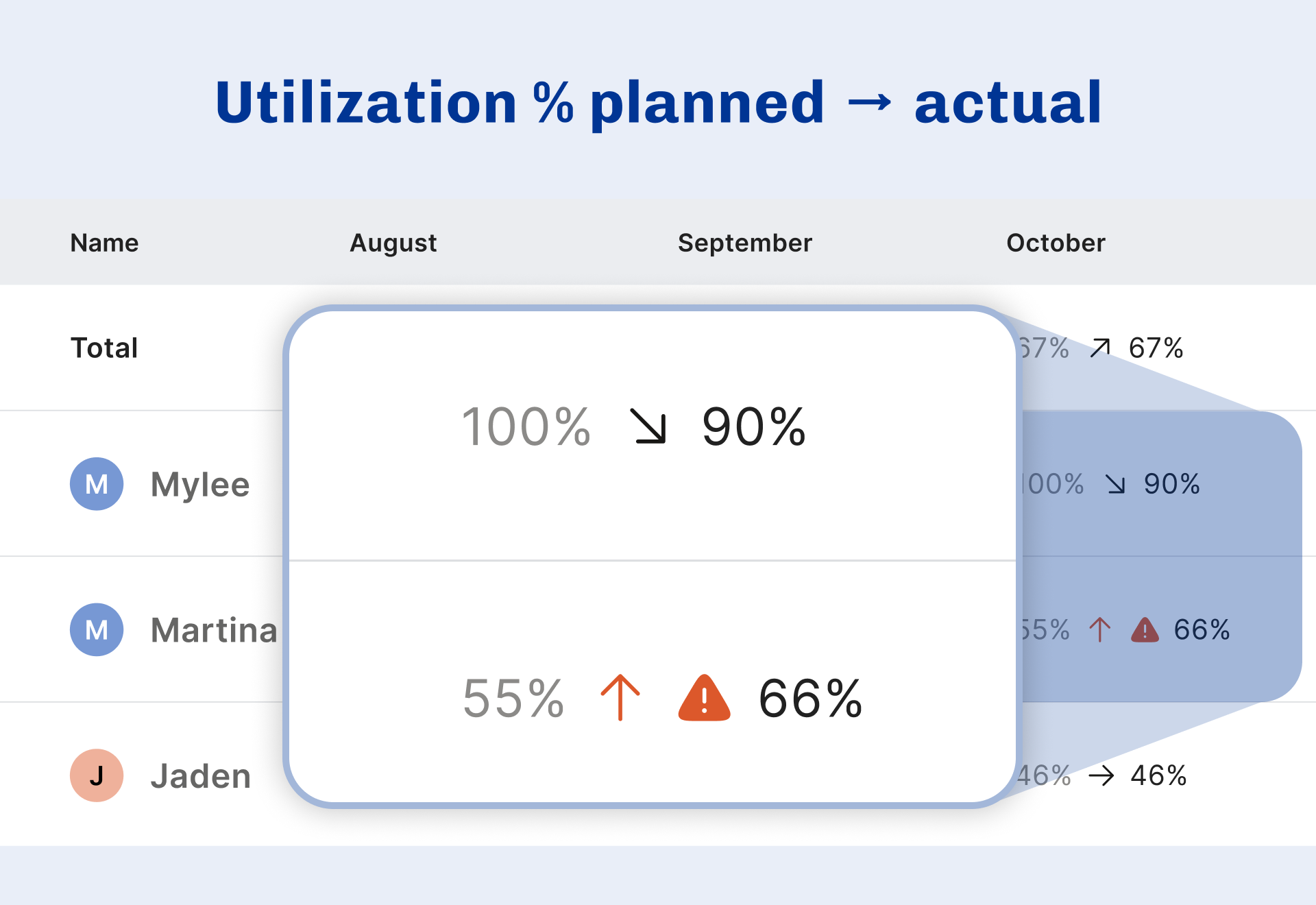
Managers use these views to:
- Reassign work when a project accelerates or slows
- Spot over-capacity or under-capacity early
- Identify skill gaps that affect delivery
- Understand when subcontractors or specialists are needed
This is often the clearest link between project tracking and resource planning.
Reporting and Portfolio Visibility
Operations leaders and PMOs use project tracking tools not just for individual projects, but to understand the full portfolio.
Common reporting includes:
- Planned vs actual performance across all projects
- Delivery margins and margin risk
- Utilization impact from ongoing projects
- Which project types create bottlenecks
- Time forecasts for upcoming months
- Patterns that inform hiring or skill development
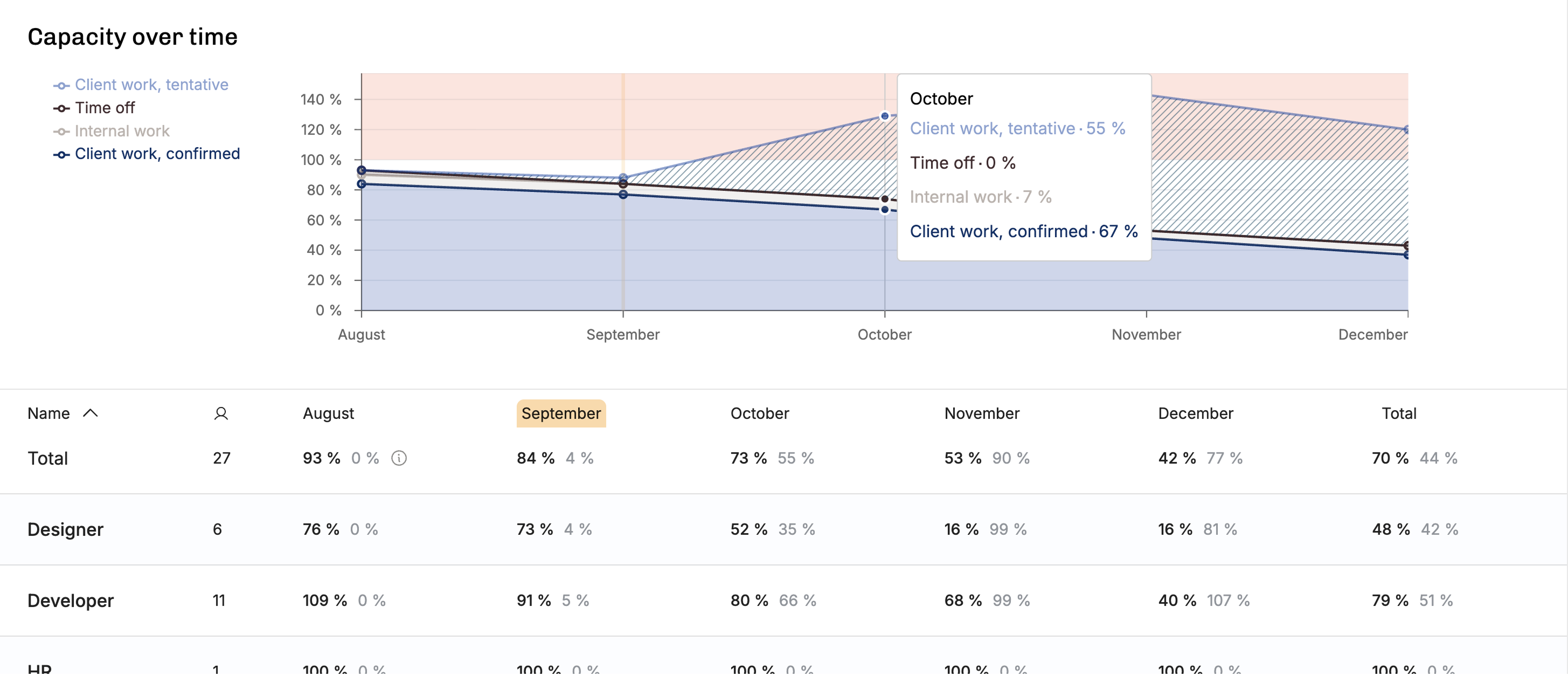
For consulting firms, these insights are often the bridge between day-to-day delivery and long-term workforce strategy.
Who Uses Project Tracking Tools in Professional Services?
Project Managers
PMs monitor how client projects perform against expectations. They use tracking tools to stay ahead of issues, communicate clearly with clients, and maintain predictable delivery. In consulting firms, PMs often manage several parallel projects, which makes the clarity even more valuable.
Operations Leaders and Resource Managers
Operations teams and resource managers use project tracking as an input for staffing, forecasting, and utilization management. They need portfolio-level data to understand what the upcoming weeks and months look like, which roles are in high demand, and where capacity is at risk.
Finance and Leadership
Finance teams use tracked hours and phase-level performance to understand margin trends, overruns, and which project structures work well. Leadership teams rely on the data to refine pricing models, improve forecasting, and identify investment opportunities.
Resource & Staffing Managers
Resource managers use project tracking tools to assess whether people are available for work. Project tracking tool reveals both the planned and actual utilization of the person, revealing if there's a mismatch, and helping these people make better staffing decisions.
Why Project Tracking Matters for Professional Services Firms
1. Predictable Delivery
Clients expect predictable execution. A project tracking tool shows when phases slip, when hours burn too fast, and when plans need to be revisited with the client.
2. Better Staffing Decisions
Tracking highlights where teams are overworked, underutilized, or mismatched with the type of work required. This feeds directly into workforce planning, hiring, and skill development.
3. Stronger Margins
Comparing budgeted, planned, and spent hours shows where profits are gained or lost. Firms can see which project types consistently run over, where scope changes accumulate, and how delivery behaviors affect margins.
As an example, when our founding team still worked in consulting, we were able to identify and salvage $25,000 worth of mistakenly unbilled work within a single month in a team of roughly 100 consultants. That's $300k per year slipping through the cracks. This is why we built Operating in the first place – to make sure the hard work that's delivered gets billed for!
4. Clearer Portfolio Control
Operations leaders get visibility into the entire pipeline and active portfolio. They can compare similar projects, identify systemic issues, and adjust resourcing strategies before problems escalate.
5. Continuous Improvement
Professional services firms depend on repeatable delivery. Tracking helps teams refine scoping assumptions, pricing, staffing patterns, and investment decisions, especially when working across different clients or industries.
FAQ
What is a project tracking tool for professional services?
A project tracking tool for professional services helps consulting and services teams compare budgeted, planned, and spent hours, monitor delivery pace, and ensure projects stay aligned with scope, timelines, and margins.
What does a project tracking tool measure in consulting?
It tracks budgeted hours, planned hours, spent hours, burnup, phase completion, staffing levels, and delivery performance. These insights help consulting firms predict overruns, identify bottlenecks, and maintain client expectations.
Who uses project tracking tools in professional services?
Project managers use tracking tools to oversee project-level performance, while operations leaders and resource managers use them to understand capacity, utilization, and portfolio health. Finance teams rely on tracking data to monitor margins.
Why is project tracking important for consulting firms?
Project tracking supports predictable delivery, stronger margins, and better staffing decisions. It helps firms identify skill gaps, improve scoping accuracy, and maintain visibility across client engagements.