
TL;DR: Book to bill ratio = new work you signed ÷ work you invoiced, in the same period. Above 1.0, your backlog of signed work is growing. Below 1.0, it's shrinking, and the bench is coming. Use the last 3 months, not one month, because one big contract can swing a single month. Most firms sit close to 1.0: even Accenture's consulting business reported 1.1 for fiscal 2026. A 3-month ratio between 1.05 and 1.2 is healthy for a growing firm. Under 0.9 for a whole quarter means sell before you hire. The calculator below gives you your ratio and tells you which one to do.
Book to bill calculator
Put in what you signed and what you invoiced over the last 3 months, plus your team size. You get your ratio and a plain answer: hire, hold or sell.
Three numbers from the last 3 months. The answer updates as you type. Nothing leaves your browser.
New contracts, SOWs and extensions. Any currency.
Same currency, same 3 months.
People who bill clients.
Make it more accurate
Billable hours a month × rate. 128 h × 125 = 16,000.
Your backlog. Leave empty to skip.
Ratio = signed ÷ invoiced over the same 3 months. People your sales keep busy = average monthly signed work ÷ what one person bills a month. Months left = backlog ÷ average monthly invoicing. The verdict bands (below 0.9, 0.9 to 0.95, 0.95 to 1.05, 1.05 to 1.2, above 1.2) are Operating's rule of thumb, not a published benchmark.
Below: the formula, what counts as a booking, what a good ratio looks like and how to turn it into a hire-or-sell call. At the end there's a 15-minute monthly review you can copy.
What is the book to bill ratio?
Book to bill compares the new work you signed in a period with the work you invoiced in the same period. It's also called the BB ratio. You'll see it a lot in chip and electronics reports, where it's about orders and shipments. Same idea, different words.
In a services firm, a booking is a signed SOW, contract or change order. A billing is what you invoiced. Signed work fills your backlog. Billing empties it. So the ratio tells you, in one number, whether the pile of signed work in front of your team is growing or shrinking.
Why care? A consultant's unsold week is gone for good. Book to bill warns you before the bench shows up in your utilization report.
Book to bill ratio formula
Divide what you signed by what you invoiced, for the same period.
| Month | Bookings (signed SOWs) | Billings (invoiced) | Book to bill |
|---|---|---|---|
| August | $520,000 | $380,000 | 1.37 |
| September | $310,000 | $395,000 | 0.78 |
| October | $280,000 | $410,000 | 0.68 |
| Trailing 3 months | $1,110,000 | $1,185,000 | 0.94 |
Take a 25-person IT consultancy. One big SOW pushed August to 1.37. September and October were weak. Over the 3 months the ratio is 0.94: the firm invoiced $75,000 more than it signed, so its backlog shrank. Look at August alone and you'd have hired. That's why you use 3 months.
One more rule: pick what counts as billings and stick with it. Big firms like Accenture divide by revenue. Small firms usually use invoices, because that's what they see. Both work if you don't switch.
What counts as a booking in a services firm?
A booking is work a client committed to in writing, valued at what you expect to bill. Here is how the common cases work.
| Situation | Count as a booking? | How to value it |
|---|---|---|
| Signed fixed-price SOW | Yes, in the month it's signed | The contract value |
| Signed time and materials SOW | Yes | The estimate or not-to-exceed amount in the SOW |
| Retainer | Yes, for the committed term only | Monthly fee × months the client can't cancel |
| Change order or extension | Yes | The added value, not the new total |
| Verbal yes, deal at 90% | No, not yet | Track it in the pipeline, not in bookings |
| Cancelled or cut scope | Subtract it | A negative booking in the month it's cut |
Careful with retainers. A 12-month retainer isn't 12 months of bookings if the client can cancel with 30 days' notice. Count only the months they can't walk away from. Our guide to fixed price vs time and materials contracts covers how contract type changes billing.
Watch billings too. Write-offs and discounts lower your billings while your team was just as busy, so the ratio looks better than it is. Work you delivered but never billed is revenue leakage, and it needs its own number.
What is a good book to bill ratio?
Above 1.0, your backlog grew. At 1.0, it held. Below 1.0, it shrank.
Public numbers only exist for big listed firms. For fiscal 2026, Accenture's consulting business reported 1.1, and CGI reported 108.1% over twelve months. Project consulting hovers around 1.0. Small firms don't publish theirs, and one signature can swing a 30-person firm from 0.6 to 1.8. So use this rule of thumb. It's our reasoning, not survey data.
| Trailing 3-month ratio | What it usually means | What to do |
|---|---|---|
| Below 0.9 | Backlog shrinking fast. The bench forms within a quarter. | Push sales now. Hold hiring. Look at extensions with current clients. |
| 0.9 to 0.95 | Backlog shrinking slowly | Check which months are short of signed work and sell into them. |
| 0.95 to 1.05 | Holding steady | Fine for a firm that isn't trying to grow headcount. |
| 1.05 to 1.2 | Backlog growing | Healthy for most growing firms. Check start dates against capacity. |
| Above 1.2 | Backlog growing fast | Plan hires or subcontractors before the work starts, not after. |
Rule of thumb from Operating, not a benchmark. Large IT services firms reported 1.0 to 1.4 in 2026 (Accenture, CGI). Read the trend over two or three quarters, not one month.
One thing the ratio can't tell you: whether you have the people. That takes one more step.
Book to bill and capacity: hire or sell?
Turn bookings into people. Divide what you sign in an average month by what one person bills in a month. That's how many people your sales keep busy. Compare it with the size of your team.
Our 25-person firm signed $370,000 a month on average. Each consultant bills about $16,000 a month (128 hours at $125). So sales keep about 23 people busy, and the firm has 25. It's two people short of work every month. Sell, don't hire, even though August felt like a boom.
Now flip it. At $480,000 a month, sales keep 30 people busy and five people of work are missing. Line up hires or subcontractors now, because hiring a consultant takes longer than closing a deal.
The last number is months of work in backlog. Divide the signed work you haven't billed yet by what you bill in a month. A $900,000 backlog at $395,000 a month is about 2.3 months. Under one month, next month's bench is already forming. Two to three months gives you time to staff well. Our guide to types of capacity planning shows how to work out available hours per person.
Where the book to bill ratio misleads
The ratio is simple, so it's easy to fool yourself. Watch for four traps.
Start dates. A $600,000 SOW that starts in five months counts today but fills nothing next month. Check when work starts, not only when it was signed.
Long contracts. One multi-year retainer can hold the ratio above 1.0 while project sales dry up. Accenture showed it in the same quarter: managed services at 1.4, consulting at 1.0. If you sell both, track them separately.
Mix. A ratio of 1.1 made of data engineering work doesn't help your idle designers. Give every booking a role, not only an amount.
Pass-through billings. Subcontractor work and software resale say nothing about your own people. Keep them on their own line.
Use the ratio as a monthly warning light. Decide on people from your staffing plan, by role and by week.
From booking to plan: fix the sales-to-delivery handover
Book to bill looks back. By the time a weak quarter shows up in the ratio, it's too late to fill it. The earlier signal is your pipeline, weighted by how likely each deal is to close, in the same plan as your people.
Most firms hand over by email. Sales closes a deal, delivery hears about it a week later and scrambles for people. A better routine pulls likely deals from the CRM into the resource plan as tentative projects, so delivery sees the start date and the roles while the deal is still open.
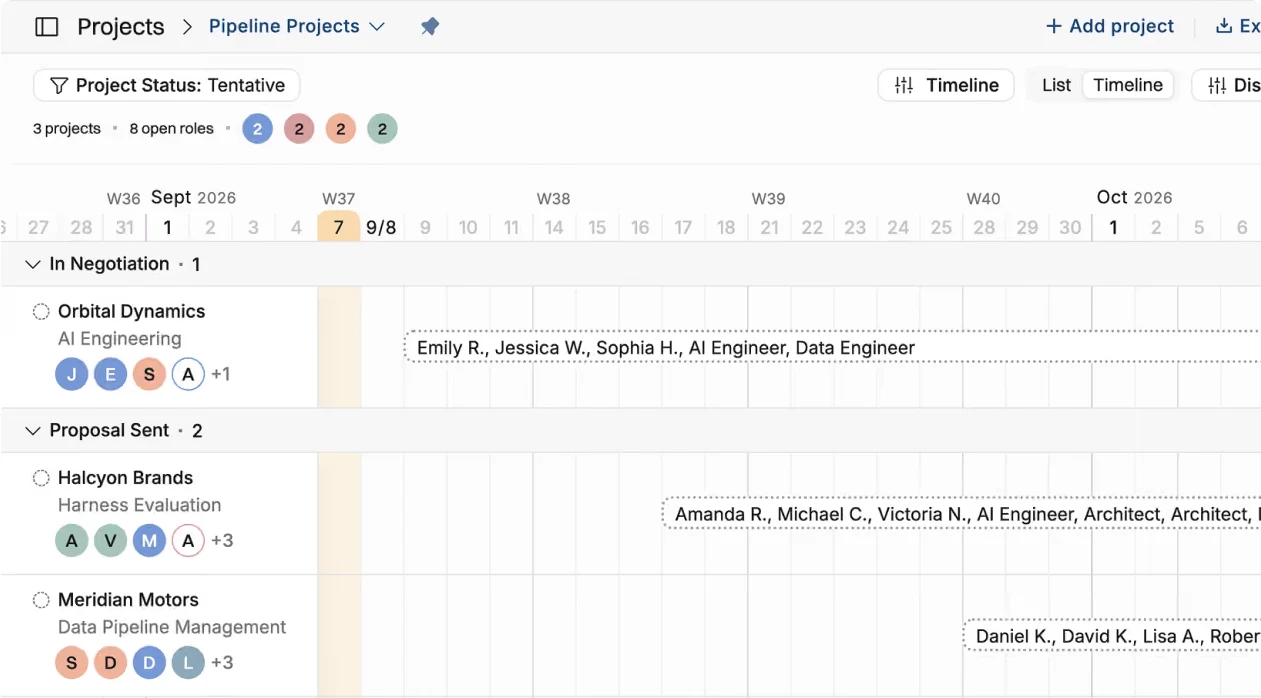
Operating does this with HubSpot, Salesforce and Pipedrive. With HubSpot, every deal in the stages you choose arrives as a tentative project with the amount, owner and close date already on it, and the forecast counts each deal in proportion to its HubSpot probability. When the deal is signed, the booking is already staffed. Disclosure: Operating makes this tool, and other PSA tools offer similar CRM links. If you're still choosing how sales and delivery share data, start with which CRM fits a services firm.
Then read book to bill for the trend and capacity planning for who is free in which week. It belongs next to utilization and margin in your agency and consulting KPIs.
Your 15-minute monthly book to bill review
Run this in the first week of each month, with whoever owns sales and whoever owns staffing in the same room. Copy the table into your notes.
| Step | Do this | Done when |
|---|---|---|
| 1 | Add last month's signed SOWs, change orders and cancellations. Add last month's invoices. | Both totals use the same definitions as last month. |
| 2 | Calculate the monthly and trailing 3-month ratio. | You know whether backlog grew or shrank this quarter. |
| 3 | Turn average bookings into people and compare with billable headcount. | You can say "we sold work for 23 people and have 25". |
| 4 | Divide backlog by monthly billings. Check start dates for the next 8 weeks. | You know which weeks and roles are short of signed work. |
| 5 | Decide: sell into the gap, hold, or start hiring or subcontracting. | One owner and one date for the decision. |
Give it three months. A trend beats any single reading. If the same gap keeps coming back, the issue is usually the handover from sales to delivery, not the sales number.
Book to bill ratio FAQ
Questions people ask about book to bill
Short answers for services firms.
What is the book to bill ratio?
The book to bill ratio is the value of new orders booked in a period divided by the amount billed in the same period. In a services firm, bookings are signed SOWs, contracts and change orders, and billings are invoiced work. Above 1 means the backlog of signed work grew.
How do you calculate book to bill?
Divide bookings by billings for the same period. If you signed $450,000 of work in a quarter and invoiced $400,000, your book to bill ratio is 1.125. Use a trailing 3-month or quarterly figure, because single months swing with large deals.
What is a good book to bill ratio?
Above 1.0 means your backlog is growing. Large IT services firms reported between 1.0 and 1.4 in 2026: Accenture had 1.1 for consulting over fiscal 2026. There is no reliable public benchmark for small consulting firms. As a rule of thumb, a trailing ratio between 1.05 and 1.2 is healthy for a growing firm.
What does a book to bill ratio below 1 mean?
It means you billed more than you sold, so your backlog of signed work is shrinking. One month below 1 is normal. A trailing quarter below 0.9 usually means idle consultants within a few months unless sales pick up.
Is book to bill the same as backlog?
No. Backlog is the total signed work you have not billed yet. Book to bill shows how that backlog changes: bookings add to it and billings reduce it. Divide backlog by average monthly billings to see how many months of work you have.
Should book to bill use revenue or invoices?
Either, as long as you stay consistent. Large firms such as Accenture and CGI divide bookings by revenue. Smaller firms often use invoiced amounts because that is the number they see each month.