
Disclosure: Operating publishes this page, and Operating is on the list. Every product claim was checked against the vendor's own pricing page, docs or help center, and each section says where Ruddr may still be the better choice.
Last updated September 26, 2026.
TL;DR
The best Ruddr alternatives in 2026 are Operating, Projectworks, Scoro, Productive, BigTime, Kantata, Rocketlane and Certinia PS Cloud. The right one depends on why you want to leave Ruddr, not on a feature count. For many firms, the honest answer is to stay on Ruddr.
Operating (operating.app) fits consulting firms of 30 to 500 people that want resource planning in the entry plan, from $13 per person per month billed annually. Projectworks fits consultancies and engineering firms that want resourcing and deep project financials, from $17. Scoro and Productive fit agencies that want one tool for projects and billing. BigTime fits time-and-billing-heavy firms.
Kantata and Certinia fit larger firms with complex needs, and Certinia runs on Salesforce. Rocketlane fits customer onboarding teams. Ruddr itself is still the strongest pick if you want projects, time, and invoicing without resource planning in one mature tool for $14 per billable user, with free non-billable seats.
Comparing only two tools? Read Operating vs Ruddr or our guide to the best PSA software for consulting firms.
At a glance
Operating, Projectworks, Scoro, Productive, BigTime and Rocketlane publish entry prices. Kantata and Certinia are quote only. The table shows who each tool is for and the main trade-off compared with Ruddr.
Why teams leave Ruddr
Most firms do not leave Ruddr for missing basics. They leave because a key feature sits in the Pro plan, because they need a different stack or hosting setup, or because their AI plans need more write access than Ruddr's MCP offers today.
- Resource planning costs the top tier. Resource Allocations, placeholders and plan and forecast reports are Pro features at $24 per user per month billed annually, per Ruddr's pricing page.
- CRM integrations are Pro only. HubSpot and Salesforce need Pro, and we found no Pipedrive connector in Ruddr's integration directory.
- Hosting and certificates. Ruddr says it is ISO 27001 certified and its privacy policy lists AWS in the United States. EU hosting and a SOC 2 report are not published on the public pages we checked.
- Reporting style. Ruddr has a large report library and builds custom reports through Ruddr Assistant, but we found no drag-and-drop report builder in its docs.
- Stack philosophy. Some firms want one broad PSA. Others want a planning and finance layer next to their own CRM and PM tools.
- AI scope. Ruddr launched an MCP server on September 22, 2026. It reads a lot, but its documented writes focus on time entries. Teams that want agents to staff projects may look further.
Ruddr is still a strong product. It bundles projects, tasks, time, expenses and invoicing at $14, its Fair Pricing Policy makes non-billable staff free, and pricing is locked for 24 months. If those points matter most, staying on Ruddr can be the right call.
How we picked
We picked tools that can replace Ruddr for at least one real use case, then checked each against its own live pricing page and help center. We did not use other comparison sites as a source for prices or features.
What to compare before you replace Ruddr:
- Resource planning: allocations, placeholders, tentative work, skills, capacity and pipeline demand.
- Project delivery: tasks, Gantt or Kanban, and whether you want to keep your own PM tool.
- Time and billing: approvals, billing types, retainers and revenue recognition.
- Financials: budgets, cost rates, margins and accounting sync.
- Integrations: CRM, accounting, HR, API and which plan includes them.
- AI and MCP: which plan includes it, and what an agent can read and write.
- Security: SOC 2 or ISO 27001, SSO, SCIM and hosting region.
- Seat economics: who counts as a seat, minimums and renewal terms.
- Onboarding: what is included, what costs extra and the published timeline.
The 8 alternatives
Each tool uses the same format: best for, why it is a Ruddr alternative, where it differs, where Ruddr may still be better, and pricing. Operating comes first because Operating publishes this page. The order is not a ranking.
1. Operating
Best for: consulting, IT services and engineering firms of 30 to 500 people that plan staffing from their CRM pipeline and keep delivery in Jira, Linear or Asana.
Why it is a Ruddr alternative: Operating covers the same chain as Ruddr, from pipeline to invoice, but puts resource planning first. Staffing, skills matching and capacity forecasting are in the entry plan, not in a top tier.
Where it differs from Ruddr:
- Open positions matched by role, seniority, skills and availability, with margin per position, in the $13 Planning plan.
- Native HubSpot, Salesforce and Pipedrive on every plan; deals become tentative projects weighted by probability.
- MCP server with 59 tools on every plan. Agents can create and update people, positions, allocations, time, budgets and expenses.
- SOC 2 Type II, GDPR and hosting on AWS in Frankfurt, with SSO on every plan.
- Free onboarding: data migration, training and support in every plan, and firms go live in weeks.
Where Ruddr may still be the better fit: Ruddr is cheaper if you only need time and invoicing, since Operating needs Full Suite ($21) for invoicing. Ruddr Assistant gives more flexible in-app reports, and non-billable staff are free on Ruddr.
Pricing: Planning $13, Plan & Track $17 and Full Suite $21 per person per month billed annually, or $15, $19 and $23 monthly. Scheduled-only seats cost $11 annually. Enterprise pricing from 100 people is custom. See pricing.
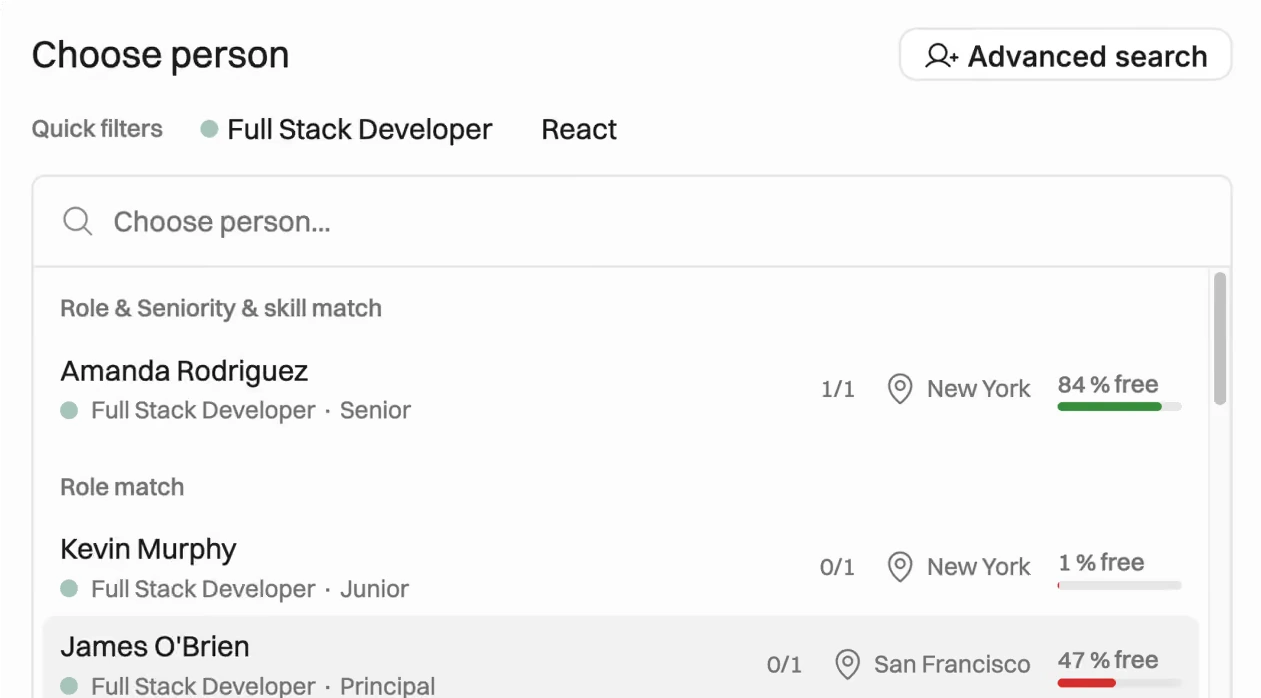
Compare in detail: Operating vs Ruddr.
See Operating on your own pipeline. Book a 30-minute walkthrough of staffing, capacity and margins with Lauri, our CEO. Book an intro
2. Projectworks
Best for: consultancies, engineering, architecture and software services firms of 10 to 500 people that care about project financials.
Why it is a Ruddr alternative: Projectworks overlaps closely with Ruddr. It combines resourcing, time, invoicing and forecasting in one consulting-focused PSA with public prices.
Where it differs from Ruddr:
- Penciled resourcing with placeholders, skills filtering and capacity heatmaps in every plan.
- Live WIP, burn and margin reporting, plus revenue recognition as an option.
- SOC 2 Type 2 report, announced in March 2026.
- HubSpot, Jira and SSO start at Scale; Salesforce and the API sit in Unleash.
Where Ruddr may still be the better fit: Ruddr has a live MCP server and in-app AI today, while Projectworks lists its MCP server and Kea AI agent as coming soon. Projectworks needs 10 users, a one-year commitment even on monthly billing, and paid onboarding from $1,000. Its SSO works only with Microsoft Azure.
Pricing: Build $17, Scale $24 and Unleash $41 per user per month billed annually ($19, $27 and $45 monthly with a one-year minimum). Enterprise is custom. Standard onboarding starts at $1,000, and most firms go live in four to six weeks (vendor claim). See Projectworks pricing.
3. Scoro
Best for: agencies and consultancies that want CRM, quoting, delivery and invoicing in one system.
Why it is a Ruddr alternative: Scoro covers quote-to-cash in one product: CRM, quotes, projects, resource bookings, time and invoicing. It suits firms that use Ruddr as their main operating system and also want sales in the same tool.
Where it differs from Ruddr:
- Built-in CRM and quoting, which Ruddr does not offer.
- Modular apps: you pay for the parts you use, such as Projects and Resources.
- MCP server and Scoro AI included in every package.
- ISO 27001, with a choice of hosting region.
Where Ruddr may still be the better fit: Ruddr is simpler to buy, with two plans and free non-billable seats. Scoro's price grows with each app, has a five-user minimum, and puts SSO and SCIM on its Enterprise platform.
Pricing: Combinations start from $17 per user per month, and the Projects & Resources bundle is listed at $29. Minimum five users; 14-day free trial. See Scoro pricing.
4. Productive
Best for: creative and digital agencies, and smaller consultancies, that want projects, scheduling and budgets in one tool.
Why it is a Ruddr alternative: Productive puts tasks, scheduling, time, budgets and billing in one product, much like Ruddr, with a strong focus on agencies.
Where it differs from Ruddr:
- Full project management with Gantt (from Professional), boards and docs.
- Retainers as recurring budgets from the Professional plan.
- SOC 2 Type II and hosting on AWS in the EU; SSO on all plans.
- Low entry price with a three-seat minimum.
Where Ruddr may still be the better fit: Ruddr includes HubSpot, Salesforce and MCP from Pro or Team. Productive puts HubSpot, Salesforce, skill-based resource requests and its MCP server in the Ultimate plan, which has no public price.
Pricing: Essential $10 and Professional $25 per user per month billed annually ($12 and $29 monthly). Ultimate is on request. See Productive pricing.
5. BigTime
Best for: US accounting, engineering and consulting firms where time capture, billing and getting paid are the main problems.
Why it is a Ruddr alternative: BigTime is built around time, billing and payments. Every plan includes time tracking, invoicing, expenses and payments, so it is a direct substitute for firms that use Ruddr mainly for time-to-invoice.
Where it differs from Ruddr:
- T&M, fixed fee, milestone and retainer billing, with card and ACH payments built in.
- SOC 1 Type 2 and SOC 2 Type 2 reports.
- A separate Enterprise PSA product for multi-entity and multi-currency firms.
- An AI assistant and a beta MCP connection for time and expense data.
Where Ruddr may still be the better fit: Ruddr includes resource allocations in Pro, while BigTime sells full resource management as a paid add-on. BigTime's upper tiers have no public price, and it hosts data only in the US.
Pricing: Essentials starts at $20 per user per month. Advanced, Premier and Enterprise prices are on request, and add-ons are billed separately. See BigTime pricing.
6. Kantata
Best for: mid-market and enterprise services firms that want deep resourcing, project accounting and task-level delivery in one platform.
Why it is a Ruddr alternative: Kantata is the benchmark for complex resource operations. It runs task-level projects, formal resource requests, soft and hard allocations and deep project accounting.
Where it differs from Ruddr:
- Two products: Kantata OX (formerly Mavenlink) and Kantata SX, which runs on Salesforce.
- MCP server with 150+ tools once Kantata AI is activated, plus in-app agents.
- SOC 1 and SOC 2 Type II reports.
- A claimed 1,200+ prebuilt connectors, including NetSuite and Jira.
Where Ruddr may still be the better fit: Ruddr is much easier to buy and run for small and mid-sized firms. It publishes prices, while Kantata is quote only, and a third-party estimate reports a 50-seat minimum. Kantata's HubSpot connector needs its Enterprise plan.
Pricing: Quote only. Springman Consulting (third-party estimate, spring 2025) reported $50 to $110 per user per month with a 50-seat minimum. See Kantata pricing.
7. Rocketlane
Best for: customer onboarding and implementation teams at software companies and services firms that deliver projects with their clients.
Why it is a Ruddr alternative: Rocketlane is a PSA with a branded customer portal at its core. Its Premium plan adds resource planning, capacity, budgets, margins, revenue recognition and invoicing.
Where it differs from Ruddr:
- Customer portal, customer approvals and CSAT at milestones on every plan.
- HubSpot, API and an MCP server with 24 tools from the entry plan.
- SOC 2 Type II certified and ISO 27001 compliant.
- Skills matrix, soft allocations and SAML SSO on the Enterprise plan.
Where Ruddr may still be the better fit: Ruddr is far cheaper for internal delivery work, with a stronger finance back office for the price. Rocketlane has a five-seat minimum, and implementation packages cost extra.
Pricing: Standard $49 and Premium $69 per user per month billed annually. Enterprise is custom. A monthly price is not published. See Rocketlane pricing.
8. Certinia PS Cloud
Best for: larger services firms that have standardized on Salesforce for CRM and want PSA on the same platform.
Why it is a Ruddr alternative: Certinia (formerly FinancialForce) runs the services lifecycle on Salesforce, from opportunity to project, staffing, billing and revenue. Certinia says more than 1,400 firms use it (vendor claim).
Where it differs from Ruddr:
- Projects created straight from Salesforce opportunities.
- Resource management with supply and demand, skills, utilization and capacity.
- Veda AI with a Resourcing Agent; in September 2026 Certinia announced Veda actions through MCP.
- SOC 1 Type II, SOC 2 Type II and SOC 3 reports.
Where Ruddr may still be the better fit: Ruddr works without Salesforce, sends invoices itself and publishes prices. Certinia needs Salesforce licenses, creates billing events for Certinia Accounting or your ERP, and usually needs a partner-led rollout.
Pricing: Quote only. See Certinia Professional Services Cloud.
Also worth a look: Accelo for retainer-heavy client work, and Teamwork for agencies that want a PM-first tool. We kept them outside the main eight because they overlap less with Ruddr's core use case.
Full comparison
The biggest differences are in plan gates, CRM integrations, MCP scope and hosting. Ruddr is the benchmark in each table.
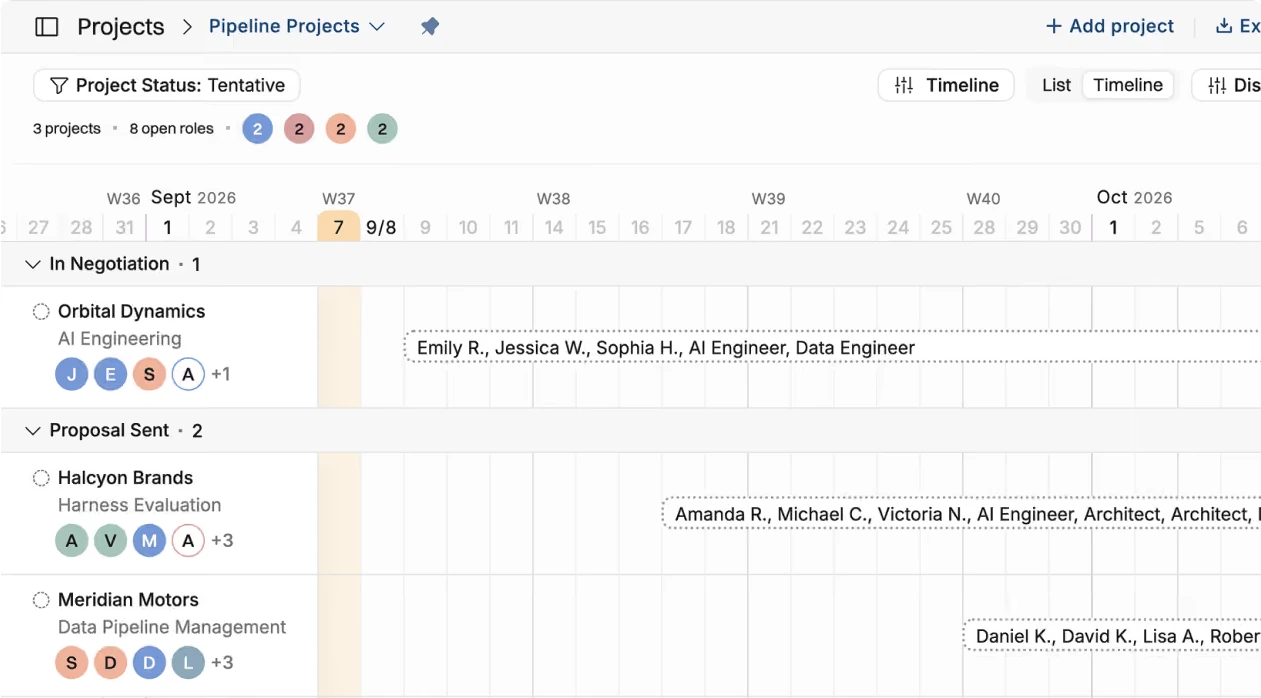
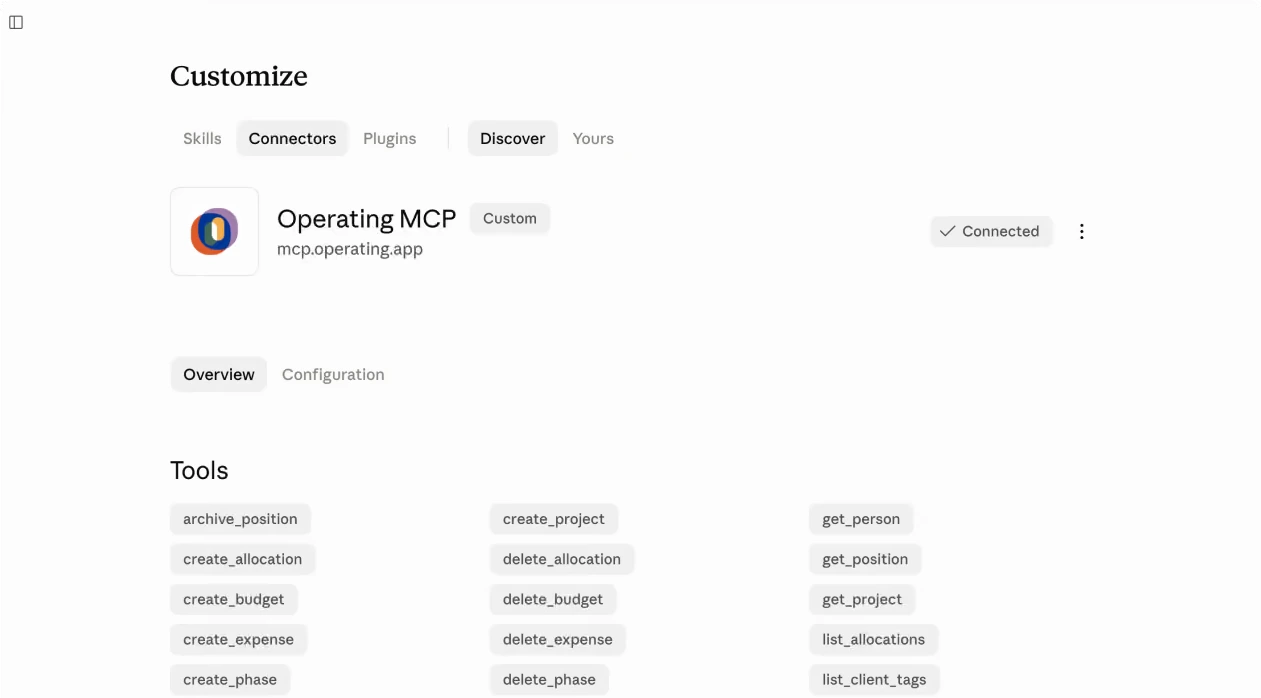
Pricing compared
The cheapest public entry prices are Productive at $10 and Operating at $13 per person per month billed annually. Ruddr is $14 but only charges billable members. Always check which plan unlocks the feature you are switching for.
Two worked examples at annual list prices show why no tool is cheapest for everyone.
- 50 billable people who need resource planning: Operating Planning is 50 x $13 = $650 a month, Projectworks Build is 50 x $17 = $850, and Ruddr Pro is 50 x $24 = $1,200.
- 40 billable plus 10 ops staff who need time and invoicing only: Ruddr Team is 40 x $14 = $560 a month, because ops staff are free. Projectworks Build is 50 x $17 = $850 and Operating Full Suite is 50 x $21 = $1,050.
Best by use case
Start from the problem you want to fix. The table maps common needs to a short list worth a demo, and includes the cases where staying on Ruddr makes sense.
Migrating from Ruddr
Plan a Ruddr migration as a short project with a test phase. List your data, export it through the Ruddr API or report exports, load one team, check the numbers match, run both tools for one cycle, then switch.
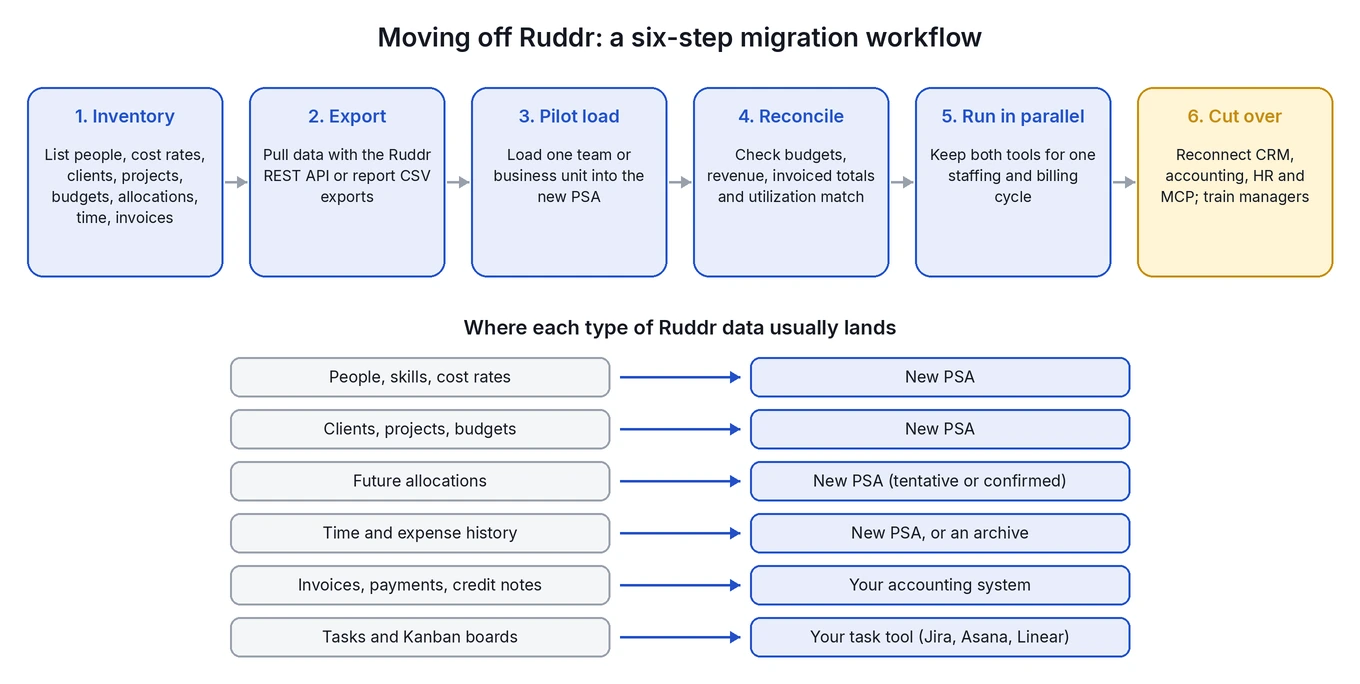
- Inventory your data. List people, skills, cost rates, clients, projects, budgets, allocations, time, expenses, invoices and retainers.
- Export. Pull data through the Ruddr REST API or CSV exports from its reports.
- Pilot load. Load one team or business unit into the new PSA.
- Reconcile. Check budgets, earned revenue, invoiced totals, prepayments and utilization against Ruddr.
- Run in parallel. Keep both tools for one staffing and billing cycle.
- Cut over. Reconnect CRM, accounting, HR and MCP, then train resource managers, PMs and finance.
Before you sign, ask each vendor to confirm in writing which data they migrate for you, how retainers and prepayments map, which plan includes the integrations and SSO you need, and how long a test migration takes. Operating includes migration, training and process help in every plan at no extra cost.
Moving off Ruddr? We will map your Ruddr setup to Operating and run a free test with one of your teams. Book a time with Lauri
FAQ
What are the best Ruddr alternatives in 2026?
The best Ruddr alternatives in 2026 are Operating, Projectworks, Scoro, Productive, BigTime, Kantata, Rocketlane and Certinia PS Cloud. Operating fits consulting firms of 30 to 500 people that plan from the pipeline. Scoro and Productive fit agencies, BigTime fits billing-heavy firms and Certinia fits Salesforce-centric enterprises.
What is cheaper than Ruddr?
Productive starts at $10 per user per month billed annually, and Operating starts at $13 per person. For resource planning, Operating Planning ($13) and Projectworks Build ($17) cost less than Ruddr Pro ($24). For time and invoicing only, Ruddr Team at $14 with free non-billable seats is hard to beat.
Which Ruddr alternative is best for resource planning?
It depends on size and style. Operating has the lowest entry price for staffing, with skills matching and a capacity forecast weighted by CRM deals. Projectworks pairs resourcing with strong project financials. Kantata suits larger firms that need formal resource requests and approvals.
Which Ruddr alternative is best for consulting firms?
For consulting firms of 30 to 500 people, shortlist Operating if staffing from the pipeline is the main problem, and Projectworks if project financials and WIP matter most. Larger Salesforce-first firms should look at Certinia. If time and billing are the main needs, Ruddr may still be the best fit.
Which Ruddr alternative is best for agencies?
Agencies that want projects, tasks, time and billing in one tool should look at Productive and Scoro. Productive has a low entry price and supports retainers from Professional. Scoro adds a built-in CRM and quoting. Agencies that keep their own PM tool and need staffing can use Operating.
Which Ruddr alternative is Salesforce-native?
Certinia PS Cloud is built on Salesforce, and Kantata SX also runs inside Salesforce. Operating is not Salesforce-native, but it has a native Salesforce integration on every plan that turns opportunities into tentative projects.
Which Ruddr alternatives have an MCP server or AI agents?
As of September 2026, Operating (59 tools, every plan), Scoro (every package), Kantata (150+ tools with Kantata AI), Rocketlane (24 tools) and Productive (Ultimate plan) offer MCP servers. BigTime has a beta MCP connection, Certinia announced Veda actions through MCP, and Projectworks lists MCP as coming soon.
Does Ruddr have an MCP server?
Yes. Ruddr launched its MCP server on September 22, 2026, with 91 query tools across 19 namespaces. It uses OAuth, runs with the member's permissions and is read-only by default. Its documented write action is time tracking, with a confirmation step before each write.
Which Ruddr alternatives host data in the EU?
Operating is hosted on AWS in Frankfurt, Germany. Productive is hosted on AWS in the EU, and Scoro lets you choose a region, including Germany and Sweden. Ruddr's privacy policy lists AWS in the United States, and BigTime hosts data only in the US.
Can I migrate projects, time and financial history out of Ruddr?
Yes. Ruddr has a REST API and report exports, so you can move people, cost rates, projects, allocations and time history. Invoice and payment history usually stays in your accounting system. Test the migration with one team and reconcile the numbers before you switch everyone.
What should I compare before replacing Ruddr?
Compare resource planning depth, billing types including retainers, CRM and accounting integrations, the plan that unlocks each feature, MCP write scope, security and hosting, seat rules and onboarding costs. Ruddr's billable-only seats and 24-month price lock are a real benchmark, so model your own headcount mix.
When should I stay on Ruddr?
Stay on Ruddr if you mainly need projects, time, expenses and invoicing at a low price, have many non-billable staff, bill retainers, or value its 24-month price lock. Look at alternatives when resource planning, native Pipedrive, EU hosting or agent-driven staffing matters more.
Methodology and sources
We checked every product against its own live pricing page, docs and help center on September 25, 2026. Review scores come from G2 and Capterra on the same day.
- Pricing: taken from each vendor's pricing page. Where prices load with JavaScript, we read them from the page code and state whether they are billed monthly or annually.
- Features: checked against vendor docs and help centers. Where a vendor's own pages disagree, we used the more cautious reading.
- Reviews: G2 and Capterra scores and counts only.
- Vendor claims: customer counts, go-live times and case-study numbers are labeled as vendor claims.
- Third-party estimates: the Kantata price estimate comes from Springman Consulting and is labeled as an estimate.
- Screenshots: only Operating's own product images. We did not reproduce other vendors' interfaces.
- Not published: Kantata and Certinia prices, Productive Ultimate and BigTime upper-tier prices, Rocketlane monthly prices, Ruddr onboarding prices and SOC 2 status.
- Disclosure: Operating publishes this page.
Sources: Ruddr
- Pricing
- Fair Pricing Policy
- MCP server launch post (September 22, 2026)
- Help: AI connectors overview
- Integrations
- Help: Billing types
- Help: Reporting overview
- Privacy policy (hosting)
- Onboarding services
Sources: Operating
- Pricing
- Integrations
- Security
- MCP server
- Help: AI chat via MCP (59 tools)
- Help: Billing types and known limitations
- Help: Security and privacy FAQ
Sources: other vendors
- Projectworks: pricing
- Projectworks: resourcing
- Projectworks: SOC 2 Type 2
- Scoro: pricing
- Scoro: security
- Productive: pricing
- Productive: security
- BigTime: pricing
- Kantata: pricing
- Kantata: MCP server overview
- Kantata: security
- Rocketlane: pricing
- Certinia: Professional Services Cloud
Sources: third party
- G2: PSA category
- G2: Ruddr
- Capterra: Ruddr
- G2: Operating
- Capterra: Operating
- Springman Consulting: Kantata price estimate (third party)
Written by Lauri Eurén, CEO of Operating. Last updated September 26, 2026.