Discussing with multiple consulting leaders and professionals every week, I've come to realize one thing. We seem to be past the initial shock of "AI is going to take consultants' jobs". The industry has started to mold towards LLMs being "just tools". Especially larger organizations have realized that just buying a license to a model still doesn't mean you have any sort of competitive advantage. Just look at what Anthropic and OpenAI are doing: they're building literal consulting firms in order to help their customers deploy their models into production, and to make actual use of them beyond simple point solutions that run on people's local machines. And now that everyone's speed of execution is, at least theoretically, 10x or 100x from before, the hard part isn't going fast. It's knowing what to build.
It was never about the speed of execution.
Or sometimes it was. Back when I was in consulting, and now building a complex product for running a consulting firm, I've certainly found myself wishing that things would go faster. "Can't we just finish this scope quicker?" But it turns out that now that everyone's 100X to 1,000X faster, many of us have come to the realization that... it was never about the speed. You see, speed in the corporate world has one big problem. It makes it harder to change course.
Let's take a physics lesson:
- Speed tells you how much ground an object covers in a set time. It has no direction. Example: 60mph.
- Velocity tells you how fast an object changes its position and where it goes. It includes both a number value and a direction (like North). Example: 60 mph North. (Usually things go south though)
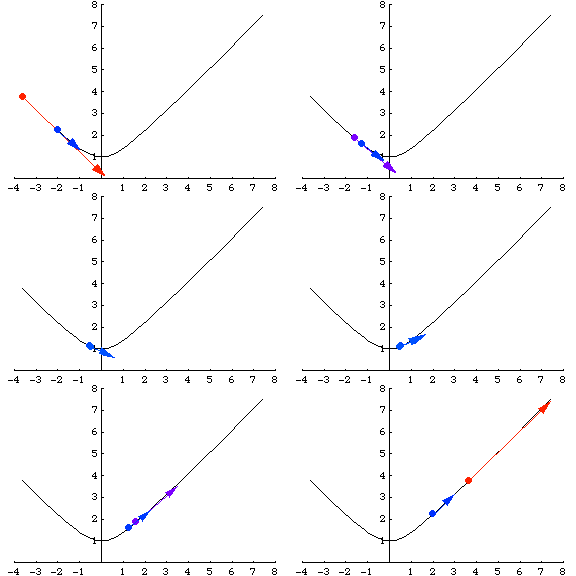
- Vector quantities like velocity are often pictured with an arrow. The length of the arrow directly represents the strength or magnitude of that quantity. See example.
The theory on hitting the apex: Formula 1
Imagine that arrow is an F1 car. You see that approaching the corner speed is reduced. That's done in order to make the turn. Too much speed into the corner and it becomes quite hard to turn the car into the curve, i.e. changing the direction of the velocity vector becomes tough. This is called understeering. In order to hit the apex (the middle point of the corner) and to successfully accelerate to the straight, you need to have exactly the right amount of speed. Otherwise, you'll end up on the sand! From the sand, they have to take your car to the pits to fix it, and you can only join the next race. God forbid you run into a wall and you wreck the car. That's a longer, more costly fix and your pit crew will not love you for that!
How you miss the Apex: An enterprise organization
Let's look at that example like it was a software project in a large enterprise. Imagine you've deployed the most powerful AI model to an organization that's not very technical or is lacking direction, leadership, or both. You'll create a lot of speed. But speed alone generates no value, you have to hit the apex. And what happens is that as your output increases (lines of code, features shipped), it becomes harder to see the forest for the trees, what you were building in the first place, so you miss the corner. The speed combined with the organizational inertia (the amount of people, processes, integrations...) is what keeps you going straight. You carried too much speed into the corner, and now the organization won't turn with you. I.e. you've produced a whole lot of ado about nothing, you've created a bunch of disconnected workflows and no value was generated. More often than not you're driving the track in the wrong direction from the get-go. But hey, what do we care, we're 100,000X more efficient now!
Helping companies hit the apex: The consultants
Consultants will play a key role in getting the car through the corner. They still have the advantage of seeing multiple companies struggle with all of this, whereas the end customer only sees their own situation. They've watched plenty of cars go into that same corner too fast.
I must also say that building enterprise-grade, stable software that does what it's supposed to do is still hard and at points slow, so there'll be a place for software consulting as before — only part of it has to change. Web changed consulting. Cloud changed consulting. Mobile changed consulting. AI is changing consulting. It's just a new layer on top, and consultants will be there to help customers navigate the new reality. And the direction still comes from the consultant the client actually trusts. It all ties back to consulting being only partly about technical skills, and more about being a trusted advisor to your clients.