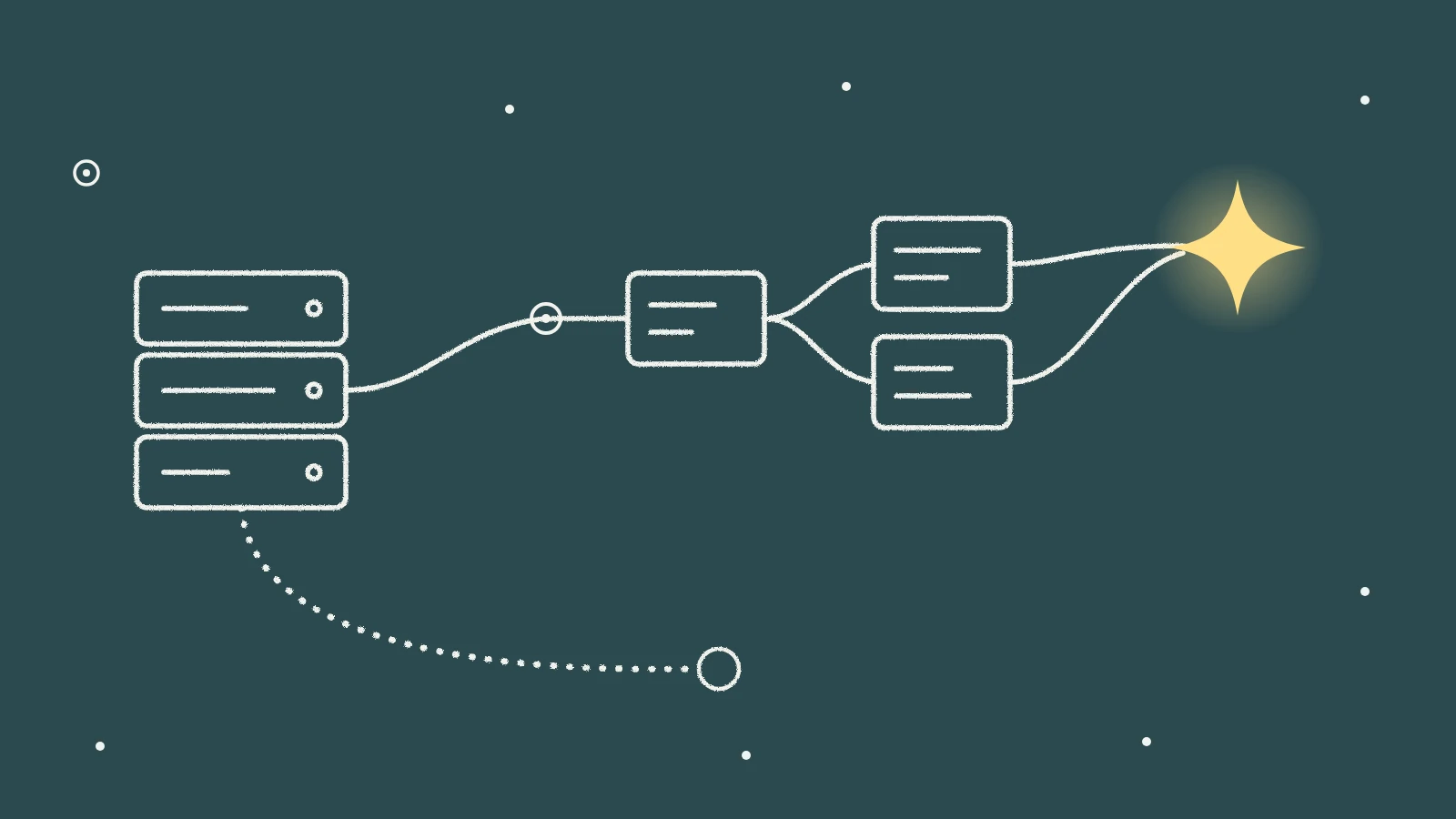
Quick summary: Project management tools and resource plans should stay loosely coupled: connect them at the level of positions, phases, and allocations rather than at the task level, because delivery changes daily while staffing and budgets move on a slower rhythm. Model Context Protocol (MCP) servers now make an AI agent the integration layer, since Linear, Asana, Notion, Jira, and the consulting operations platform Operating all offer one, so a consultant sees task status, allocations, and budget burn in a single conversation.
PM Tool != Resource Plan
Most consulting ops platforms try to be everything. Project management, resource planning, budgeting, time tracking, invoicing — all jammed into one system with tight dependencies between layers. Change a task, and your resource plan flinches. Restructure a phase, and finance loses visibility for a week.
No one loves that.
Two systems, two rhythms
Project delivery and resource planning operate on fundamentally different cadences. A project lead restructures tasks daily — scope shifts, priorities change, clients change their minds. That's the job. But staffing and budgets move on a slower rhythm. You don't reallocate a senior consultant every time a Jira/Linear ticket changes status.
When you tightly couple these two worlds, one of two things happens. Either PMs stop updating their plans because every change breaks something downstream. Or finance and ops stop trusting the numbers because they're constantly in flux. Both outcomes are worse than having no system at all.
The answer isn't a better all-in-one tool. It's loose coupling. Let the PM tool be a PM tool. Let the resource planning and financial system be that. Connect them at the right level of abstraction — positions, phases, allocations — not at the task level.
Fun fact: some of your clients might actually appreciate the fact that you use the planning tool that's native to them rather than forcing your tooling on them. This is only feasible when you run your consulting business in a tool like Operating and the PM details live in other systems.
MCP changes the game
Here's what's new: the integration layer is no longer a brittle point-to-point API sync that someone built in a sprint and nobody maintains. It's MCP — Model Context Protocol — and it turns every connected tool into something an AI agent can read and write to, in real time, in context.
Linear has an MCP server. So does Asana, Notion, Jira. So does Operating.
This means a project lead working in Claude Code can triage their Linear board, update task status, write specs — and in the same session, the agent can check Operating to see who's allocated, what the budget situation looks like, and when the current phase ends. No tab switching. No "let me check the resource plan." The agent holds context across both systems and surfaces what matters: you've burned 80% of the phase budget with three weeks left. Your designer's availability drops next week. The pipeline for this client is thin after July.
It works the other way too. An ops lead reviewing utilization in Operating can ask the agent to pull delivery context from the PM tool. Why is this senior consultant showing 40% bench? Are they blocked on something? Has scope been cut? Is the project winding down earlier than planned? The LLMs are great at providing an executive summary to people following the project from the sidelines. Such as the COO or the ops lead.
The reconciliation that used to require a Monday morning meeting, six browser tabs, and a shared spreadsheet now happens inside a conversation.
The all-in-one trap
The instinct to build everything into one platform is understandable. Single source of truth. One login. Unified data model. But in practice, all-in-one tools are mediocre at everything and excellent at nothing. The PM features are worse than Linear. The financial views are worse than a proper ops platform. And the integration between them is so tight that the system becomes fragile — optimized for a demo, not for how consulting firms actually operate.
Loose coupling with MCP connectivity is the opposite bet. Best-in-class tools own their domain. The agent is the integration layer. And because the coupling is loose, each system can evolve independently. Your PMs can switch from Jira to Linear without blowing up your resource plan. Your ops team can change how they model phases and allocations without breaking anyone's task board.
What this looks like day-to-day
A consultant opens Claude Code in the morning. They ask what's on their plate. The agent checks Linear for their assigned issues, checks Operating for their allocations and upcoming phase deadlines, and gives them a coherent picture of their week — delivery tasks and operational context in one response.
A partner asks for a project status update. The agent pulls delivery progress from the PM tool and financial status from Operating, drafts a summary, and flags the things that actually need attention.
An ops lead needs to staff a new project starting in two weeks. The agent checks availability across the bench in Operating, cross-references skills and current delivery load from Linear, and proposes options.
No system needs to know about any other system. The agent is the connective tissue. The loose coupling is what makes it work.
At the end of the day, heading home, the consultant prompts their Claude mobile app to "track time according to plans, add notes based on our chats today". Done.
The punchline
Tightly-coupled all-in-one platforms are the legacy architecture. Loosely-coupled, MCP-connected toolchains — with an AI agent as the integration layer — are where consulting ops is headed. Not because the technology is novel, but because it finally matches how these firms actually run. Delivery is messy and fast, resourcing is deliberate and structured, and the people doing the work need both without the friction of keeping them in sync manually.