
Quick summary: Resource management is the allocation, utilization, and optimization of an organization's resources (people, budgets, equipment, and facilities) to meet its goals; in agencies it is often called staffing. Effective practice rests on forecasting resource needs, scheduling against real availability to avoid overbooking, leveling workloads with buffer time, and protecting employee engagement. The most accurate capacity forecast comes from people updating their own future plans, while project managers watch allocations at project level and resource managers handle higher-level planning. Utilization targets should be reverse-engineered from your own profitability goals rather than copied from industry benchmarks.
This guide explains what resource management is, why it decides the profitability of a services business, and how to run it in practice: the step-by-step process, the established techniques, how to set your utilization target, and real examples from consulting firms and agencies.
What Is Resource Management?
Resource management is the practice of planning, allocating, and optimizing an organization's resources — people, budgets, equipment, and facilities — so that work is delivered on time, within budget, and without overloading the team. In consulting firms and agencies, where the resource in question is almost always people's time, it is often called staffing or resource planning. Read our thoughts on agency resource management here: Mastering Agency Project Staffing.
Why Resource Management Matters
In a professional services business, people are both the product and the biggest cost. Payroll goes out every month whether your team is billing client work or sitting on the bench, so even small swings in how well people are allocated show up directly in the bottom line. Poor resource management costs money in both directions: idle capacity means paying salaries without revenue, while overbooking leads to burnout, turnover, and quality problems that surface later as unhappy clients.
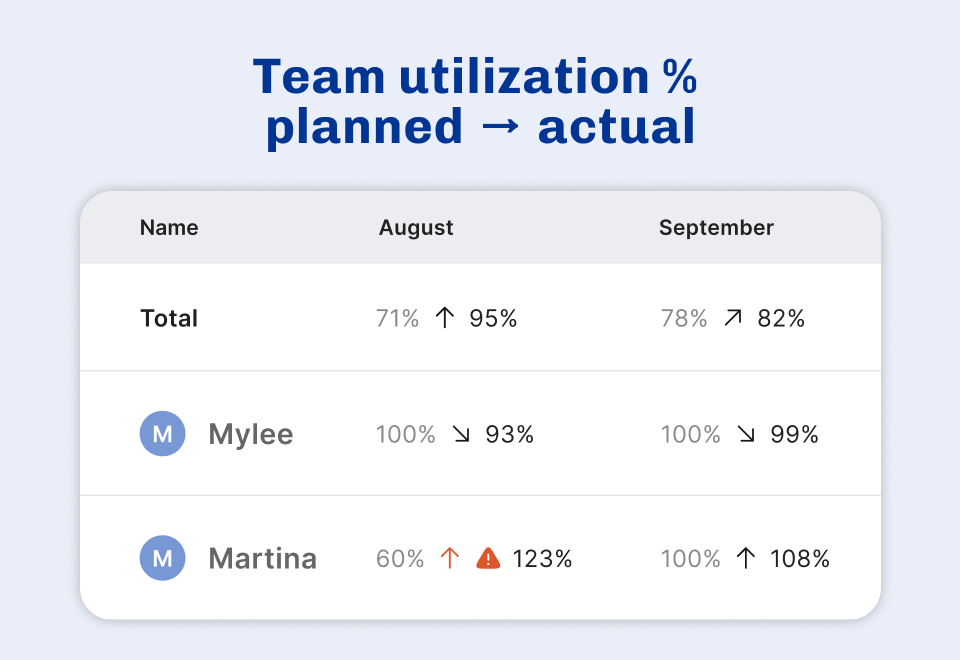
There's a second, less obvious cost: decisions made on outdated information. When allocation plans live in stale spreadsheets, leadership discovers utilization problems only after the month has closed — when nothing can be done about them anymore. The gap between planned hours and hours actually worked is one of the earliest warning signals for both delivery risk and margin, but you can only see it if plans are kept up to date.
The Resource Management Process
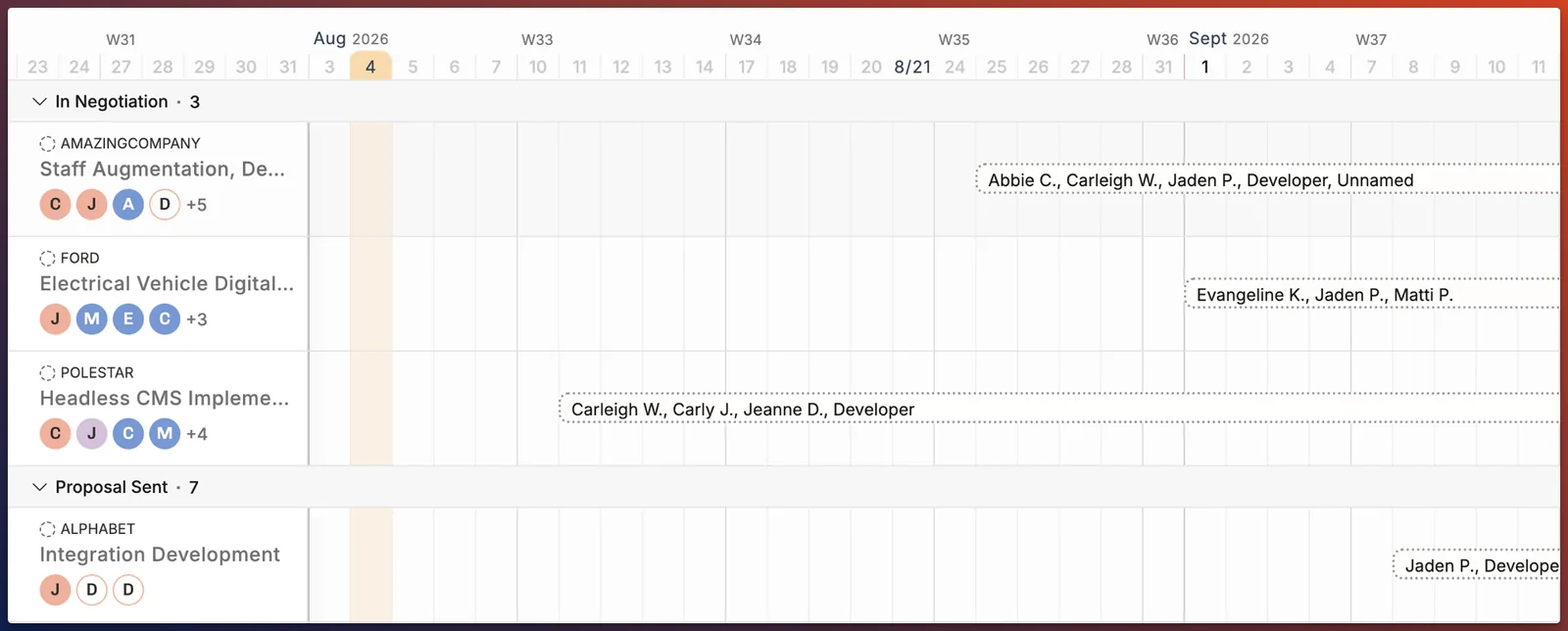
The process looks the same in most services firms, whatever tool you run it in:
- Forecast demand. Map the work coming in — both confirmed projects and tentative deals in the sales pipeline — and estimate the hours, skills, and roles each one needs.
- Know your capacity. Keep an up-to-date view of who is available, who is fully booked, who on PTO, and what skills are free in the coming weeks and months, accounting for vacations and internal work.
- Allocate people to projects. Match people to work based on availability, skills, and their own development goals — not just whoever happens to be free.
- Level the workload. Smooth out peaks and gaps, and leave buffer time for the unforeseen so one delayed project doesn't cascade through the whole plan.
- Track planned versus actual. Compare allocated hours against hours logged. A widening gap is an early signal that a project is over- or under-running.
- Review and adjust weekly. Client needs shift fast; a weekly resource management meeting keeps allocations, the pipeline, and people's wishes aligned.
Key Strategies for Effective Resource Management
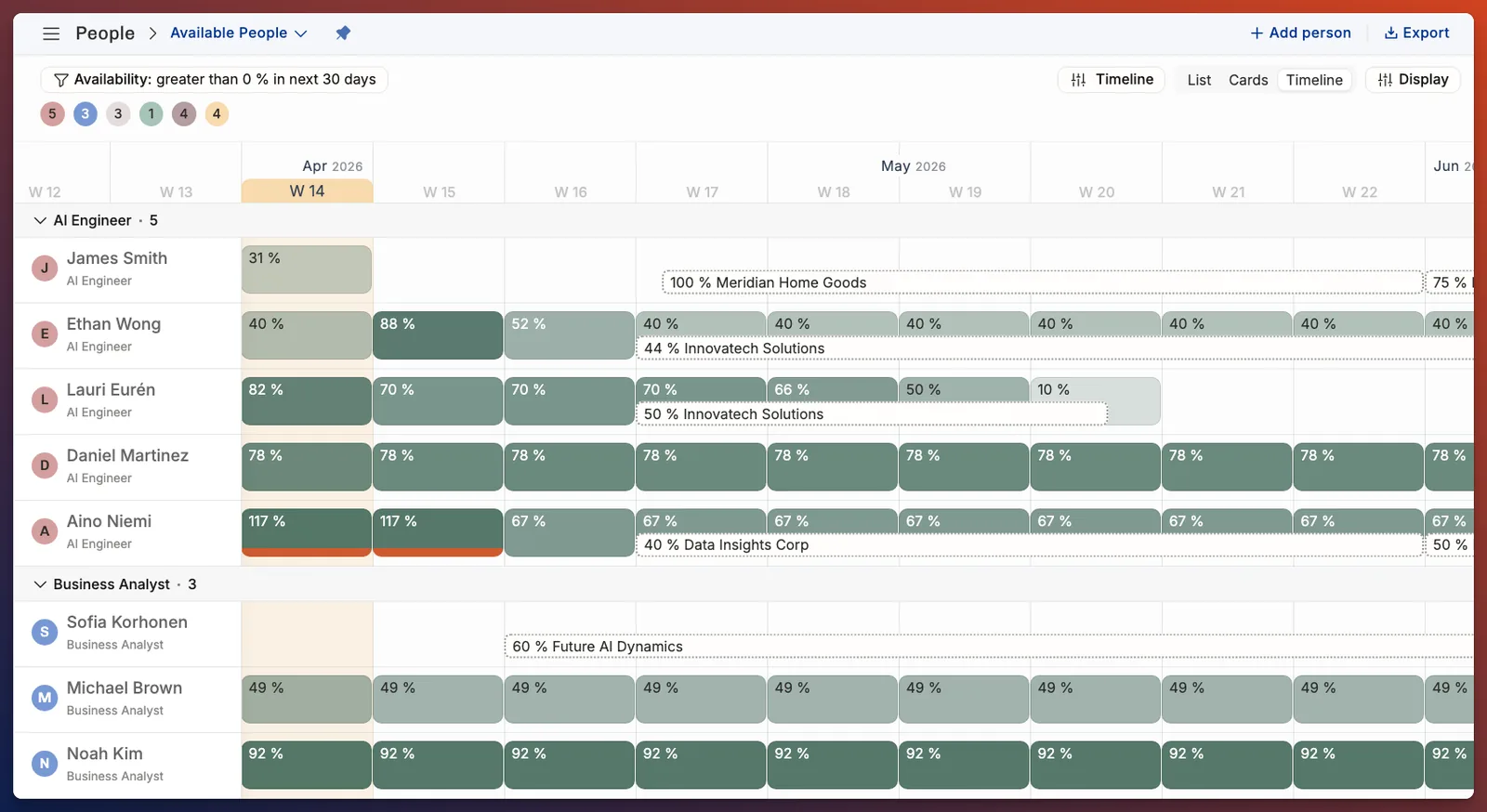
- Planning and Forecasting: Develop a resource management plan to identify the number and type of resources needed for each project. Forecasting future needs makes sure you have the required skills and budget when the work lands.
- Resource Allocation and Scheduling: Allocate tasks based on team members' availability and suitability. Use software to visualize and manage schedules, avoiding overbooking and conflicts.
- Clear Responsibilities: Making sure resources are allocated well is the job of many people in a company. Read more on how the responsibilities split between roles in this article.
- Resource Leveling and Smoothing: Create reasonable workloads for your team. Factor in buffer time for unforeseen events to avoid overstretching resources and ensure deadlines are met.
- Employee Engagement and Satisfaction: Focus on providing a great employee experience by ensuring work-life balance, reducing stress, and avoiding burnout. Happy employees lead to higher productivity and better customer service.
Resource Management Techniques
A handful of established techniques come up again and again. You don't need all of them on day one, but it helps to know them by name:
- Resource forecasting — estimating future demand for people and skills from confirmed work and the sales pipeline, so hiring and staffing decisions are made ahead of the need rather than after it.
- Capacity planning — comparing total available hours against total demand to see whether you can deliver what's coming. We've written a practical guide to capacity planning in agencies.
- Resource leveling — resolving overbookings by shifting work in time: if a person is allocated 60 hours in a 40-hour week, something moves to next week.
- Resource smoothing — evening out workload within the existing deadlines, so people aren't sprinting one week and idle the next.
- Skills-based allocation — staffing by skill and development goals, not just availability. The right person on the right project beats the free person on the next project.
- Scenario planning — testing staffing plans against what-ifs: what happens if the big deal closes, if it slips a quarter, or if a key person leaves?


How to Set Your Utilization Target: Start From Profitability
Utilization — the share of people's available time that goes to billable work — is the single most-watched number in resource management. But there is no universal "right" utilization rate to copy from a benchmark. The honest way to set a target is to reverse-engineer it from your own goals:
- Start with the profitability you want. Decide the margin the business should make this year.
- Add up your cost base. With your current headcount, salaries, tools, and overhead, you know what the year costs.
- That gives you the revenue you need. Costs plus target margin equals required revenue.
- Divide by your blended rate. Your blended rate is the average hourly rate you actually invoice across everyone. Required revenue divided by blended rate gives the billable hours the team must deliver.
- Compare against available hours. Divide required billable hours by the team's total workable hours, and the result is the average utilization you need to hit your profitability target.
As an illustration: a firm with a €2.4M annual cost base targeting a 15% margin needs about €2.8M in revenue. At a blended rate of €110/hour, that's roughly 25,700 billable hours. If the team's realistic workable capacity is 34,000 hours a year, the firm needs about 75% average utilization — a target derived from its own numbers, not from someone else's benchmark. Run the same arithmetic with your figures and you'll know whether your plan is realistic, whether pricing needs to move, or whether the pipeline needs to grow.
Alongside utilization, keep an eye on the supporting numbers: blended rate, planned versus actual hours, and revenue per person. Together they tell you whether a utilization problem is really a pricing problem or a sales problem in disguise.
What to Review at Project Completion
Resource management does not end when the project ships. The close-out review is where your planning improves, because it is the only moment you can compare every assumption against what actually happened. Three checks are worth running on every completed project:
- Planned vs. actual hours. Compare the hours that were sold and scheduled against the hours logged, per person and per project phase. A consistent overrun in one type of work means the estimating model is off — fix the model, not the team.
- Realized margin against budget. Check the delivered margin against what was planned when the project was sold. Scope creep, unbilled hours, and quiet discounting all show up here first.
- Utilization impact. Look at how the project affected the utilization of the people staffed on it. Long idle gaps before kickoff or after handover are a planning problem, not a people problem.
Feed these findings back into your estimates and staffing templates. Over time the gap between planned and actual narrows — and that narrowing gap is the truest measure of resource management maturity.
Using Technology in Resource Management
You should use a resource management software to plan, schedule, allocate, and adjust resources as needed. These tools offer a comprehensive view of resource availability, help in decision-making, and save time and costs. They are crucial for capacity planning, improved project management, and managing unforeseen changes.
A benefit of using a tool for resource management is that it enables communicating your company's resource allocations to everyone in real-time, providing clarity and reducing the need for ad-hoc one-to-one discussions. At Operating, we try to help companies with just this — see how our resource management product approaches it.
"We had an Excel for time tracking, an Excel for vacation planning, and so forth. Moving to Operating gave us one connected platform where we can plan resources, track time, and see utilization in real time. Amazing!" — Perttu Paarma, VP of Professional Services, Sievo
Resource Management in IT and Professional Services
Resource management looks different in an IT consultancy or professional services firm than in a factory or a marketing team, because the "resource" is billable expertise. Three things make it harder: demand is uncertain (the pipeline can close or slip), supply is specific (you need a senior data engineer, not just "a person"), and every unstaffed week is revenue that never comes back.
That's why services firms invest in resource management earlier and more seriously than most industries. Solita, a European digital transformation company with over 2,500 employees across multiple countries, chose Operating as its go-to tool for project staffing and resource planning. As their COO Simo Paasi put it: "With Operating, we can better match people with the right projects, ensuring everyone can focus on meaningful work where they thrive. Additionally, we will find the best experts for our customers, regardless of where experts come from, while keeping our staffing practices aligned with our growth."
Resource Management Examples From Real Firms
What does the payoff look like in practice? A few examples from firms that moved their resource management out of spreadsheets:
"I used to spend 3 hours per week updating data from CRM to resource allocation sheets. It only takes me 15-20 minutes with Operating." — Alisha David, COO, Supreme Optimization
"Operating serves as a single source of truth for everyone to see resource availability, lowering the amount of confusion or overstaffing of individuals." — Jay Russell, Principal, Lotis Blue Consulting
The pattern repeats: the win is rarely one big decision, but the steady removal of small blind spots — a vacation that turns into an onboarding opportunity, a pipeline deal spotted early enough to staff properly. Our capacity planning guide walks through two concrete scenarios of forward-looking scheduling unlocking billable work.
Adopting a People-First Approach
Remember that your team members are not just resources; they are people with unique needs and aspirations. In fact it's your employees' time that's the resource in question here. Engage people in decision-making processes, understand their career goals, and align them with projects that match their interests. This approach not only enhances job satisfaction but also increases retention and overall productivity. Some firms take this further by building self-organizing teams, where trust and shared ownership reduce the need for top-down allocation.
We recommend taking a look at Operating Method, which gives an overarching introduction to human-first and efficient resource management.
Who's Responsible For Resource Allocation?
People know best what their future plans look like, so our suggestion is to always have people update their own future plans. This way, you'll get the most accurate capacity forecast. However, project managers need to keep an eye on the allocations on a project level, while for larger companies, resource managers take care of the resource management process on a higher level. The responsibility for resource allocation shifts over time as companies grow, first being the job of the founders and later transitioning to multiple people being focused solely on that task.
Continuous Improvement and Leadership Support
Always seek to improve your resource management practices. Obtain buy-in and support from leadership by demonstrating the value of effective resource management in achieving organizational goals. Prioritize transparency and communication to build trust among team members and stakeholders.
Frequently Asked Questions
What is resource management in consulting and agencies?
Resource management is the process of efficiently allocating and utilizing resources—people, budgets, equipment, and facilities—to achieve organizational goals. In agencies, it is sometimes referred to as staffing.
Why is resource management important?
In services businesses, people are both the product and the biggest cost. Good resource management keeps utilization healthy in both directions: it avoids paying salaries for idle capacity and avoids the burnout and quality problems caused by overbooking. It also surfaces delivery and margin problems early, through the gap between planned and actual hours.
What are the steps in the resource management process?
Forecast demand from confirmed and pipeline work, maintain an up-to-date view of capacity and skills, allocate people to projects, level workloads with buffer time, track planned versus actual hours, and review the plan weekly as client needs change.
What are the main resource management techniques?
The established techniques are resource forecasting, capacity planning, resource leveling (moving work in time to resolve overbookings), resource smoothing (evening out workload within deadlines), skills-based allocation, and scenario planning.
How do you calculate a utilization target?
Reverse-engineer it from profitability: take your cost base and target margin to get required revenue, divide by your blended hourly rate to get required billable hours, then divide by the team's total workable hours. The result is the average utilization your own targets demand—no external benchmark needed.
How can technology improve resource management?
Resource management software provides a clear view of resource availability, helps in scheduling and allocation, enables real-time updates, and integrates with other systems like CRM and HR tools, reducing manual work and errors.
Who is responsible for resource allocation in a growing company?
Initially, founders may handle allocations. As the company grows, project managers oversee allocations at the project level, while resource managers take responsibility for higher-level planning and optimization.
Why is a people-first approach essential in resource management?
Focusing on employees' needs, career goals, and work-life balance increases satisfaction, retention, and productivity. People-first resource management aligns employee interests with project requirements.
What is the difference between resource management and resource planning?
Resource planning is the forward-looking part of resource management: forecasting demand, scheduling people against real availability, and building the staffing plan. Resource management is the broader discipline that also covers executing that plan day to day — tracking actual hours and utilization, and rebalancing work when reality diverges from the plan.
What is the difference between resource leveling and resource smoothing?
Resource leveling resolves overbooking by moving tasks or shifting dates so nobody is scheduled beyond capacity, even if the timeline extends. Resource smoothing keeps deadlines fixed and evens out workload within the available slack, trimming peaks without changing the end date.
Key Takeaways
Effective resource management is a dynamic and continuous process. It requires understanding of your team's capabilities, strategic planning, and the right tools to ensure that resources are utilized optimally. Set your utilization target from your own profitability goals, keep plans updated by the people closest to the work, and watch planned versus actual hours as your early-warning system. By focusing on a human-centric approach, leveraging technology, and continuously adapting to changes, businesses can achieve increased efficiency, higher employee satisfaction, and ultimately, greater success.
Related reading: Guide For Agency Resource Management Meetings.